
Inquiry · Logic and reasoning
Abductive Reasoning: Inference to the Best Explanation
Abductive reasoning infers the explanation that would best account for what we observe. This article explains how it differs from deduction and induction, the criteria for judging the best explanation, and its strengths and pitfalls in research, diagnosis and everyday inquiry.
A doctor sees a patient with fever, a stiff neck and sensitivity to light, and suspects meningitis. A mechanic hears a particular knocking sound and suspects a worn bearing. An analyst sees sales fall in one region only and suspects a competitor's new store. In each case, the reasoner infers an explanation that would, if true, account for what has been observed. This is abductive reasoning, often called inference to the best explanation. It is probably the most common form of reasoning in everyday life and in research, and also one of the most error-prone.
Three kinds of inference
The American philosopher Charles Sanders Peirce distinguished abduction from deduction and induction. Deduction derives conclusions that must be true if the premises are true. Induction generalises from observed cases to a wider pattern. Abduction proposes a hypothesis to explain a surprising observation. Peirce described its form as follows: "The surprising fact, C, is observed; But if A were true, C would be a matter of course, Hence, there is reason to suspect that A is true" (Peirce, 1934).
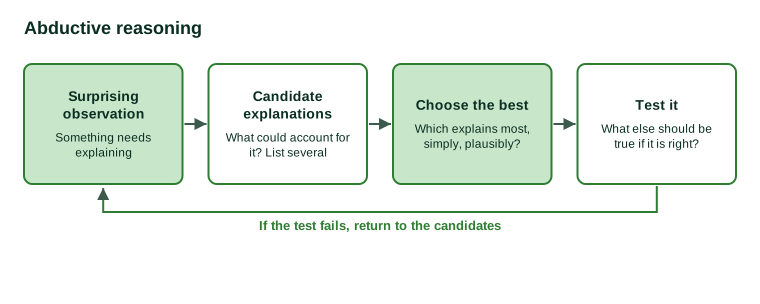
The conclusion of an abductive inference is not certain. Peirce saw abduction as the source of new ideas in inquiry: the step at which a hypothesis is proposed, to be tested afterwards by deduction (working out what else should be true if it is correct) and induction (checking whether those predictions hold). Norwood Russell Hanson (1958) argued that this step is central to scientific discovery and is neglected by accounts that describe only how hypotheses are tested.
Gilbert Harman (1965) introduced the phrase inference to the best explanation, emphasising that we usually choose among several possible explanations, and infer the one that explains the evidence best. Figure 1 shows the process.
What makes an explanation best?
Philosophers have proposed several criteria. Paul Thagard (1978) suggested consilience (explaining more of the evidence), simplicity (requiring fewer special assumptions) and analogy (resembling explanations that have worked before). Peter Lipton (2004) distinguished the explanation that is most likely, given the evidence, from the one that is most lovely, offering the deepest understanding, and argued that in practice we use loveliness as a guide to likeliness. Igor Douven (2021) reviews the debate about whether and when this is justified.
Psychological research shows that people do use such criteria, but not always wisely. Tania Lombrozo (2007) found that people strongly prefer simpler explanations, those that invoke fewer causes, even when a more complex explanation is more probable given the evidence. Lombrozo (2016) reviewed evidence that explanatory preferences shape what people learn and infer, sometimes helpfully and sometimes not.
Pitfalls
The main risk of abduction is stopping at the first explanation that fits. Medical researchers call this premature closure: a diagnosis that accounts for the main symptoms is accepted, and alternatives are not considered. Pat Croskerry (2009) described how diagnostic reasoning combines fast, intuitive pattern recognition with slower analytical checking, and argued that many diagnostic errors arise when the intuitive explanation is not checked. Thomas Chamberlin (1890) recommended the method of multiple working hypotheses for this reason: keeping several explanations in view prevents attachment to the first.
A second risk is mistaking a good story for good evidence. An explanation that is coherent and satisfying may still be false. Abduction suggests what is worth testing; it does not establish what is true.
A third risk is that the range of explanations considered is limited by what the reasoner already knows. A person can only infer an explanation they are able to think of. Experts generate better candidate explanations in their own fields for this reason, but they can also miss explanations that lie outside their training. Asking colleagues from other backgrounds what they think might be going on is a simple way to widen the range.
Using abduction well
Josephson and Josephson (1994) described abduction as a process that can be made systematic, and their account suggests some practical habits:
- Generate several explanations before choosing one.
- Ask what each explanation predicts that the others do not.
- Prefer explanations that account for all the evidence, including the awkward details.
- Treat the best explanation as a hypothesis and test it.
In a hypothetical example, an analyst sees that customer complaints rose sharply in March. The first explanation, a new product fault, fits the timing. But listing alternatives reveals two others: a change in the complaints form that made complaining easier, and a news story that encouraged people to complain. Each predicts something different. A product fault predicts complaints concentrated on that product; a form change predicts a rise across all products; a news story predicts a short spike. Checking the data shows the second pattern, and the explanation changes. The first explanation was plausible, but it was only one of three, and the data could tell them apart.
Conclusion
Abduction is the reasoning that proposes explanations. It is indispensable, because without it inquiry would have no hypotheses to test. But it is fallible, because the explanation that comes first, or feels best, is not always true. Used well, with several candidates, explicit criteria and a commitment to testing, it is one of the most productive tools of inquiry.
References
Chamberlin, T. C. (1890). The method of multiple working hypotheses. Science, 15(366), 92–96. https://doi.org/10.1126/science.ns-15.366.92
Croskerry, P. (2009). A universal model of diagnostic reasoning. Academic Medicine, 84(8), 1022–1028. https://doi.org/10.1097/ACM.0b013e3181ace703
Douven, I. (2021). Abduction. In E. N. Zalta (Ed.), The Stanford encyclopedia of philosophy (Summer 2021 ed.). Stanford University. https://plato.stanford.edu/archives/sum2021/entries/abduction/
Hanson, N. R. (1958). Patterns of discovery: An inquiry into the conceptual foundations of science. Cambridge University Press.
Harman, G. H. (1965). The inference to the best explanation. The Philosophical Review, 74(1), 88–95. https://doi.org/10.2307/2183532
Josephson, J. R., & Josephson, S. G. (Eds.). (1994). Abductive inference: Computation, philosophy, technology. Cambridge University Press. https://doi.org/10.1017/CBO9780511530128
Lipton, P. (2004). Inference to the best explanation (2nd ed.). Routledge.
Lombrozo, T. (2007). Simplicity and probability in causal explanation. Cognitive Psychology, 55(3), 232–257. https://doi.org/10.1016/j.cogpsych.2006.09.006
Lombrozo, T. (2016). Explanatory preferences shape learning and inference. Trends in Cognitive Sciences, 20(10), 748–759. https://doi.org/10.1016/j.tics.2016.08.001
Peirce, C. S. (1934). Collected papers of Charles Sanders Peirce: Vol. 5. Pragmatism and pragmaticism (C. Hartshorne & P. Weiss, Eds.). Harvard University Press.
Thagard, P. R. (1978). The best explanation: Criteria for theory choice. The Journal of Philosophy, 75(2), 76–92. https://doi.org/10.2307/2025686