
The Generation of Knowledge · History of knowledge
The Scientific Revolution and the Birth of Modern Knowledge
How sixteenth- and seventeenth-century Europe developed new ways of producing knowledge about nature, based on observation, experiment, mathematics and public scrutiny, and why historians still debate what the "Scientific Revolution" was.
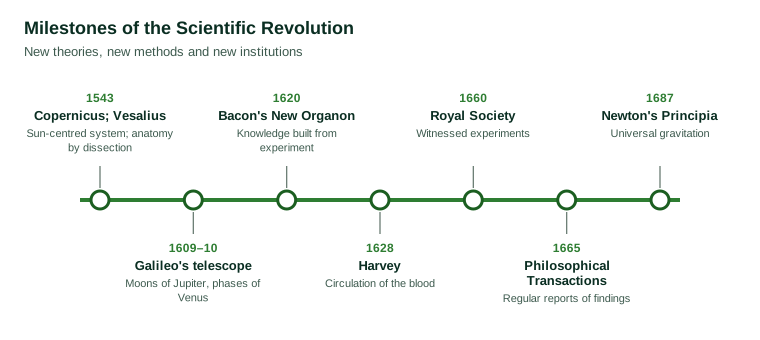
Between the publication of Copernicus's book on the motions of the heavens in 1543 and Newton's Principia in 1687, the European understanding of nature was transformed. The Earth was moved from the centre of the universe; the heavens were shown to obey the same laws as falling objects on Earth; the body was explored by dissection rather than by reading ancient authorities; and new instruments revealed moons around Jupiter and creatures in a drop of water. Historians have called this period the Scientific Revolution. Its most lasting result was not any single discovery, but a new set of methods and institutions for producing knowledge, many of which still shape research today.
A contested label
The term became standard in the mid-twentieth century. Butterfield (1949) claimed that the Scientific Revolution "outshines everything since the rise of Christianity". Later historians have been more cautious. Shapin (1996) opened his history of the period with the sentence "There was no such thing as the Scientific Revolution, and this is a book about it", meaning that the changes were neither sudden, nor unified, nor a clean break with the past. Cohen (1994) surveyed decades of debate about what caused the changes and how they should be described. Many continuities with medieval scholarship have been documented, and some sciences, such as chemistry and biology, changed later than astronomy and mechanics.
Even so, most historians agree that something important happened. Wootton (2015) argued that the period saw the invention of science in the modern sense: a shared commitment to discovering new facts, testing claims against evidence and accepting that established authorities could be wrong. New words, such as "discovery", "fact" and "hypothesis", took on their modern meanings in this period, reflecting new ways of thinking about knowledge.
New ideas about nature
Astronomy and mechanics
Kuhn (1957) traced how the Copernican system, which placed the Sun at the centre, gradually replaced the Earth-centred cosmos inherited from Aristotle and Ptolemy. The change was slow because the new system was at first no more accurate than the old, and because it contradicted both common sense and established physics. Galileo's observations with the telescope in 1609 and 1610, including the phases of Venus and the moons of Jupiter, provided powerful new evidence (Galilei, 1957). Kepler showed that planets move in ellipses, and Newton unified astronomy and mechanics under a single law of universal gravitation.
A mathematical and mechanical world
Underlying these changes was a new picture of nature. Instead of explaining things by their purposes, as Aristotle had, natural philosophers increasingly explained them by the motion of matter according to mathematical laws (Henry, 2008). In The Assayer (1623), Galileo wrote that the book of nature is written in the language of mathematics (Galilei, 1957). This approach made quantitative measurement central to knowledge and allowed predictions to be tested precisely.
The body and the living world
The life sciences changed too. In 1543, the same year as Copernicus's book, Andreas Vesalius published On the Fabric of the Human Body, based on his own dissections, which corrected many errors in the ancient anatomy of Galen. In 1628 William Harvey argued, from careful dissection, experiment and a simple calculation of how much blood the heart pumps, that blood circulates around the body rather than being continually produced and consumed (Henry, 2008). Harvey's quantitative argument was as important as his conclusion: it showed how a measurement could overturn a theory that had stood for fourteen centuries.
New methods of knowing
Experiment
Francis Bacon, in his New Organon of 1620, argued that knowledge of nature should be built up gradually from careful observation and experiment, not deduced from accepted principles (Bacon, 2000). He warned against the "idols" that distort human understanding, including the tendency to see patterns that are not there and to favour evidence that confirms what we already believe. Bacon's vision of collaborative, experimental inquiry inspired many later scientific institutions. He also insisted that knowledge should be useful: the point of studying nature was to improve human life, through new arts, inventions and medicines, not only to contemplate it. Mokyr (2002) argues that this Baconian programme, linking the study of nature to practical improvement, laid the cultural foundations for the later Industrial Revolution and the modern knowledge economy.
The experimental method was not simply common sense. Shapin and Schaffer (1985) showed, through a study of Robert Boyle's experiments with the air pump, how much work was needed to make experiments convincing. An experiment performed in one laboratory had to be trusted by people who were not there. Boyle used three techniques: public demonstrations before credible witnesses, detailed written reports that allowed readers to imagine themselves present, and a modest style that separated matters of fact from speculation. These techniques for producing trust in reported observations are ancestors of the methods sections and transparency standards of modern research.
Observation and instruments
New instruments extended the senses. The telescope and microscope revealed things no one had seen before, which raised the question of how to trust what instruments showed. Dear (2009) describes how natural philosophers developed ways to establish the reliability of instruments and observations, including repetition, comparison between observers and careful record-keeping.
New institutions
The period also created new social arrangements for knowledge. Learned societies, such as the Accademia dei Lincei in Rome, the Royal Society of London (1660) and the Paris Académie des Sciences (1666), provided places to perform and witness experiments, exchange correspondence and judge claims. The Philosophical Transactions, first published by the Royal Society's secretary in 1665, created a regular means of reporting new findings, with records of who discovered what and when.
The printing press, introduced about a century before the main developments, was an essential precondition. Eisenstein (1979) argued that print allowed astronomers to compare accurate tables and diagrams, built up cumulative bodies of data, and made it possible for errors to be corrected across editions. Without it, the international community of correspondents who checked and extended each other's work could not have functioned.
Historians have also asked why these changes happened in Europe. Merton (1938) argued that the values of seventeenth-century English Puritanism, with its emphasis on useful work and the study of creation, encouraged scientific activity. Huff (2003) emphasised the legal autonomy of European universities and corporations, which gave scholars protected spaces to pursue and debate new ideas. The question remains open, and most historians now stress a combination of intellectual, social, economic and technological factors.
The legacy for knowledge production
The Scientific Revolution left a set of principles that underlie modern research of every kind.
Evidence over authority. Claims should be judged by evidence, not by the reputation of the person who makes them or the age of the text that contains them.
Method that others can follow. A finding should be reported in enough detail that others can check it, as Boyle's reports allowed.
Measurement and quantification. Precise measurement allows claims to be tested and compared.
Organised scrutiny. Knowledge is strengthened by institutions that collect, publish and criticise claims.
Openness to revision. Accepted knowledge can be overturned by new evidence, as the Earth-centred cosmos was.
These principles apply as much to a market survey as to physics. A survey finding earns trust when its methods are reported clearly, its measurements are sound, its claims are open to scrutiny and its conclusions are revised when new evidence arrives. Daston and Park (1998) remind us that the period also changed which phenomena were thought worth studying, from rare wonders to regular patterns. Modern research inherits that focus on systematic, repeatable observation as the basis of knowledge, along with the conviction, first argued in this period, that the best way to learn about the world is to ask it carefully designed questions and record its answers honestly.
References
Bacon, F. (2000). The new organon (L. Jardine & M. Silverthorne, Eds.). Cambridge University Press. https://doi.org/10.1017/CBO9781139164030 (Original work published 1620)
Butterfield, H. (1949). The origins of modern science, 1300–1800. G. Bell and Sons.
Cohen, H. F. (1994). The scientific revolution: A historiographical inquiry. University of Chicago Press.
Daston, L., & Park, K. (1998). Wonders and the order of nature, 1150–1750. Zone Books.
Dear, P. (2009). Revolutionizing the sciences: European knowledge and its ambitions, 1500–1700 (2nd ed.). Princeton University Press.
Eisenstein, E. L. (1979). The printing press as an agent of change: Communications and cultural transformations in early-modern Europe. Cambridge University Press.
Galilei, G. (1957). Discoveries and opinions of Galileo (S. Drake, Trans.). Doubleday.
Henry, J. (2008). The scientific revolution and the origins of modern science (3rd ed.). Palgrave Macmillan.
Huff, T. E. (2003). The rise of early modern science: Islam, China, and the West (2nd ed.). Cambridge University Press.
Kuhn, T. S. (1957). The Copernican revolution: Planetary astronomy in the development of Western thought. Harvard University Press.
Merton, R. K. (1938). Science, technology and society in seventeenth century England. Osiris, 4, 360–632. https://doi.org/10.1086/368484
Mokyr, J. (2002). The gifts of Athena: Historical origins of the knowledge economy. Princeton University Press.
Shapin, S. (1996). The scientific revolution. University of Chicago Press.
Shapin, S., & Schaffer, S. (1985). Leviathan and the air-pump: Hobbes, Boyle, and the experimental life. Princeton University Press.
Wootton, D. (2015). The invention of science: A new history of the scientific revolution. Allen Lane.