
The Generation of Knowledge · History of knowledge
The Printing Press and the Knowledge Revolution
How movable-type printing changed the production, checking and spread of knowledge in early modern Europe, what economic historians have measured about its effects, and why historians still debate what kind of revolution it was.
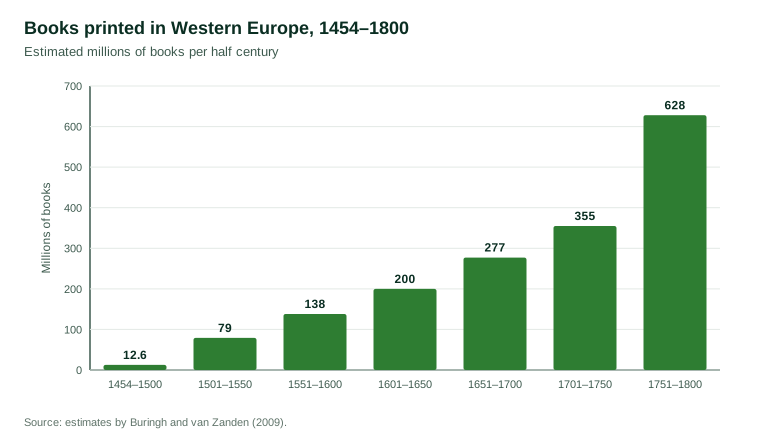
In the early 1450s, in the German city of Mainz, Johannes Gutenberg and his partners began printing with movable metal type. Within fifty years, presses were operating in more than two hundred European towns, and millions of printed books were in circulation. By 1800, Europe had produced hundreds of millions of books, far more than the hand-copied manuscripts of all previous centuries combined (Buringh & van Zanden, 2009). Few technologies have had such far-reaching effects on how knowledge is made, kept and shared.
This article examines what changed when knowledge moved from manuscript to print, the evidence for print's effects on science, religion and the economy, and the debate among historians about how revolutionary those effects really were. It ends with what the history of print suggests about the technologies of knowledge today.
Before print
Printing was not invented in Europe. Woodblock printing had been used in China since at least the eighth century, and movable type made of ceramic and later metal was used in China and Korea centuries before Gutenberg (Tsien, 1985). What was new in Mainz was a combination of technologies, including an adjustable mould for casting large numbers of uniform metal letters, an oil-based ink and a press adapted from those used for wine and paper, that made printing in alphabetic scripts fast and economical.
Before print, books in Europe were copied by hand, first mainly in monasteries and later also in university towns and commercial workshops. Copying was slow and costly, and every copy was different. Errors accumulated as copies were made from copies. A scholar who wanted to compare texts had to travel to the libraries that held them, and many works survived in only a few copies, vulnerable to loss.
Manuscript culture was not static. By the fifteenth century, commercial copying was well organised in many cities, and some popular works existed in hundreds of copies. Readers annotated, excerpted and compiled texts, and new knowledge circulated through letters and lectures. But the cost of each copy limited who could own books, and the variation between copies limited how far scholars could rely on a shared text. The ceiling on the production and reliability of written knowledge was set by the speed and accuracy of human hands.
What print changed
Standardisation and fixity
Elizabeth Eisenstein's The Printing Press as an Agent of Change (Eisenstein, 1979) made the strongest case for print as a turning point. She argued that print brought a new fixity to texts. Hundreds of identical copies of an edition could be distributed, so that scholars in different cities could refer to the same page and the same diagram. Errors could be identified and corrected in later editions, rather than multiplied by copyists. Tables of astronomical data, maps and anatomical illustrations could be reproduced accurately, which was essential for the sciences of observation and measurement.
Accumulation and comparison
Print also made it possible to gather and compare many texts. A scholar with a modest library could now own works that had previously been scattered across Europe. Eisenstein (1979) argued that this encouraged the comparison of conflicting authorities, exposing contradictions in inherited knowledge and stimulating new inquiry. Blair (2010) showed that scholars soon faced the problem of "too much to know" and developed new tools to manage it, including indexes, reference works, compilations of notes and alphabetical arrangements, many of which anticipate modern information management.
Spread and speed
Print greatly increased the number of books and lowered their cost. Febvre and Martin (1976), in a pioneering study first published in French in 1958, traced the rapid spread of printing across Europe and the development of a commercial book trade, with publishers, booksellers, fairs and distribution networks. Pettegree (2010) describes how printers had to find markets for their products, which pushed them towards practical works, religious texts, schoolbooks and pamphlets as well as learned volumes.
Print and the transformation of knowledge
Religion
The Protestant Reformation was the first great movement to use print on a mass scale. Martin Luther's writings were printed in enormous numbers in the years after 1517, and pamphlets in the vernacular carried religious arguments to readers far beyond universities and the clergy. Edwards (1994) analysed the output of Luther and his opponents and showed how quickly print allowed arguments to circulate and be answered. Pettegree (2015) argued that Luther's success depended on his close collaboration with printers and his skill at writing short, accessible works suited to the new medium. Rubin (2014) found that towns that had a printing press by 1500 were significantly more likely to adopt Protestantism by 1600, even after accounting for other factors.
Science
Print was a precondition of the Scientific Revolution. Copernicus, Vesalius, Kepler and Galileo all depended on printed books to spread their work, and on accurately reproduced tables, figures and diagrams. Eisenstein (1979) argued that the ability to compile, correct and reissue astronomical tables was crucial to the improvements in astronomy that made Copernicus's system persuasive. Shapin (1996) notes that the experimental reports of the seventeenth century relied on print to turn experiments seen by a few into knowledge shared by many.
Literacy and the vernacular
Print encouraged the use of vernacular languages, as printers sought larger markets than those for Latin. Houston (2002) traces the growth of literacy in early modern Europe, which was gradual and uneven, varying greatly by region, gender and social class, but which print both encouraged and depended on. Ong (1982) argued that the shift from oral to written and then printed communication changed not only how knowledge was stored but how people thought, making knowledge seem more fixed, visual and individually possessed. McLuhan (1962) made similar, more speculative claims about the "Gutenberg galaxy".
Data and statistics
Print also made it possible to publish numbers in quantity, and so helped create new kinds of knowledge about society. In London, weekly bills of mortality, printed lists of burials and christenings by parish, were sold to the public from the early seventeenth century. In 1662 John Graunt, a London haberdasher, collected decades of these printed bills and analysed them. He estimated the population of London, compared death rates from different causes, noticed that more boys than girls were born, and constructed an early table of survival by age (Graunt, 1662). His book is often regarded as a founding work of demography and statistics.
Graunt's achievement depended on print in two ways. The raw data existed because the bills were printed and kept, and his conclusions reached readers because they too were printed. Hacking (1990) describes how, over the following two centuries, the publication of ever larger quantities of numbers about births, deaths, crime, trade and disease, an "avalanche of printed numbers", transformed how governments and scholars understood society. Modern survey research and official statistics descend directly from this tradition of collecting, printing and analysing data about populations.
Organising printed knowledge
As printed books multiplied, so did tools for finding and organising what they contained. Printers added title pages, page numbers, tables of contents and indexes, which were rare or inconsistent in manuscripts. Bibliographies attempted to list everything published on a subject. Encyclopaedias and dictionaries summarised knowledge in alphabetical order, culminating in the great eighteenth-century projects such as the French Encyclopédie. Blair (2010) shows that these were not mere conveniences. They changed how scholars read, from slow, repeated study of a few texts towards the rapid consultation of many, a style of reading that modern researchers would recognise.
The first scientific journals, the Journal des sçavans in Paris and the Philosophical Transactions in London, both founded in 1665, used print to create a regular, dated public record of new findings. Johns (1998) argues that such periodicals, published under the authority of learned bodies, were one of the ways early modern people learned to trust what they read in print.
Measuring the economic effects
Economic historians have tried to measure print's effects. Buringh and van Zanden (2009) estimated the production of manuscripts and printed books in Europe from the sixth to the eighteenth centuries and found an extraordinary increase after 1450, together with large differences between regions. Baten and van Zanden (2008) found that countries with higher book production per person in the early modern period tended to experience faster economic growth later. Dittmar (2011) compared European cities that adopted printing in the fifteenth century with similar cities that did not, and found that early adopters grew substantially faster between 1500 and 1600. He suggested that print helped spread business skills, such as commercial arithmetic and bookkeeping, as well as other practical knowledge.
Mokyr (2002) placed print within a longer story of falling access costs to knowledge. In his account, modern economic growth depended on the ability of people to find, share and use what others knew, and each reduction in the cost of accessing knowledge, from printing to postal services, encyclopaedias and scientific societies, expanded the pool of useful knowledge.
A revolution? The debate
Eisenstein's thesis was influential but controversial. Grafton (1980), in a detailed review, praised the breadth of her argument but questioned whether print by itself caused the changes she described, and pointed to the persistence of errors and variation in early printed books. The sharpest challenge came from Johns (1998). In The Nature of the Book, he argued that the fixity and reliability Eisenstein attributed to print were not inherent in the technology. Early modern printed books were often pirated, altered and unreliable. Readers had to decide which printed works to trust, and trust depended on the reputations of printers, booksellers, authors and institutions. Fixity, in Johns's view, was a social achievement that took centuries to build, through practices such as licensing, copyright, the reputations of learned societies and the conventions of scholarly publishing.
The two historians debated the question directly in the American Historical Review. Eisenstein (2002) defended the claim that print brought an "unacknowledged revolution" in communications. Johns (2002) replied that the revolution must be explained, not assumed, by studying how people actually made and used printed books. Most historians now see the two positions as complementary. Print made new things possible, but whether they happened depended on the institutions, markets and practices that grew up around it. Darnton (1982) proposed studying the whole "communications circuit", from author to publisher, printer, shipper, bookseller and reader, to understand how printed knowledge actually moved through society.
Burke (2000) also cautions against treating print as the only force at work. Manuscript copying continued for centuries, oral communication remained central, and many changes in early modern knowledge, such as new institutions and new methods of observation, had other causes as well.
Lessons for the technologies of knowledge today
The history of print has obvious parallels with the digital revolution, and it offers several lessons for anyone who produces knowledge.
New technologies lower costs and multiply output. Print made books cheaper and more numerous, as digital technology has made publishing and data collection almost free. In both cases, the volume of available information grew far faster than the capacity to evaluate it.
Abundance creates new problems of management. Early modern scholars faced information overload and invented indexes, catalogues and reference works to cope (Blair, 2010). Modern organisations face the same problem with data, and need equivalent tools: metadata, documentation, search systems and curated summaries.
Reliability is not built into the technology. Johns's (1998) argument applies with force to digital information. Print could carry errors and forgeries as easily as scholarship, and the same is true of websites, social media and datasets. Trust has to be built through institutions and practices: reputations, standards, review, transparency about sources and methods.
Access to knowledge drives growth. The evidence of Dittmar (2011) and Mokyr (2002) suggests that making knowledge cheaper and easier to obtain has large economic benefits. Organisations that make their knowledge easy to find and use internally, and that draw effectively on external knowledge, gain an advantage.
Data become knowledge only when someone analyses them. The bills of mortality were printed for decades before Graunt saw what they could reveal. Organisations today often hold data that nobody has examined with a question in mind. The value lies not in collecting and publishing numbers but in the analysis that turns them into understanding.
The whole circuit matters. Darnton's (1982) communications circuit is a reminder that knowledge passes through many hands before it is used. A research finding must be produced, checked, published, distributed and understood. Weakness at any point can prevent good knowledge from having its effect.
Conclusion
The printing press did not, by itself, create modern knowledge. But it changed the conditions under which knowledge was produced and shared. It made texts more uniform and more widely available, encouraged comparison and criticism, supported new forms of science and religion, and helped spread practical skills that contributed to economic growth. Its history shows that a technology of knowledge becomes revolutionary only when institutions, markets and habits of trust develop around it. The same is true of the digital technologies that are transforming knowledge production today.
References
Baten, J., & van Zanden, J. L. (2008). Book production and the onset of modern economic growth. Journal of Economic Growth, 13(3), 217–235.
Blair, A. M. (2010). Too much to know: Managing scholarly information before the modern age. Yale University Press.
Buringh, E., & van Zanden, J. L. (2009). Charting the "rise of the West": Manuscripts and printed books in Europe, a long-term perspective from the sixth through eighteenth centuries. The Journal of Economic History, 69(2), 409–445. https://doi.org/10.1017/S0022050709000837
Burke, P. (2000). A social history of knowledge: From Gutenberg to Diderot. Polity Press.
Darnton, R. (1982). What is the history of books? Daedalus, 111(3), 65–83.
Dittmar, J. E. (2011). Information technology and economic change: The impact of the printing press. The Quarterly Journal of Economics, 126(3), 1133–1172. https://doi.org/10.1093/qje/qjr035
Edwards, M. U., Jr. (1994). Printing, propaganda, and Martin Luther. University of California Press.
Eisenstein, E. L. (1979). The printing press as an agent of change: Communications and cultural transformations in early-modern Europe. Cambridge University Press.
Eisenstein, E. L. (2002). An unacknowledged revolution revisited. The American Historical Review, 107(1), 87–105. https://doi.org/10.1086/532098
Febvre, L., & Martin, H.-J. (1976). The coming of the book: The impact of printing 1450–1800 (D. Gerard, Trans.). NLB. (Original work published 1958)
Grafton, A. T. (1980). The importance of being printed. The Journal of Interdisciplinary History, 11(2), 265–286. https://doi.org/10.2307/203783
Graunt, J. (1662). Natural and political observations mentioned in a following index, and made upon the bills of mortality. John Martyn.
Hacking, I. (1990). The taming of chance. Cambridge University Press. https://doi.org/10.1017/CBO9780511819766
Houston, R. A. (2002). Literacy in early modern Europe: Culture and education 1500–1800 (2nd ed.). Longman.
Johns, A. (1998). The nature of the book: Print and knowledge in the making. University of Chicago Press.
Johns, A. (2002). How to acknowledge a revolution. The American Historical Review, 107(1), 106–125. https://doi.org/10.1086/532099
McLuhan, M. (1962). The Gutenberg galaxy: The making of typographic man. University of Toronto Press.
Mokyr, J. (2002). The gifts of Athena: Historical origins of the knowledge economy. Princeton University Press.
Ong, W. J. (1982). Orality and literacy: The technologizing of the word. Methuen.
Pettegree, A. (2010). The book in the Renaissance. Yale University Press.
Pettegree, A. (2015). Brand Luther: 1517, printing, and the making of the Reformation. Penguin Press.
Rubin, J. (2014). Printing and Protestants: An empirical test of the role of printing in the Reformation. The Review of Economics and Statistics, 96(2), 270–286. https://doi.org/10.1162/REST_a_00368
Shapin, S. (1996). The scientific revolution. University of Chicago Press.
Tsien, T.-H. (1985). Paper and printing (J. Needham, Ed.; Science and Civilisation in China, Vol. 5, Part 1). Cambridge University Press.