
The Generation of Knowledge · History of knowledge
The History of Knowledge Production From Antiquity to Today
A short history of how societies have organised the making of knowledge, from ancient libraries and medieval universities to print, scientific societies, research universities, big science and the digital era.
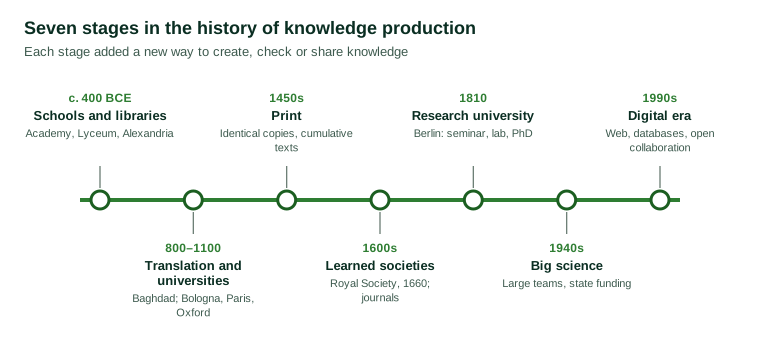
Every society produces knowledge, but the way it does so has changed dramatically over time. Who is allowed to create knowledge, where the work takes place, how results are recorded and shared, and how claims are checked have all been transformed, often by new institutions or technologies. The historian Peter Burke has argued that knowledge should be studied as a social activity, shaped by institutions such as libraries, universities and academies as much as by individual genius (Burke, 2000, 2012). This article sketches that history in seven broad stages.
Antiquity: schools and libraries
In the ancient Mediterranean world, knowledge was produced in small communities of scholars around a teacher, such as Plato's Academy and Aristotle's Lyceum in Athens. Their methods combined argument, observation and the systematic classification of what was known. Lindberg (2007) describes how Greek natural philosophy established a tradition of explaining nature through reason rather than myth. The great library and museum at Alexandria, founded in the third century BCE, gathered texts from across the known world and supported scholars who edited, catalogued and extended them.
The medieval world: translation and the university
After the decline of the western Roman Empire, much ancient learning was preserved and developed in the Islamic world. Gutas (1998) describes how, between the eighth and tenth centuries, scholars in Baghdad translated a large part of the surviving Greek scientific and philosophical literature into Arabic, with support from the ʿAbbāsid elite. Scholars writing in Arabic made major advances in mathematics, astronomy, optics and medicine. In Latin Europe, monasteries copied and preserved texts, and from the late eleventh century the first universities emerged, at Bologna, Paris and Oxford, creating durable corporate institutions devoted to teaching and disputation.
Print: a new means of sharing
The printing press, introduced in Europe by Johannes Gutenberg in the mid-fifteenth century, changed how knowledge circulated. Eisenstein (1979) argued that print made it possible to produce identical copies, to compare texts and correct errors across editions, and to accumulate knowledge rather than lose it through copying mistakes. Knowledge became more standardised, more widely available and easier to build upon.
The Scientific Revolution and learned societies
In the sixteenth and seventeenth centuries, a new approach to nature took shape, emphasising experiment, mathematics and the public demonstration of results. Shapin (1996) describes how this involved new social arrangements as well as new ideas. Learned societies such as the Royal Society of London, founded in 1660, provided places where experiments could be witnessed and reports could be published and criticised. Huff (2003) argues that such autonomous corporate institutions, with their own rules for judging claims, were a distinctive feature of European science.
The research university
In the nineteenth century, the university became a site of research as well as teaching. The University of Berlin, founded in 1810, combined the two in a model built around the seminar, the laboratory and the doctoral thesis. Clark (2006) traces how this model made original research the main source of academic prestige. It spread across Europe and to the United States, and it remains the template for universities today.
Big science and the knowledge economy
In the twentieth century, knowledge production grew in scale. Price (1963) showed that the number of scientific journals and papers had been growing exponentially for centuries, doubling roughly every ten to fifteen years, and described the shift from "little science" to "big science", organised in large teams with major funding from governments and industry. Mokyr (2002) argued that the growing connection between scientific knowledge and practical technique was a central cause of modern economic growth. Gibbons et al. (1994) described a new "Mode 2" of knowledge production, organised around problems in their contexts of application, involving many kinds of organisation beyond universities.
The digital era
Since the late twentieth century, digital technology has transformed knowledge production again. The web made publishing almost free, databases made vast quantities of data searchable, and online collaboration made new forms of collective work possible. Bornmann and Mutz (2015) estimated that the volume of scientific publication has been growing at several per cent a year since the mid-twentieth century. Knowledge is now produced not only in universities and laboratories but by companies, governments, research firms, volunteers and online communities, often from data that people generate in daily life.
Continuities
Across these stages, two needs have remained constant. Knowledge must be checked, through disputation, witnessing, peer review or replication, and it must be shared in forms others can use and build upon. Each new institution, from the library to the online database, has offered new answers to these two needs. A third continuity is that each new means of producing knowledge also created new problems of trust. Print spread errors and forgeries as efficiently as it spread scholarship. Learned societies had to decide whose reports to believe. Big science raised questions about who controls research and for whose benefit. The digital era has made it easy to publish anything, so the work of checking has become harder and more important.
Organisations that generate knowledge today inherit all three tasks: producing knowledge efficiently, checking it rigorously and sharing it in forms that others can trust. Survey research, for example, combines an ancient practice, asking people what they know and think, with modern sampling theory, digital collection and statistical analysis. Its credibility still depends on the old disciplines of transparent method and open scrutiny.
References
Bornmann, L., & Mutz, R. (2015). Growth rates of modern science: A bibliometric analysis based on the number of publications and cited references. Journal of the Association for Information Science and Technology, 66(11), 2215–2222. https://doi.org/10.1002/asi.23329
Burke, P. (2000). A social history of knowledge: From Gutenberg to Diderot. Polity Press.
Burke, P. (2012). A social history of knowledge II: From the Encyclopaedia to Wikipedia. Polity Press.
Clark, W. (2006). Academic charisma and the origins of the research university. University of Chicago Press.
Eisenstein, E. L. (1979). The printing press as an agent of change: Communications and cultural transformations in early-modern Europe. Cambridge University Press.
Gibbons, M., Limoges, C., Nowotny, H., Schwartzman, S., Scott, P., & Trow, M. (1994). The new production of knowledge: The dynamics of science and research in contemporary societies. SAGE.
Gutas, D. (1998). Greek thought, Arabic culture: The Graeco-Arabic translation movement in Baghdad and early ʿAbbāsid society (2nd–4th/8th–10th centuries). Routledge.
Huff, T. E. (2003). The rise of early modern science: Islam, China, and the West (2nd ed.). Cambridge University Press.
Lindberg, D. C. (2007). The beginnings of Western science: The European scientific tradition in philosophical, religious, and institutional context, prehistory to A.D. 1450 (2nd ed.). University of Chicago Press.
Mokyr, J. (2002). The gifts of Athena: Historical origins of the knowledge economy. Princeton University Press.
Price, D. J. de S. (1963). Little science, big science. Columbia University Press.
Shapin, S. (1996). The scientific revolution. University of Chicago Press.