
The Generation of Knowledge · Knowledge economy
Knowledge as a Competitive Advantage
Why knowledge can give a firm an advantage over its rivals, what makes that advantage last, how it can turn into rigidity, and what this means for firms that rely on research and data.
Why do some firms consistently outperform their rivals? For much of the twentieth century, strategists looked mainly outside the firm, at the structure of industries and the firm's position within them (Porter, 1985). From the 1980s, a second view looked inside, at the resources a firm controls. Within that view, many researchers came to regard knowledge as the most important resource of all. This article explains why knowledge can give a competitive advantage, what makes the advantage last and how it can be lost.
The resource-based view
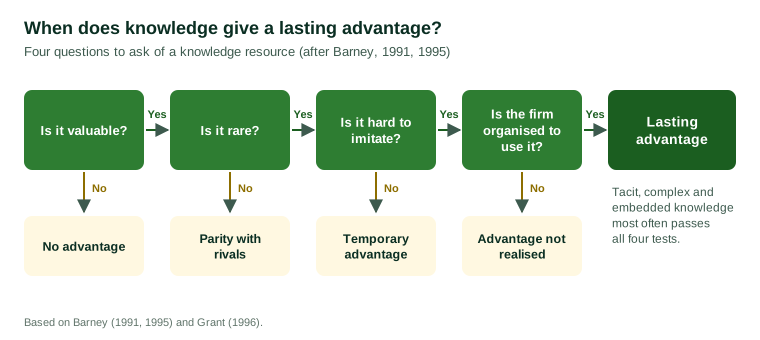
Wernerfelt (1984) proposed that firms be seen as bundles of resources rather than as collections of products. Barney (1991) developed this into the resource-based view of the firm. He argued that a resource gives a sustained competitive advantage when it is valuable, allowing the firm to exploit opportunities or counter threats; rare among competitors; imperfectly imitable, so that rivals cannot easily copy it; and non-substitutable, so that rivals cannot achieve the same result by other means. Barney (1995) later added a further question: whether the firm is organised to exploit the resource. Figure 1 shows the reasoning.
Why knowledge fits the tests
Knowledge, especially knowledge that is tacit, complex and embedded in an organisation, often passes all four tests.
It is hard to see. Lippman and Rumelt (1982) showed that when the causes of a firm's success are uncertain, even to the firm itself, competitors cannot know what to copy. They called this uncertain imitability. Much organisational knowledge has this quality: it lies in skills, routines and relationships rather than in documents.
It takes time to build. Dierickx and Cool (1989) argued that strategic assets are stocks built up through flows of investment over time. A reputation for quality, a body of technical expertise or a deep understanding of customers cannot be bought quickly, and rivals that start later may never catch up.
It is held collectively. Kogut and Zander (1992) argued that a firm's knowledge lies in the way its members share and combine what they know. Grant (1996) described the firm as an institution for integrating the specialised knowledge of many individuals. Such collective knowledge cannot be acquired simply by hiring one person away. Spender (1996) emphasised that the most strategically important knowledge is often collective and tacit, embedded in the practices of the organisation as a whole.
Prahalad and Hamel (1990) described the core competences of a corporation as the collective learning of the organisation, especially how to coordinate diverse skills and integrate several technologies. They argued that such competences provide access to many markets, contribute substantially to what customers value and are difficult for competitors to imitate.
Keeping the advantage
Markets and technologies change, and knowledge that once gave an advantage can lose its value. Teece et al. (1997) argued that lasting advantage depends on dynamic capabilities: the firm's ability to integrate, build and reconfigure its competences in response to change. A firm must not only hold valuable knowledge but keep renewing it.
Renewal depends partly on learning from outside. Cohen and Levinthal (1990) showed that a firm's ability to recognise and use external knowledge depends on its existing related knowledge, so investment in knowledge makes further learning easier.
Capturing the value of knowledge
Holding valuable knowledge is not the same as profiting from it. Teece (1986) asked why firms that pioneer an innovation often fail to profit from it, while imitators or suppliers capture most of the value. He argued that the answer depends on two things. The first is the regime of appropriability: how easily the knowledge can be protected, through patents, copyright, secrecy or its own tacit nature. The second is control of complementary assets, such as manufacturing, distribution, brands and service networks, that are needed to bring the knowledge to market. Where knowledge is easy to copy and complementary assets are held by others, those others usually capture the gains.
This analysis has practical consequences. A firm whose knowledge is easily codified and imitated must rely on legal protection, speed or complementary assets to benefit from it. A firm whose knowledge is tacit and embedded is naturally protected, but may find it harder to expand, because the same knowledge is also hard to transfer to new sites, partners and staff. Kogut and Zander (1992) described this as a tension between replication and imitation: the codification that helps a firm grow also makes it easier for rivals to copy.
When strength becomes weakness
Knowledge can also hold a firm back. Leonard-Barton (1992) found that the core capabilities that made firms successful could become core rigidities when circumstances changed. Skills, systems and values built around one way of working made it hard to adopt another. The same features that make knowledge hard to imitate, its tacit and embedded nature, can also make it hard to change.
Knowledge advantage in research and data
For firms that sell research, data and analysis, knowledge is the product as well as the resource. Data alone is rarely a lasting advantage, because comparable data can often be collected by others. More durable advantages lie in what is hard to copy: long-running series that rivals cannot reconstruct, accumulated expertise in method and design, deep understanding of particular markets and the trust of clients built over many projects. These are built slowly and must be renewed as methods and markets change.
The same reasoning applies to the clients of research. An organisation that gathers better evidence about its customers and markets than its rivals, and that is organised to act on it, can make better decisions. But evidence that is bought and not used, or used in the same way as everyone else, gives no lasting edge.
Conclusion
Knowledge can give a firm a lasting competitive advantage when it is valuable, rare, hard to imitate and put to use. Tacit, collective knowledge built over time is the hardest for rivals to copy. Yet the advantage lasts only if the firm continues to learn, renews its knowledge as conditions change and avoids letting established strengths become rigidities.
References
Barney, J. (1991). Firm resources and sustained competitive advantage. Journal of Management, 17(1), 99–120. https://doi.org/10.1177/014920639101700108
Barney, J. B. (1995). Looking inside for competitive advantage. Academy of Management Executive, 9(4), 49–61. https://doi.org/10.5465/ame.1995.9512032192
Cohen, W. M., & Levinthal, D. A. (1990). Absorptive capacity: A new perspective on learning and innovation. Administrative Science Quarterly, 35(1), 128–152. https://doi.org/10.2307/2393553
Dierickx, I., & Cool, K. (1989). Asset stock accumulation and sustainability of competitive advantage. Management Science, 35(12), 1504–1511. https://doi.org/10.1287/mnsc.35.12.1504
Grant, R. M. (1996). Toward a knowledge-based theory of the firm. Strategic Management Journal, 17(S2), 109–122. https://doi.org/10.1002/smj.4250171110
Kogut, B., & Zander, U. (1992). Knowledge of the firm, combinative capabilities, and the replication of technology. Organization Science, 3(3), 383–397. https://doi.org/10.1287/orsc.3.3.383
Leonard-Barton, D. (1992). Core capabilities and core rigidities: A paradox in managing new product development. Strategic Management Journal, 13(S1), 111–125. https://doi.org/10.1002/smj.4250131009
Lippman, S. A., & Rumelt, R. P. (1982). Uncertain imitability: An analysis of interfirm differences in efficiency under competition. Bell Journal of Economics, 13(2), 418–438. https://doi.org/10.2307/3003464
Porter, M. E. (1985). Competitive advantage: Creating and sustaining superior performance. Free Press.
Prahalad, C. K., & Hamel, G. (1990). The core competence of the corporation. Harvard Business Review, 68(3), 79–91.
Spender, J.-C. (1996). Making knowledge the basis of a dynamic theory of the firm. Strategic Management Journal, 17(S2), 45–62. https://doi.org/10.1002/smj.4250171106
Teece, D. J. (1986). Profiting from technological innovation: Implications for integration, collaboration, licensing and public policy. Research Policy, 15(6), 285–305. https://doi.org/10.1016/0048-7333(86)90027-2
Teece, D. J., Pisano, G., & Shuen, A. (1997). Dynamic capabilities and strategic management. Strategic Management Journal, 18(7), 509–533. https://doi.org/10.1002/(SICI)1097-0266(199708)18:7<509::AID-SMJ882>3.0.CO;2-Z
Wernerfelt, B. (1984). A resource-based view of the firm. Strategic Management Journal, 5(2), 171–180. https://doi.org/10.1002/smj.4250050207