
The Generation of Knowledge · Knowledge economy
Intellectual Capital and Intangible Assets
What intellectual capital and intangible assets are, how they are divided into human, structural and relational capital, why accounting struggles to record them, how researchers and firms have tried to measure them and what the evidence says about their value.
Much of what makes a modern organisation valuable cannot be seen on its balance sheet. The skills of its staff, the methods it has developed, its databases, its reputation and its relationships with clients are all sources of value, yet most of them are not recorded as assets in financial accounts. The terms intellectual capital and intangible assets describe these sources of value. This article explains what they are, how they are usually classified, why they are hard to account for and how researchers and organisations have tried to measure and manage them.
From hidden value to intellectual capital
The gap between what organisations are worth and what their accounts record became a subject of attention in the 1990s. Lev (2001) documented that the market value of many listed companies had risen far above the book value of their recorded assets, and argued that the difference reflected intangible assets that accounting failed to capture: research and development, brands, customer relationships, software, organisational practices and the skills of employees.
Several writers proposed ways of describing these hidden assets. Stewart (1997), writing for a business audience, defined intellectual capital as intellectual material, knowledge, information, intellectual property and experience, that can be put to use to create wealth. Edvinsson and Malone (1997), drawing on Edvinsson's work at the Swedish financial services company Skandia, described intellectual capital as the difference between a firm's market value and its book value, and divided it into components that could be identified and managed. Sveiby (1997) proposed that a firm's intangible assets lay in the competence of its people, its internal structure and its external structure of relationships.
Skandia became an early example of reporting on intellectual capital. Edvinsson (1997) described how the company developed a framework called the Navigator, which supplemented financial measures with indicators of customers, internal processes, renewal and development, and people, and how, from 1995, it published reports on its intellectual capital alongside its annual accounts. The approach shared ideas with the balanced scorecard of Kaplan and Norton (1992), which encouraged managers to track customer, process and learning measures alongside financial results.
The parts of intellectual capital
Most frameworks divide intellectual capital into three parts, shown in Figure 1.
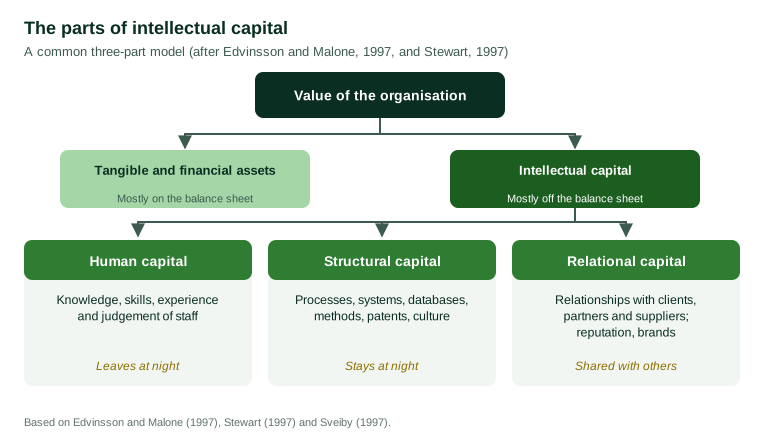
Human capital is the knowledge, skills, experience and judgement of individual employees. The term comes from economics, where Becker (1964) analysed education and training as investments that raise people's productivity and earnings. Human capital belongs to the people who hold it, not to the organisation, which is why it is sometimes described as the asset that goes home at night.
Structural capital, sometimes called organisational capital, is the knowledge that stays when employees leave: processes, routines, systems, databases, documented methods, intellectual property and culture. Structural capital allows the organisation to make repeated use of what its people know.
Relational capital, sometimes called customer capital, is the value of the organisation's relationships with customers, suppliers, partners and the wider community, including its reputation and brands.
Researchers have added a further dimension. Nahapiet and Ghoshal (1998) argued that social capital, the networks of relationships among people and the trust and shared understanding they create, helps organisations create and share intellectual capital. They suggested that organisations have an advantage over markets partly because they are better at developing social capital.
Why accounting struggles
Financial accounting records assets when an organisation controls them, expects future benefits from them and can measure their cost or value reliably. Many intangibles fail one or more of these tests. An organisation does not own its employees' skills; the future benefits of a training programme or a new method are uncertain; and the value of a reputation is hard to measure.
International accounting standards reflect these difficulties. Under the international standard on intangible assets, spending on research must be treated as an expense when it is incurred, while development spending can be recorded as an asset only when strict conditions are met; internally generated brands, customer lists and similar items cannot be recorded as assets at all (International Accounting Standards Board, 2004). Intangibles bought from others, for example when one company acquires another, are recorded, but the same kinds of assets built internally usually are not.
Lev and Sougiannis (1996) examined what this means for investors. They estimated the value of firms' R&D capital as if it had been recorded as an asset, and found that it was associated with both the market value of the firms and their subsequent stock returns. This suggested that investors did not fully take account of R&D because it was not shown in the accounts. Chan et al. (2001) found that, on average, firms with high R&D spending earned stock returns similar to those of firms without R&D, but that firms with high R&D spending relative to their market value earned higher returns later, again consistent with the market undervaluing intangible investment that accounts did not recognise.
The way intangibles are recorded can also affect how managers behave. Because spending on research, training and marketing reduces reported profit in the year it is made, managers under pressure to meet short-term earnings targets may cut it. Graham et al. (2005) surveyed several hundred financial executives in the United States and found that a majority said they would reduce discretionary spending on items such as research and development, advertising and maintenance to meet an earnings target, even at some cost to long-term value. Accounting that hides intangible investment can therefore discourage it.
Measuring intangible assets
Because accounts leave out most intangibles, researchers and organisations have developed other ways to measure them.
Indicators and scorecards
The first approach uses sets of indicators. Sveiby's intangible assets monitor tracked indicators of growth, efficiency and stability for each type of intangible asset (Sveiby, 1997). Skandia's Navigator and the balanced scorecard took similar approaches. Roos and Roos (1997) proposed ways of combining indicators of different kinds of intellectual capital into overall indices. These approaches are flexible, but they produce many measures that are hard to compare between organisations and difficult to sum into a single value.
Market-based and investment-based estimates
A second approach infers the value of intangibles from market prices. The gap between market and book value is the simplest such measure, but it also reflects investor sentiment and the prospects of the industry. A more careful approach estimates intangible capital by accumulating past spending on items such as R&D, software, training and marketing, allowing each year's investment to depreciate. Corrado et al. (2009) used this method to estimate intangible investment across the economy of the United States, and found it to be as large as investment in tangible capital. Peters and Taylor (2017) applied a similar method to individual firms and found that including intangible capital made measures of corporate investment much better at explaining how firms behave.
Brynjolfsson et al. (2002) studied large companies in the United States and found that each unit of investment in computers was associated with a much larger increase in market value. They argued that the difference reflected intangible organisational investments, such as new business processes, training and decentralised decision-making, that accompanied investment in computers but were not recorded.
Surveys
A third approach measures intangibles directly through surveys of firms and their managers. Bloom and Van Reenen (2007) developed a structured interview method to score the management practices of manufacturing firms in several countries, such as how they monitored performance, set targets and managed people. They found large differences between firms and countries, and higher scores were strongly associated with productivity, profitability and growth. Such survey-based measures make one important kind of organisational capital visible and comparable.
What intellectual capital does
Research has examined how different parts of intellectual capital contribute to performance. Bontis (1998) surveyed managers and found that human capital was associated with structural and customer capital, and that these in turn were associated with business performance. Youndt et al. (2004) studied how firms invested in human, social and organisational capital. Firms with high levels of all three performed better than others. Subramaniam and Youndt (2005) found that different parts of intellectual capital supported different kinds of innovation. Organisational capital was associated with incremental innovation, the improvement of existing products and processes. Social capital was associated with both incremental and radical innovation. Human capital supported radical innovation only when combined with strong social capital, suggesting that individual expertise needs relationships to make a difference.
Why intangible assets behave differently
Haskel and Westlake (2018) argued that intangible assets differ from physical assets in four ways that matter for managers and investors. First, they are often sunk: money spent developing a method or training staff usually cannot be recovered by selling the asset if the venture fails. Second, they generate spillovers: others can often benefit from an organisation's ideas without paying for them. Third, they are scalable: a method, a piece of software or a brand can be used across many operations at little extra cost. Fourth, they show synergies: they are often much more valuable in combination than alone, as when a database becomes valuable only together with the skills to analyse it and the relationships through which results are sold.
These properties help explain some features of organisations rich in intangibles. Because intangibles are scalable, successful firms can grow very large. Because they are sunk and hard to value, such firms can find it harder to borrow against them. And because of synergies, the value of a single intangible asset often depends on what else the organisation has, which makes intangibles hard to value one by one.
Reporting intellectual capital
In the late 1990s and early 2000s, governments and companies in several countries, particularly in Scandinavia, experimented with formal intellectual capital statements. Mouritsen et al. (2001) studied Danish companies that prepared such statements and found that they were valuable less as precise measurements than as a way of telling a coherent story about how the company created value through knowledge, connecting its strategy with indicators and activities.
Formal intellectual capital reporting did not become widespread. Dumay (2016) reviewed its history and argued that attempts to report intellectual capital as a separate, standardised set of figures had largely failed, and that the future lay instead in disclosing information about intangible resources within broader reporting on strategy, risks and value creation.
Intellectual capital in research organisations
For a research and data organisation, intellectual capital is most of what it has. Its human capital lies in the methodological and analytical skills of its researchers and in their knowledge of particular markets and populations. Its structural capital includes questionnaire libraries, sampling frames, data processing systems, quality procedures, documented methods and archives of past studies. Its relational capital lies in the trust of clients and the reputation built through reliable work.
Recognising these assets has practical consequences. Converting human capital into structural capital, by documenting methods, maintaining question libraries and recording lessons learned, protects the organisation against the loss of key people. Investing in relational capital, through consistent quality and honest reporting of uncertainty, builds the reputation on which future work depends. And understanding which assets matter most helps an organisation decide where to invest.
A research organisation can also apply simple measures to its own intellectual capital. Indicators might include the share of projects whose methods are fully documented, the proportion of questions drawn from tested libraries, the number of staff trained in each key method, the share of revenue from repeat clients and the time taken to bring a new researcher to full productivity. None of these is a precise valuation, but together they show whether the organisation's knowledge is growing, being kept and being put to use.
Conclusion
Intellectual capital and intangible assets account for much of the value of modern organisations, but most are absent from financial accounts. Frameworks dividing intellectual capital into human, structural and relational capital help organisations identify and manage these assets. Accounting rules, evidence from stock markets and new methods of measurement all show that intangible investment is large and often undervalued. Measuring intangibles remains difficult, but indicators, investment-based estimates and well-designed surveys each make part of this hidden value visible. For organisations whose work is knowledge, managing intellectual capital is central to managing the organisation itself.
References
Becker, G. S. (1964). Human capital: A theoretical and empirical analysis, with special reference to education. National Bureau of Economic Research.
Bloom, N., & Van Reenen, J. (2007). Measuring and explaining management practices across firms and countries. Quarterly Journal of Economics, 122(4), 1351–1408. https://doi.org/10.1162/qjec.2007.122.4.1351
Bontis, N. (1998). Intellectual capital: An exploratory study that develops measures and models. Management Decision, 36(2), 63–76. https://doi.org/10.1108/00251749810204142
Brynjolfsson, E., Hitt, L. M., & Yang, S. (2002). Intangible assets: Computers and organizational capital. Brookings Papers on Economic Activity, 2002(1), 137–198. https://doi.org/10.1353/eca.2002.0003
Chan, L. K. C., Lakonishok, J., & Sougiannis, T. (2001). The stock market valuation of research and development expenditures. Journal of Finance, 56(6), 2431–2456. https://doi.org/10.1111/0022-1082.00411
Corrado, C., Hulten, C., & Sichel, D. (2009). Intangible capital and U.S. economic growth. Review of Income and Wealth, 55(3), 661–685. https://doi.org/10.1111/j.1475-4991.2009.00343.x
Dumay, J. (2016). A critical reflection on the future of intellectual capital: From reporting to disclosure. Journal of Intellectual Capital, 17(1), 168–184. https://doi.org/10.1108/JIC-08-2015-0072
Edvinsson, L. (1997). Developing intellectual capital at Skandia. Long Range Planning, 30(3), 366–373. https://doi.org/10.1016/S0024-6301(97)90248-X
Edvinsson, L., & Malone, M. S. (1997). Intellectual capital: Realizing your company's true value by finding its hidden brainpower. HarperBusiness.
Graham, J. R., Harvey, C. R., & Rajgopal, S. (2005). The economic implications of corporate financial reporting. Journal of Accounting and Economics, 40(1–3), 3–73. https://doi.org/10.1016/j.jacceco.2005.01.002
Haskel, J., & Westlake, S. (2018). Capitalism without capital: The rise of the intangible economy. Princeton University Press.
International Accounting Standards Board. (2004). IAS 38 Intangible assets. IFRS Foundation.
Kaplan, R. S., & Norton, D. P. (1992). The balanced scorecard: Measures that drive performance. Harvard Business Review, 70(1), 71–79.
Lev, B. (2001). Intangibles: Management, measurement, and reporting. Brookings Institution Press.
Lev, B., & Sougiannis, T. (1996). The capitalization, amortization, and value-relevance of R&D. Journal of Accounting and Economics, 21(1), 107–138. https://doi.org/10.1016/0165-4101(95)00410-6
Mouritsen, J., Larsen, H. T., & Bukh, P. N. D. (2001). Intellectual capital and the 'capable firm': Narrating, visualising and numbering for managing knowledge. Accounting, Organizations and Society, 26(7–8), 735–762. https://doi.org/10.1016/S0361-3682(01)00022-8
Nahapiet, J., & Ghoshal, S. (1998). Social capital, intellectual capital, and the organizational advantage. Academy of Management Review, 23(2), 242–266. https://doi.org/10.5465/amr.1998.533225
Peters, R. H., & Taylor, L. A. (2017). Intangible capital and the investment-q relation. Journal of Financial Economics, 123(2), 251–272. https://doi.org/10.1016/j.jfineco.2016.03.011
Roos, G., & Roos, J. (1997). Measuring your company's intellectual performance. Long Range Planning, 30(3), 413–426. https://doi.org/10.1016/S0024-6301(97)00022-8
Stewart, T. A. (1997). Intellectual capital: The new wealth of organizations. Doubleday/Currency.
Subramaniam, M., & Youndt, M. A. (2005). The influence of intellectual capital on the types of innovative capabilities. Academy of Management Journal, 48(3), 450–463. https://doi.org/10.5465/amj.2005.17407911
Sveiby, K. E. (1997). The new organizational wealth: Managing and measuring knowledge-based assets. Berrett-Koehler.
Youndt, M. A., Subramaniam, M., & Snell, S. A. (2004). Intellectual capital profiles: An examination of investments and returns. Journal of Management Studies, 41(2), 335–361. https://doi.org/10.1111/j.1467-6486.2004.00435.x