
Share your experience of hair care
Tell us how often you get your hair done, what you pay and what you do at home. Your answers are combined with other people's and reported only as totals.
Start the hair care and salons surveyAbout 5 minutes. No account needed. You can stop at any time.
What hair care covers
Hair care includes what people do at home and what they pay professionals to do. At home it means washing, conditioning, drying, styling and sometimes trimming or colouring. Professionally it means haircuts, colour, chemical treatments such as perms and relaxers, extensions, braiding, blow-outs and scalp treatments.
The professionals who do this work go by several names:
- Hairstylists and hairdressers, who cut, colour and style hair in salons.
- Barbers, who traditionally cut shorter styles and shave or trim beards, often in a barbershop.
- Colourists, stylists who specialize in hair colour.
- Braiders and natural hair specialists, who work with textured and curly hair, often in specialist salons or from home.
- Mobile stylists, who visit clients at home, in care homes or at events such as weddings.
In Canada, hairstyling is a regulated trade in several provinces. Ontario, for example, lists hairstylist as a trade with an apprenticeship and certificate. Rules differ from province to province, and from state to state in the United States, where cosmetology licences are common.
How often people get their hair done
How often a person visits a salon or barber depends on hair length, style, budget and habit. Short, sharp cuts need trimming more often to keep their shape, while longer hair can go months between visits. Colour adds its own schedule: roots grow out and need touching up.
Example
A man with a short fade visits a barber every three weeks to keep the sides tidy. His partner, who has long hair, gets a trim twice a year and colours their own hair at home in between. Their teenager has not had a professional cut in a year and asks a friend to trim their fringe.
Questions that businesses want answered include how often people visit, what triggers a visit (a special occasion, a new job, grown-out colour), and whether people book ahead or walk in.
Choosing a salon or barber
People often stay with one stylist or barber for years, and some follow a stylist when they move to a new salon. The relationship matters as much as the haircut. Reasons people give for choosing or staying include:
- Skill with their hair type: curly, coily, very fine or very thick hair often needs a stylist with specific training.
- Location and hours: close to home or work, open evenings and weekends.
- Price and whether it is clear before the appointment.
- Booking: online booking, reminders and how far ahead appointments fill up.
- Atmosphere: busy and social, or quiet and private.
- Recommendations and photos of past work, often shared online.
A bad experience, such as a cut that is much shorter than asked or colour that comes out wrong, is one of the most common reasons people change salons. Others leave when their stylist leaves, retires or raises prices.
Salon prices, tipping and booking
Salon pricing is often less clear than people expect. A haircut price may depend on the stylist's level (junior, senior or master), hair length and thickness, and whether a wash and blow-dry are included. Colour services are often priced from a starting figure, with more added for long or thick hair, extra product or extra time.
In Canada and the United States, tipping hairstylists and barbers is a common custom, and card machines in many salons suggest tip amounts. Some salons have dropped tipping and include it in the price. Many salons also charge a fee for late cancellations or missed appointments, or take a deposit when booking a long service.
Example (hypothetical figures)
A client books a "colour from $120" appointment. Because their hair reaches past their shoulders, the salon adds $30 for length and $25 for a gloss. The total before tax is $175. They tip 18 percent, which is $31.50, and leave having spent $206.50 plus tax, well above the $120 they had planned for.
Salon colour or home colour
Hair colour can be done at a salon or at home with a box kit. Each has trade-offs:
- Salon colour costs more and takes longer, but a colourist can mix shades, use techniques such as highlights and balayage, and correct problems.
- Home colour is cheaper and fits around a person's schedule, but results vary, and lightening dark hair at home is harder to get right.
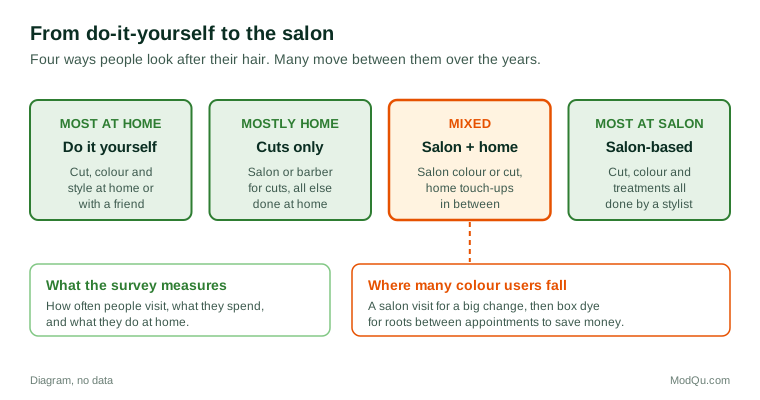
Many people do both: a salon visit for a big change and home touch-ups for roots in between. Box dye on hair that will later be coloured at a salon can make the salon's job harder, so some stylists ask clients what they have used.
Hair dye can cause allergic reactions in some people. Box kits sold in Canada carry a warning and instructions for a skin allergy test before each use. This page describes hair colour in general; anyone with a reaction should stop and speak to a health professional.
Products and hair types
Shampoo and conditioner are bought by most households, but the range of hair products is wide: leave-in conditioners, masks, oils, styling creams, gels, mousses, dry shampoo and heat protectants. Choices often depend on hair type: straight, wavy, curly or coily, fine or thick, oily or dry.
Over the past several years, more products and salons have focused on curly and textured hair, and on routines that skip sulphates or silicones. People with textured hair have long said it was hard to find stylists and products that suited them, and this remains a theme in surveys of salon users.
Example
A woman with tightly coiled hair moves to a small city and cannot find a local salon that works with natural hair. She drives an hour to a braider every eight weeks, buys products online because the local pharmacy carries few that suit her, and washes and styles her hair herself in between.
Changes in the industry
The salon trade has changed in several ways. Many stylists now rent a chair or a small private suite and run their own business rather than working on wages or commission. Online booking and payment apps have made it easier to book, cancel and compare. Short videos have made certain cuts and colours popular very quickly. Barbershops have grown in many cities, and some salons now price by service time rather than by gender.
People also disagree about some of these changes: whether chair-rental stylists offer better or less consistent service, whether gender-neutral pricing is fair, how much to tip and when, and whether expensive salon products are worth the price compared with supermarket brands.
Key terms
- BalayageA colouring technique where lightener is painted on by hand for a soft, graduated effect.
- HighlightsStrands of hair coloured lighter than the rest of the hair.
- Root touch-upColouring only the new growth near the scalp to match the rest of the hair.
- FadeA men's haircut where hair gets gradually shorter down the sides and back.
- Blow-outA wash and blow-dry styling service, usually without a cut.
- RelaxerA chemical treatment that straightens curly or coily hair.
- Allergy alert testA small skin test done before using hair dye, to check for a reaction.
- Chair rentalAn arrangement where a stylist rents space in a salon and runs their own business.
Full glossary: hairdressing terms on EditingTests.com.
Hair care and salons vocabulary test
How well do you know the language of this topic? Try 8 quick questions. Your score is shown straight away and is not saved.
What the hair care and salons survey asks
This survey is part of ModQu's Beauty and Personal Care survey. The hair care and salons part takes about five minutes and covers:
- How often you visit a hair salon or barber, and what for.
- How you chose your current stylist or barber, and how long you have been going.
- How much you spend per visit, including tips.
- Whether you colour, cut or style your hair at home, and why.
- Which hair products you buy and where.
- What would make you change salons.
After that you can choose to continue with other short parts of the Beauty and Personal Care survey, such as skin care or makeup and cosmetics, or stop.
Ready to take part?
Your answers help show what people really think and do. Results are only ever reported as totals; no one can see your individual answers.
Start the surveyQuestions about this survey
Who can take part?
Adults.
Do I have to give my name?
No. You may be asked for your age group, region and similar details so results can be broken down, but not your name. ModQu never asks for passwords, card numbers or account numbers.
How are the results used?
Answers are combined into totals and percentages and published in ModQu reports. Individual answers are never shown.
Is the vocabulary test part of the survey?
No. It is optional and separate, and your score is not stored.