
Share your views on cosmetic treatments
Tell us whether you have had or would consider a cosmetic treatment, and how you would choose a provider. Your answers are combined with other people's and reported only as totals.
Start the cosmetic treatments surveyAbout 5 minutes. No account needed. You can stop at any time.
What cosmetic treatments include
A cosmetic treatment is a procedure done to change appearance, not to treat a medical problem. The line is not always sharp: eyelid surgery can be cosmetic or can improve vision, and a nose operation can be cosmetic or can fix breathing. In Canada, provincial health plans generally do not pay for procedures done only for appearance.
The main groups are:
- Injectables: neuromodulators (botulinum toxin), which relax muscles to soften lines, and dermal fillers, usually made of hyaluronic acid, which add volume.
- Energy-based treatments: lasers, intense pulsed light (IPL) and radiofrequency devices used for hair removal, pigment, redness, scars and skin texture.
- Skin treatments: chemical peels, microneedling and microdermabrasion.
- Body treatments: fat-reduction by cooling or other devices, and body contouring.
- Cosmetic surgery: procedures such as breast augmentation or reduction, liposuction, tummy tucks, facelifts, eyelid surgery and rhinoplasty.
- Other services: cosmetic tattooing such as microblading of eyebrows, and hair transplants.
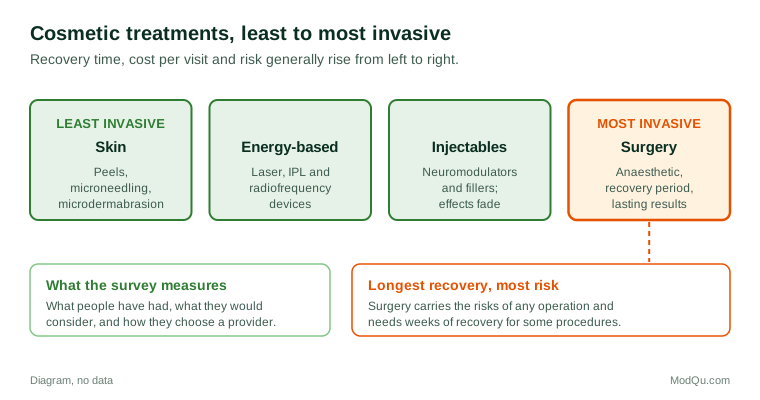
Non-surgical and surgical: the main differences
Non-surgical treatments are usually quicker, cost less per session and need little or no time off, but their effects often fade and need repeating. Surgery usually costs more, involves anaesthetic and a recovery period, and has longer-lasting results, along with greater risks.
Who provides them
Who may perform which treatment depends on the province or state, and the rules are complex. In general terms:
- Plastic surgeons are medical specialists certified in plastic and reconstructive surgery. In Canada, certification is by the Royal College of Physicians and Surgeons of Canada.
- Dermatologists are medical specialists in skin, and many offer injectables and laser.
- Other physicians, including family doctors, sometimes offer cosmetic treatments after further training.
- Nurses and nurse practitioners often give injectables under rules set by their regulatory college, usually with a physician or nurse practitioner involved in the order.
- Estheticians and laser technicians commonly provide peels, laser hair removal and similar services, under rules that vary widely by province.
Because "cosmetic surgeon" is not a protected specialist title in the way "plastic surgeon" is, people are often advised to check a provider's training and registration with the relevant college.
Why people consider treatments
People give many reasons for considering a cosmetic treatment: to look less tired, to feel more confident, to change a feature they have disliked for years, to remove unwanted hair, to treat acne scars, or to restore their appearance after pregnancy, weight loss or illness. Some see small treatments as part of regular grooming, like a haircut. Others would never consider them.
Example
A 45-year-old teacher has noticed lines between their eyebrows that make them look angry in photos. A friend has had neuromodulator injections for years. The teacher books a consultation, asks about cost and how long the effect lasts, and decides to wait a year before deciding.
Attitudes to cosmetic treatments vary by age, gender, culture and region, and have changed as some treatments have become more common. Surveys often find a gap between what people say they would consider and what they have done, so questions usually ask about both.
Costs and repeat treatments
Cosmetic treatments are paid for privately. Prices vary by city, clinic, the amount of product used and the provider's experience. Many non-surgical treatments are priced per unit, per syringe or per session, which makes it hard to know the full cost in advance. Clinics sell packages and memberships, and some offer financing.
Example (hypothetical figures)
A client is quoted $12 per unit for a neuromodulator and is told a typical treatment for their forehead and frown lines uses 40 units, so $480 a visit. The effect usually lasts about three to four months. If they return three times a year, they spend $1,440 a year, which they had not worked out at the first visit.
Questions that businesses want answered include what people expect to pay, whether they understand that results fade, and how price compares with reputation when they choose a provider.
Risks and safety
All cosmetic treatments carry some risk, and serious problems are possible. Common side effects of injectables include bruising and swelling. Less common but serious problems include drooping eyelids after neuromodulators and blocked blood vessels after fillers. Laser treatments can cause burns or changes in skin colour, especially when the device or settings do not suit the person's skin type. Surgery carries the risks of any operation, including infection, bleeding and problems with anaesthetic.
Products such as neuromodulators and dermal fillers must be authorized by Health Canada for sale in Canada. Health Canada has warned the public about unauthorized products sold online and about treatments given in non-clinical settings such as homes and parties. People who travel abroad for cheaper surgery, sometimes called medical tourism, may face problems if complications arise after they return home. This page describes treatments in general and is not medical advice.
Choosing a clinic
People choose clinics and providers in different ways. Factors they weigh include:
- the provider's qualifications and registration;
- before-and-after photos and reviews;
- recommendations from friends;
- price, packages and payment options;
- how the consultation felt, and whether risks were explained;
- location, cleanliness and whether a doctor is on site.
Example
Someone looking for laser hair removal compares three clinics. The cheapest offers six sessions at half the price of the others but cannot say who will do the treatment or which device is used. The second clinic answers both questions, does a patch test first and explains the risk for darker skin. They choose the second.
What people disagree about
Cosmetic treatments raise strong views. Debates include whether social media and video calls push people, especially young people, towards treatments; whether there should be a minimum age; whether injectables should be given in spas and pop-up events; how advertising for treatments should be controlled; and whether cosmetic treatments are a personal choice like any other or a sign of unhealthy pressure about appearance. Surveys on this topic need careful, non-judgmental wording, because people may under-report treatments they have had.
Key terms
- NeuromodulatorAn injectable that relaxes certain muscles to soften lines, such as botulinum toxin.
- Dermal fillerAn injectable gel, often hyaluronic acid, used to add volume or smooth folds.
- Chemical peelA treatment that applies an acid solution to remove outer layers of skin.
- MicroneedlingA treatment that makes tiny punctures in the skin to prompt repair.
- RhinoplastySurgery to change the shape of the nose.
- ConsultationA meeting before treatment to discuss goals, suitability, risks and cost.
- DowntimeThe time after a treatment before a person returns to normal activities.
- Plastic surgeonA medical specialist certified in plastic and reconstructive surgery.
Full glossary: cosmetic surgery terms on EditingTests.com.
Cosmetic treatments vocabulary test
How well do you know the language of this topic? Try 8 quick questions. Your score is shown straight away and is not saved.
What the cosmetic treatments survey asks
This survey is part of ModQu's Beauty and Personal Care survey. The cosmetic treatments part takes about five minutes and covers:
- Whether you have had a cosmetic treatment, and which kinds.
- Which treatments you would consider, and which you would not.
- Why you would consider a treatment, or why not.
- How you would choose a clinic or provider, and what you would check.
- What you would expect to pay, and whether results that fade would affect your choice.
- Where you get information about cosmetic treatments.
After that you can choose to continue with other short parts of the Beauty and Personal Care survey, such as skin care or hair care and salons, or stop.
Ready to take part?
Your answers help show what people really think and do. Results are only ever reported as totals; no one can see your individual answers.
Start the surveyQuestions about this survey
Who can take part?
Adults.
Do I have to give my name?
No. You may be asked for your age group, region and similar details so results can be broken down, but not your name. ModQu never asks for passwords, card numbers or account numbers.
How are the results used?
Answers are combined into totals and percentages and published in ModQu reports. Individual answers are never shown.
Is the vocabulary test part of the survey?
No. It is optional and separate, and your score is not stored.