
Surveys · Questionnaire design
Vague Quantifiers: What Do "Often" and "Sometimes" Really Mean?
Words such as "rarely", "sometimes" and "often" are common survey answer options, but people interpret them very differently. This article explains the evidence and shows when to replace vague quantifiers with numbers.
Many survey questions offer answer options such as "never," "rarely," "sometimes," "often" and "very often." These vague quantifiers are easy to read and quick to answer, and they avoid asking respondents for exact numbers they may not know. The problem is that they do not mean the same thing to everyone. One person's "often" is another person's "sometimes," and the same person may use "often" to mean very different frequencies for different activities.
The evidence
Researchers have tested the meaning of vague quantifiers by asking people to translate them into numbers. In an early study, respondents gave strikingly different numerical values for words such as "often" and "sometimes," with wide overlaps between neighbouring terms (Hakel, 1968). Later research showed that the meaning of a quantifier depends on what it describes: "frequently" implies a much smaller number for a rare event, such as a plane crash, than for a common one (Pepper & Prytulak, 1974).
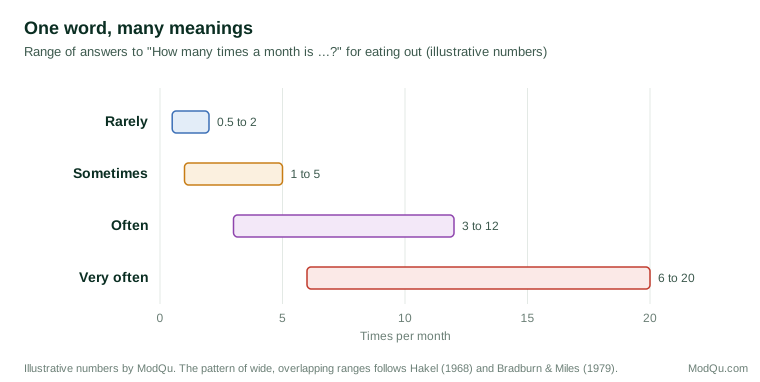
Norman Bradburn and Carrie Miles studied vague quantifiers in a national survey about feelings such as excitement and boredom. They found that the numerical meaning of terms like "very often" varied with the feeling being described and with the characteristics of the respondent (Bradburn & Miles, 1979). Nora Cate Schaeffer later showed that different demographic groups attach different meanings to the same terms, so that comparisons between groups using vague quantifiers can be misleading. Two groups that report "often" at the same rate may in fact differ in actual frequency, and vice versa (Schaeffer, 1991).
Research mapping numerical values onto quantifiers such as "quite a bit" has confirmed that the translation varies with context and between respondents (Wright et al., 1994). The same pattern appears for probability words such as "likely" and "probable": each person uses them fairly consistently, but different people mean quite different probabilities by them (Budescu & Wallsten, 1985). Reviews of how people communicate quantities suggest that these words convey a speaker's perspective, such as whether an amount is more or less than expected, as much as a quantity (Moxey & Sanford, 2000).
Why it matters
Vague quantifiers make it hard to compare groups and to estimate actual frequencies. A company that learns that 40% of customers use a service "often" cannot tell how many times a month that means, or whether heavy users in one region mean the same as heavy users in another. Changes over time are also hard to interpret, since expectations, and therefore the meaning of "often," can change.
Numeric categories are not free of problems either. Respondents use the range of numeric options as a guide to what is typical, so the options shape the answers (Schwarz et al., 1985). But at least the categories mean the same thing to everyone, so differences between groups and changes over time can be read directly. When a survey is used to track behaviour, to size a market or to compare customer segments, this comparability usually outweighs the small extra effort that numeric options ask of respondents. Pilot testing can show whether respondents find the numeric categories easy to use and whether the range of options fits the behaviour.
An example
Suppose a gym asks members, "How often do you attend classes? Never / Rarely / Sometimes / Often / Very often." A member who attends twice a week but used to attend daily may answer "sometimes," because they compare themselves with their past habits. A new member who attends twice a week may answer "often," because it is more than they have ever exercised before. Both attend at the same rate, but the survey records them differently. A version that asks "In a typical week, how many classes do you attend? None / 1 / 2 / 3 / 4 or more" removes this ambiguity and gives the gym a figure it can plan around.
The vague version is not useless. It captures how members feel about their attendance, which may predict whether they renew. If that is what the gym wants to know, the question should say so directly, for example "Do you attend classes as often as you would like?" Asking for a frequency in vague terms mixes the two purposes and serves neither well.
Practical guidance
- Use numbers when frequency matters. Ask "How many times in the past month..." or offer specific categories such as "once a week" and "two or three times a week" (Bradburn et al., 2004).
- Base categories on real distributions. Numeric categories should reflect how often the behaviour actually occurs, so that the middle categories are typical.
- Keep vague quantifiers for feelings and impressions. For subjective experiences, such as how often someone feels stressed, vague terms may be the only practical option. In that case, comparisons between groups should be made with caution.
- Do not mix the two. Lists such as "daily, weekly, often, rarely" combine specific and vague terms and leave respondents unsure which to choose.
Conclusion
Vague quantifiers are convenient, but they measure a mixture of actual frequency and personal standards. Where the purpose is to estimate how often something happens, or to compare groups, specific numbers and numeric categories give clearer and more comparable results.
References
Bradburn, N. M., & Miles, C. (1979). Vague quantifiers. Public Opinion Quarterly, 43(1), 92–101. https://doi.org/10.1086/268494
Bradburn, N. M., Sudman, S., & Wansink, B. (2004). Asking questions: The definitive guide to questionnaire design for market research, political polls, and social and health questionnaires (Rev. ed.). Jossey-Bass.
Budescu, D. V., & Wallsten, T. S. (1985). Consistency in interpretation of probabilistic phrases. Organizational Behavior and Human Decision Processes, 36(3), 391–405. https://doi.org/10.1016/0749-5978(85)90007-X
Hakel, M. D. (1968). How often is often? American Psychologist, 23(7), 533–534. https://doi.org/10.1037/h0037716
Moxey, L. M., & Sanford, A. J. (2000). Communicating quantities: A review of psycholinguistic evidence of how expressions determine perspectives. Applied Cognitive Psychology, 14(3), 237–255. https://doi.org/10.1002/(SICI)1099-0720(200005/06)14:3<237::AID-ACP641>3.0.CO;2-R
Pepper, S., & Prytulak, L. S. (1974). Sometimes frequently means seldom: Context effects in the interpretation of quantitative expressions. Journal of Research in Personality, 8(1), 95–101. https://doi.org/10.1016/0092-6566(74)90049-X
Schaeffer, N. C. (1991). Hardly ever or constantly? Group comparisons using vague quantifiers. Public Opinion Quarterly, 55(3), 395–423. https://doi.org/10.1086/269270
Schwarz, N., Hippler, H.-J., Deutsch, B., & Strack, F. (1985). Response scales: Effects of category range on reported behavior and comparative judgments. Public Opinion Quarterly, 49(3), 388–395. https://doi.org/10.1086/268936
Wright, D. B., Gaskell, G. D., & O'Muircheartaigh, C. A. (1994). How much is 'quite a bit'? Mapping between numerical values and vague quantifiers. Applied Cognitive Psychology, 8(5), 479–496. https://doi.org/10.1002/acp.2350080506