
Surveys · Types and applications
Survey Methods for Capturing Network Ties and Relational Knowledge
Surveys can measure not only individuals but the relationships between them. This article explains the main methods for collecting network data in surveys, including name generators, rosters and methods for estimating network size, and the measurement problems that affect each.
Most surveys treat respondents as separate individuals. Yet much of social life happens through relationships: people find jobs through acquaintances, get advice from friends, catch infections from contacts and form opinions in conversation. Social network research studies these relationships, and surveys are one of its main sources of data. Collecting network data in a survey raises its own design questions, because respondents must recall, name and describe other people and the ties between them (Marsden, 1990; Wasserman & Faust, 1994).
Two kinds of network data
Whole network studies measure all the ties within a defined group, such as a school class, a firm or a village. Each member is asked about their relationships with every other member. The approach goes back to Moreno (1934), who asked schoolchildren whom they would like to sit next to and drew the results as diagrams of the group. Large studies such as the National Longitudinal Study of Adolescent to Adult Health asked students to name their friends within their school, allowing whole friendship networks to be reconstructed (Harris et al., 2019).
Egocentric, or personal, network studies sample individuals from a large population and ask each about their own contacts, called alters, and sometimes about ties among those alters. Because the respondents are not connected to each other, these studies can use ordinary probability samples and generalise to a population (Perry et al., 2018).
Methods for collecting ties
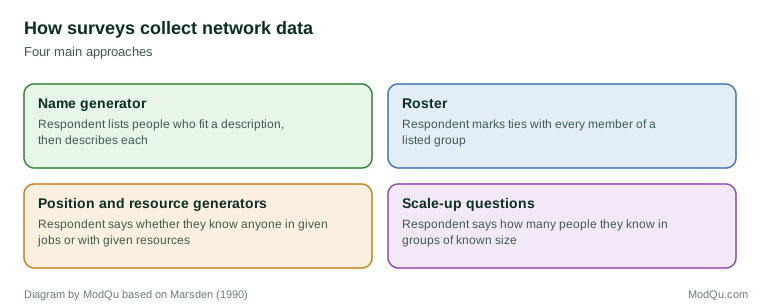
Figure 1 summarises the main methods.
Name generators and interpreters
A name generator asks respondents to list people who fit a description. The best-known example, used in the General Social Survey in the United States since 1985, asks: "From time to time, most people discuss important matters with other people. Looking back over the last six months, who are the people with whom you discussed matters important to you?" (Burt, 1984; Marsden, 1987). Name interpreter questions then ask about each person named, such as their sex, age, relationship to the respondent and how often they are in contact. Further questions ask whether each pair of named people know each other, which shows how dense the network is.
Other generators ask about specific exchanges, such as who provides help with household tasks, who lends money or who gives advice. Fischer (1982) used a set of such questions to build a detailed picture of personal networks in towns and cities in California.
Rosters
In whole network studies, respondents are often shown a roster, a list of all members of the group, and asked to mark their relationships with each. Rosters reduce the problem of forgetting, because respondents recognise names rather than having to recall them, but they are only possible when the group is known and small enough to list.
Position and resource generators
Instead of asking for names, a position generator lists a set of occupations, from doctor and lawyer to cleaner and driver, and asks whether the respondent knows anyone in each (Lin et al., 2001). A resource generator asks whether the respondent knows someone who could provide specific kinds of help, such as legal advice, a loan or help moving house (Van der Gaag & Snijders, 2005). These methods do not identify individual alters, but they are quick to answer and measure the range of social resources a person can reach.
Estimating network size
Some questions ask not who is in a network but how large it is. Scale-up methods ask respondents how many people they know in groups of known size, such as people with a particular first name or occupation, and use the answers to estimate the size of each respondent's whole network. McCarty et al. (2001) compared this approach with a method based on recalling contacts, and both gave average network sizes of about 290 people.
Measurement problems
Recall and informant accuracy
People's reports of their interactions are imperfect. Studies comparing reports with observed interactions found that respondents recalled only part of their actual communication, although they were better at reporting typical patterns than specific events (Bernard et al., 1984).
Sensitivity to wording and context
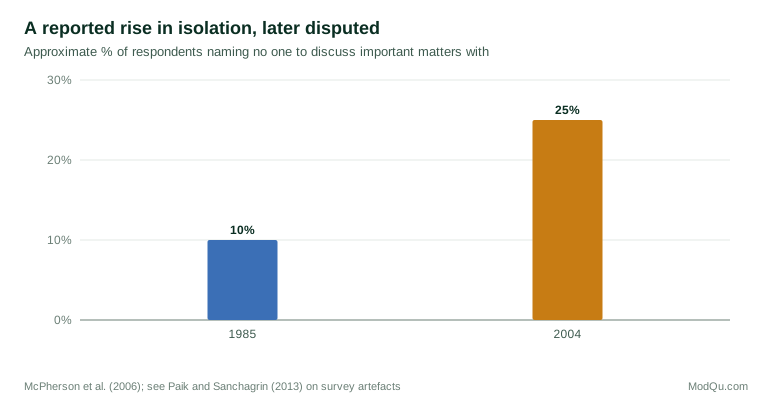
Name generators are strongly affected by wording and by their place in the questionnaire. The "important matters" question captures a mix of close relationships, and people interpret "important matters" in different ways (Bearman & Parigi, 2004). A well-known case shows how much this matters. McPherson et al. (2006) reported that the share of Americans with no one to discuss important matters with had risen sharply between 1985 and 2004, as Figure 2 shows. Later analysis suggested that much of the change was an artefact of how the 2004 survey was administered, including interviewer behaviour and question context (Paik & Sanchagrin, 2013).
Respondent burden
Each person named generates several follow-up questions, so the length of a network module grows quickly with network size. Respondents may learn to name fewer people to shorten the interview. Many surveys cap the number of names, often at five, which truncates larger networks.
Missing data
In whole network studies, a member who does not respond leaves gaps not only in their own ties but in the structure of the whole network. Kossinets (2006) showed that missing data can substantially distort measures such as the number of connections and the clustering of the network.
Online and visual methods
Web surveys have made new approaches possible. Respondents can type names into a list that then appears in later questions automatically, drag names into circles representing closeness, or draw lines between names to show who knows whom. Such visual tools make the task more engaging and can reduce the burden of rating every pair of alters, which grows rapidly with the number of names. They also allow data to be collected without an interviewer, although the loss of interviewer probing can lead to fewer names being listed. Researchers using these tools should test whether the visual layout affects how many names respondents give and how they describe their ties.
An example
A public health team wants to know how older adults get information about health services. It adds a short module to a regional survey of 2,000 people aged 65 and over. Respondents name up to five people they turn to for advice about health and answer four questions about each. Analysis shows that people who named no health advisers were twice as likely to have missed recommended screening, and that adult children were the most common source of advice. The team designs an outreach programme that works through families and community groups (illustrative example).
Practical guidance
- Choose the generator to match the research question, such as advice, support or discussion.
- Test wording and placement, and keep them constant across waves.
- Train interviewers to probe consistently for additional names.
- Limit follow-up questions to the most important attributes.
- Plan for nonresponse, especially in whole network studies.
Conclusion
Survey methods allow researchers to map relationships as well as individuals. Name generators, rosters and scale-up questions each capture different aspects of networks. Because network questions are sensitive to wording, context and burden, careful design is essential to ensure that changes in measured networks reflect real social change rather than changes in the survey.
References
Bearman, P., & Parigi, P. (2004). Cloning headless frogs and other important matters: Conversation topics and network structure. Social Forces, 83(2), 535–557. https://doi.org/10.1353/sof.2005.0001
Bernard, H. R., Killworth, P., Kronenfeld, D., & Sailer, L. (1984). The problem of informant accuracy: The validity of retrospective data. Annual Review of Anthropology, 13, 495–517. https://doi.org/10.1146/annurev.an.13.100184.002431
Burt, R. S. (1984). Network items and the General Social Survey. Social Networks, 6(4), 293–339. https://doi.org/10.1016/0378-8733(84)90007-8
Fischer, C. S. (1982). To dwell among friends: Personal networks in town and city. University of Chicago Press.
Harris, K. M., Halpern, C. T., Whitsel, E. A., Hussey, J. M., Killeya-Jones, L. A., Tabor, J., & Dean, S. C. (2019). Cohort profile: The National Longitudinal Study of Adolescent to Adult Health (Add Health). International Journal of Epidemiology, 48(5), 1415–1415k. https://doi.org/10.1093/ije/dyz115
Kossinets, G. (2006). Effects of missing data in social networks. Social Networks, 28(3), 247–268. https://doi.org/10.1016/j.socnet.2005.07.002
Lin, N., Fu, Y., & Hsung, R.-M. (2001). The position generator: Measurement techniques for investigations of social capital. In N. Lin, K. Cook, & R. S. Burt (Eds.), Social capital: Theory and research (pp. 57–81). Aldine de Gruyter.
Marsden, P. V. (1987). Core discussion networks of Americans. American Sociological Review, 52(1), 122–131. https://doi.org/10.2307/2095397
Marsden, P. V. (1990). Network data and measurement. Annual Review of Sociology, 16, 435–463. https://doi.org/10.1146/annurev.so.16.080190.002251
McCarty, C., Killworth, P. D., Bernard, H. R., Johnsen, E. C., & Shelley, G. A. (2001). Comparing two methods for estimating network size. Human Organization, 60(1), 28–39. https://doi.org/10.17730/humo.60.1.efx5t9gjtgmga73y
McPherson, M., Smith-Lovin, L., & Brashears, M. E. (2006). Social isolation in America: Changes in core discussion networks over two decades. American Sociological Review, 71(3), 353–375. https://doi.org/10.1177/000312240607100301
Moreno, J. L. (1934). Who shall survive? A new approach to the problem of human interrelations. Nervous and Mental Disease Publishing.
Paik, A., & Sanchagrin, K. (2013). Social isolation in America: An artifact. American Sociological Review, 78(3), 339–360. https://doi.org/10.1177/0003122413482919
Perry, B. L., Pescosolido, B. A., & Borgatti, S. P. (2018). Egocentric network analysis: Foundations, methods, and models. Cambridge University Press. https://doi.org/10.1017/9781316443255
Van der Gaag, M., & Snijders, T. A. B. (2005). The Resource Generator: Social capital quantification with concrete items. Social Networks, 27(1), 1–29. https://doi.org/10.1016/j.socnet.2004.10.001
Wasserman, S., & Faust, K. (1994). Social network analysis: Methods and applications. Cambridge University Press. https://doi.org/10.1017/CBO9780511815478