
Surveys · Types and applications
Survey-Based Measurement of Social Capital and Network Knowledge
Social capital refers to the resources people and communities gain from their relationships, trust and participation. This article explains the main ways surveys measure it, from trust and membership questions to position and resource generators, and the strengths and limits of each.
Social capital describes the value of social relationships: the help, information, opportunities and cooperation that people gain through their connections with others. The idea has several roots. Bourdieu (1986) treated social capital as the resources available to individuals through membership of groups and networks. Coleman (1988) emphasised the norms, trust and obligations that make cooperation possible. Putnam (2000) popularised the idea at the level of communities and nations, arguing that declining participation in civic life had weakened American society. Because the concept is broad, it has been measured in many ways, and surveys are the main source of data (Portes, 1998; Scrivens & Smith, 2013).
What is measured
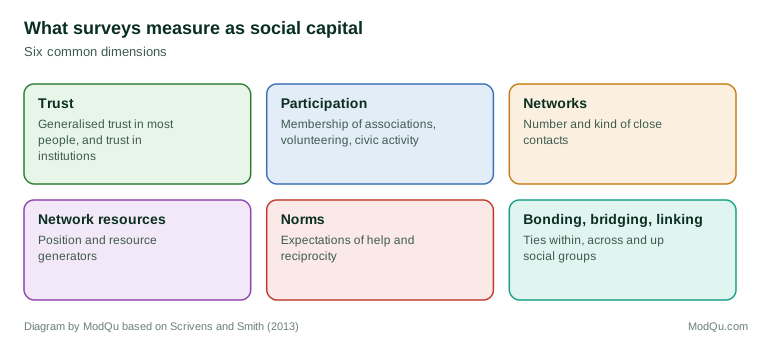
Survey measures of social capital usually cover several dimensions, shown in Figure 1.
Trust
The most widely used question asks about generalised trust: "Generally speaking, would you say that most people can be trusted, or that you can't be too careful in dealing with people?" It appears in many national and international surveys and allows comparisons across countries and over time. Its meaning has been questioned. Glaeser et al. (2000) compared answers to such questions with behaviour in experimental trust games and found that the survey question predicted trustworthy behaviour better than trusting behaviour. Naef and Schupp (2009) developed survey questions that did predict trusting behaviour in experiments more closely.
Participation
Questions about membership of associations, such as clubs, religious groups, unions and voluntary organisations, and about volunteering and civic engagement, such as attending meetings or voting, measure structural social capital. Putnam (2000) relied heavily on such measures to document declining participation. Paxton (1999) combined indicators of trust and association membership in a single model and found evidence of a decline in trust in individuals in the United States, but not a general decline in associations.
Networks and network resources
Network-based measures focus on what people can reach through their relationships. Lin (2001) defined social capital as resources embedded in social networks that people can access or mobilise. Two survey instruments put this idea into practice:
- The position generator lists a range of occupations and asks whether the respondent knows anyone in each. Measures derived from it include the number of positions reached, the highest prestige reached and the range between highest and lowest (Lin et al., 2001).
- The resource generator asks whether the respondent knows someone who could provide specific kinds of help, such as repairing a car, giving legal advice or lending a large sum of money (Van der Gaag & Snijders, 2005).
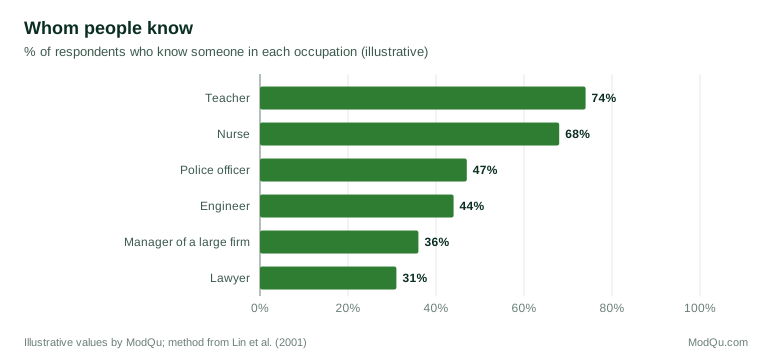
Figure 2 shows illustrative results from a position generator.
Name generators, which ask respondents to list the people they turn to for advice or support, provide a more detailed picture of close networks but take longer to administer.
Bonding, bridging and linking
Social capital is often divided into bonding ties, within close groups of similar people such as family and close friends; bridging ties, across different social groups; and linking ties, to people and institutions with power or resources. Weak, bridging ties are especially valuable for information about jobs and opportunities (Granovetter, 1973). Survey questions can distinguish these types by asking about the characteristics of contacts, such as whether they share the respondent's ethnicity, education or neighbourhood.
Integrated questionnaires
Several organisations have developed integrated questionnaires covering many dimensions. The World Bank's integrated questionnaire, designed for use in developing countries, covers groups and networks, trust, collective action, information, social cohesion and empowerment (Grootaert et al., 2004). National statistical offices in several countries include social capital modules in their household surveys, often following frameworks such as that of Scrivens and Smith (2013).
Measurement problems
- Conceptual breadth. Because social capital means different things to different researchers, measures of trust, membership and network resources may not be closely related, and combining them in a single index can hide important differences.
- Individual or collective. Survey answers describe individuals, but social capital is often discussed as a property of communities. Aggregating individual answers to the community level assumes that the average represents the whole.
- Cultural meaning. Questions about trust and association membership may be understood differently across countries and groups.
- Causation. People with more social capital tend to be better off in many ways, but the direction of cause is often unclear.
Designing a social capital module
A survey that aims to measure social capital should start by deciding which dimension matters for the question at hand. A study of job seeking needs measures of network resources and bridging ties; a study of neighbourhood safety needs measures of local trust and cooperation; a study of civic life needs measures of participation. Trying to cover everything in a short module usually produces weak measures of each.
Several design choices follow. Trust questions should specify whom respondents are asked to trust, such as neighbours, strangers or people of another religion, because generalised trust alone mixes these. Membership questions should list types of organisation and ask about active participation, not only nominal membership. Position generators should include occupations that span the range of prestige and that are common enough for respondents to know people in them. Resource generators should list kinds of help that matter in the respondent's setting. Reference periods, such as the past twelve months for volunteering, should be stated clearly. Where results will be compared across countries, the questions should be tested for comparable meaning in each language.
Uses of the results
Social capital measures are used to describe communities, to explain differences in outcomes and to evaluate programmes. Governments use them to track social cohesion over time and to identify areas where people are isolated or lack access to help. Researchers use them to study how relationships affect health, employment, education and wellbeing. Community organisations use them to show the effects of projects that bring people together. In each case, the results are most useful when the dimensions are reported separately, so that a fall in participation is not hidden by stable trust, or a gap in network resources by high membership.
An example
A city council measures social capital in two neighbourhoods using a survey with trust, participation and resource generator questions. Generalised trust is similar in both, but residents of one neighbourhood know far fewer people who could help with legal or employment problems, and fewer belong to any association. The council funds a community centre offering advice sessions and clubs in that neighbourhood and plans to repeat the survey in three years (illustrative example).
Conclusion
Surveys measure social capital through trust, participation and access to network resources. Each dimension captures part of a broad concept, and each has known limitations. Choosing measures that match the research question, and reporting the dimensions separately, gives the most informative picture of how relationships shape opportunities.
References
Bourdieu, P. (1986). The forms of capital. In J. G. Richardson (Ed.), Handbook of theory and research for the sociology of education (pp. 241–258). Greenwood Press.
Coleman, J. S. (1988). Social capital in the creation of human capital. American Journal of Sociology, 94(Suppl.), S95–S120. https://doi.org/10.1086/228943
Glaeser, E. L., Laibson, D. I., Scheinkman, J. A., & Soutter, C. L. (2000). Measuring trust. Quarterly Journal of Economics, 115(3), 811–846. https://doi.org/10.1162/003355300554926
Granovetter, M. S. (1973). The strength of weak ties. American Journal of Sociology, 78(6), 1360–1380. https://doi.org/10.1086/225469
Grootaert, C., Narayan, D., Jones, V. N., & Woolcock, M. (2004). Measuring social capital: An integrated questionnaire (World Bank Working Paper No. 18). World Bank.
Lin, N. (2001). Social capital: A theory of social structure and action. Cambridge University Press. https://doi.org/10.1017/CBO9780511815447
Lin, N., Fu, Y., & Hsung, R.-M. (2001). The position generator: Measurement techniques for investigations of social capital. In N. Lin, K. Cook, & R. S. Burt (Eds.), Social capital: Theory and research (pp. 57–81). Aldine de Gruyter.
Naef, M., & Schupp, J. (2009). Measuring trust: Experiments and surveys in contrast and combination (IZA Discussion Paper No. 4087). Institute for the Study of Labor.
Paxton, P. (1999). Is social capital declining in the United States? A multiple indicator assessment. American Journal of Sociology, 105(1), 88–127. https://doi.org/10.1086/210268
Portes, A. (1998). Social capital: Its origins and applications in modern sociology. Annual Review of Sociology, 24, 1–24. https://doi.org/10.1146/annurev.soc.24.1.1
Putnam, R. D. (2000). Bowling alone: The collapse and revival of American community. Simon & Schuster.
Scrivens, K., & Smith, C. (2013). Four interpretations of social capital: An agenda for measurement (OECD Statistics Working Papers No. 2013/06). OECD Publishing. https://doi.org/10.1787/5jzbcx010wmt-en
Van der Gaag, M., & Snijders, T. A. B. (2005). The Resource Generator: Social capital quantification with concrete items. Social Networks, 27(1), 1–29. https://doi.org/10.1016/j.socnet.2004.10.001