
Research · Quantitative and mixed methods
The Use of Simulation and Agent-Based Modeling in Research Knowledge
How simulation and agent-based modelling generate research knowledge by building artificial societies of interacting agents, what they reveal about emergent patterns, how models are built and validated, and their uses and limits.
Some questions are hard to answer with observation or experiment. How would a market respond to a new rule? How might a rumour spread through an organisation? Why do neighbourhoods become segregated when few people want them to be? Simulation answers such questions by building a model of a system and running it on a computer to see what happens. Agent-based modelling is a form of simulation in which the model consists of many individual agents, such as people, firms or households, each following rules about how to behave and interact. Patterns at the level of the whole system then emerge from these interactions. This article explains how the approach produces knowledge and where it needs care.
From factors to actors
Macy and Willer (2002) described agent-based modelling as a shift from factors to actors. Conventional statistical models relate variables to each other. Agent-based models instead represent individuals and their interactions, and ask what aggregate patterns those interactions produce. The approach is suited to systems where outcomes depend on local interaction, adaptation and feedback, and where the whole behaves differently from the sum of its parts.
Schelling (1971) gave the classic demonstration. In his model, individuals of two types live on a grid and move if too few of their neighbours share their type. Even when every individual is content to be in a mixed neighbourhood and only wants to avoid being in a small minority, the grid quickly becomes strongly segregated. The model showed that a collective outcome can be very different from what any individual intends.
Epstein and Axtell (1996) extended the idea in their Sugarscape model, an artificial society in which agents gather resources, trade, reproduce and pass on cultural traits. They argued for generative social science: to explain a social pattern, show how it can be grown from the interactions of agents following plausible rules.
How models are built
Gilbert and Troitzsch (2005) described the main steps in building a simulation, summarised below.
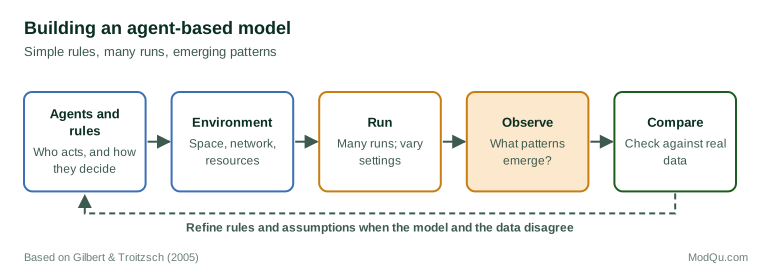
The researcher defines the agents, their attributes and their rules; specifies the environment in which they interact; runs the model many times, because outcomes often vary from run to run; and observes the patterns that emerge. The model is then compared with real data and refined.
Davis et al. (2007) described simulation as particularly useful for developing theory when there is a basic theory but its implications are unclear, for example because it involves feedback, nonlinearity or time delays that are hard to reason about without computation.
Uses
Bonabeau (2002) described business applications of agent-based modelling, including modelling crowds and evacuations, traffic and supply chains, financial markets and the spread of innovations through populations of consumers. Organisations can use simulation to test policies before applying them, to explore what might happen under conditions that have not yet occurred, and to identify unexpected consequences.
Epstein (2008) listed many reasons to build models beyond prediction: to explain, to guide data collection, to reveal core dynamics, to suggest analogies, to discover new questions and to show which outcomes are plausible.
An applied example
A hypothetical example: a retailer wants to know how a loyalty scheme might spread among its customers. A survey shows that customers are more likely to join if friends have joined, but the strength of this effect is uncertain. The team builds a model in which simulated customers are linked in a network, each joining with a probability that rises with the number of friends who have joined. Running the model under different assumptions shows that adoption either stalls at a low level or spreads widely, depending on whether early members are concentrated in connected groups or scattered. The result suggests launching the scheme through existing community groups rather than through scattered promotions. The numbers in such a model are assumptions, not findings, so the retailer then tests both launch approaches in a small number of stores before deciding.
Limits
A model is only as good as its assumptions. Rules for agent behaviour are often simplified, and different plausible rules can produce different results. Showing that a model can generate a pattern does not prove that the real world generates it in the same way. Models should therefore be checked against data where possible, tested for sensitivity to their assumptions and described fully, so that others can examine and reproduce them.
Conclusion
Simulation and agent-based modelling create knowledge by building artificial worlds and observing what emerges from them. They reveal how local behaviour produces collective patterns, help develop and test theory, and allow policies to be explored before they are tried. Their value depends on plausible rules, testing against evidence and transparent reporting.
References
Bonabeau, E. (2002). Agent-based modeling: Methods and techniques for simulating human systems. Proceedings of the National Academy of Sciences, 99(Suppl. 3), 7280–7287. https://doi.org/10.1073/pnas.082080899
Davis, J. P., Eisenhardt, K. M., & Bingham, C. B. (2007). Developing theory through simulation methods. Academy of Management Review, 32(2), 480–499. https://doi.org/10.5465/amr.2007.24351453
Epstein, J. M. (2008). Why model? Journal of Artificial Societies and Social Simulation, 11(4), Article 12.
Epstein, J. M., & Axtell, R. (1996). Growing artificial societies: Social science from the bottom up. Brookings Institution Press; MIT Press.
Gilbert, N., & Troitzsch, K. G. (2005). Simulation for the social scientist (2nd ed.). Open University Press.
Macy, M. W., & Willer, R. (2002). From factors to actors: Computational sociology and agent-based modeling. Annual Review of Sociology, 28, 143–166. https://doi.org/10.1146/annurev.soc.28.110601.141117
Schelling, T. C. (1971). Dynamic models of segregation. Journal of Mathematical Sociology, 1(2), 143–186. https://doi.org/10.1080/0022250X.1971.9989794