
Research · Quantitative and mixed methods
Configurational Comparative Methods (QCA) for Complex Causality Knowledge
How qualitative comparative analysis (QCA) and related configurational methods study complex causality, covering set-theoretic thinking, necessary and sufficient conditions, crisp and fuzzy sets, truth tables, consistency and coverage, applications in business and policy research, and the main criticisms.
Many outcomes in social and business life have more than one cause, and causes often work only in combination. A firm may succeed through a strong brand combined with wide distribution, or through low cost combined with a narrow market, while the same brand strength without distribution achieves little. Standard regression asks how much each variable, on average and holding the others constant, contributes to an outcome. Configurational comparative methods, of which qualitative comparative analysis (QCA) is the best known, ask a different question: which combinations of conditions are linked to an outcome? Ragin (1987) introduced QCA as a way of moving beyond the divide between case-oriented qualitative research and variable-oriented quantitative research. This article explains how QCA works, what kind of causal knowledge it produces and where it needs care.
Causal complexity
QCA is built to handle causal complexity, which has three features (Schneider & Wagemann, 2012):
- Conjunctural causation. Conditions produce an outcome only in combination. Neither A nor B alone is enough, but A and B together are.
- Equifinality. Several different combinations can lead to the same outcome. There is more than one path to success.
- Asymmetry. The conditions that explain the presence of an outcome may differ from those that explain its absence. Knowing why firms succeed does not automatically tell us why they fail.
Mahoney and Goertz (2006) described these features as typical of the qualitative research tradition, which seeks to explain outcomes in particular cases, in contrast to the quantitative tradition, which estimates average effects across populations. Misangyi et al. (2017) described a growing neo-configurational perspective in management research, which uses QCA to study how organisational attributes combine to produce performance.
The philosopher Mackie (1965) offered a useful account of this kind of causation. He described a cause as an INUS condition: an insufficient but necessary part of a condition that is itself unnecessary but sufficient for the result. A short circuit may cause a house fire, but only in combination with flammable materials and the absence of a sprinkler, and fires can also start in other ways. QCA searches for exactly this kind of structure.
Sets and set relations
QCA treats conditions and outcomes as sets, and cases as members of those sets to some degree. A firm may be a member of the set of "large firms", the set of "innovative firms" and the set of "profitable firms". Causal relationships are then expressed as subset relations.
A condition is sufficient for an outcome if every case with the condition also has the outcome; in set terms, the condition is a subset of the outcome. A condition is necessary if every case with the outcome also has the condition; the outcome is a subset of the condition. QCA identifies conditions and combinations that come close to these relations in the data.
Crisp and fuzzy sets
The original form, crisp-set QCA, codes each condition as present (1) or absent (0). Ragin (2000) extended the method to fuzzy sets, in which membership can take any value from 0 to 1. A firm may be fully in the set of large firms (1), fully out (0), or more in than out (0.7). Fuzzy sets keep more information than crisp sets and allow for differences of degree while still focusing on qualitative differences of kind. A third form, multi-value QCA, allows conditions to have more than two categories.
The process of assigning set membership is called calibration. Ragin (2008) emphasised that calibration should be based on theoretical and substantive knowledge, using external standards to set three anchor points: full membership, full non-membership and a crossover point of maximum ambiguity. A firm with 50 employees might be fully out of the set of large firms, and one with 5,000 fully in, with the crossover set at a level that experts would regard as the boundary between small and large. Calibration is one of the most consequential decisions in a QCA study, because results depend on it.
The truth table
At the heart of QCA is the truth table. Each row represents one logically possible combination of conditions. With three conditions there are eight rows; with four, sixteen; with k conditions, 2 to the power k. Each case is assigned to the row that best matches its combination of conditions, and each row is examined to see whether its cases consistently show the outcome. The table below shows an illustrative example.
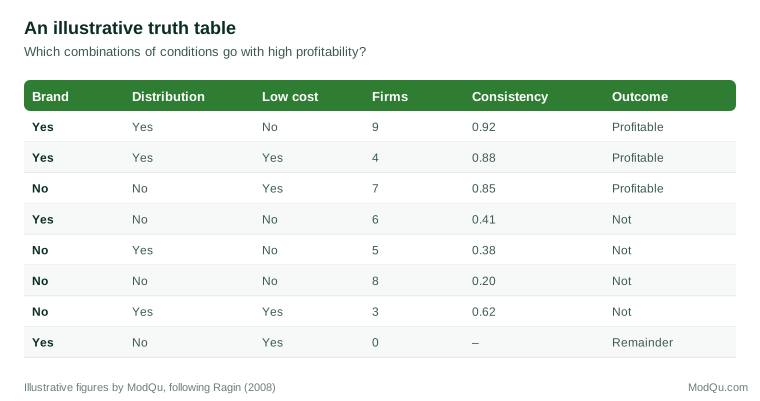
Some rows may contain no cases. These logical remainders reflect limited diversity: in the real world, not every combination occurs. How remainders are treated affects the results. Ragin (2008) distinguished complex solutions, which make no assumptions about remainders; parsimonious solutions, which use any remainder that simplifies the result; and intermediate solutions, which use only remainders consistent with theoretical expectations about the direction in which each condition should work.
Boolean minimisation
The truth table is simplified by Boolean minimisation. If two rows that both lead to the outcome differ in only one condition, that condition is irrelevant in that context and can be dropped. For example, if large innovative firms with strong brands are profitable, and large innovative firms with weak brands are also profitable, then large size combined with innovation is sufficient, regardless of brand. Repeating this process produces a solution: one or more combinations of conditions, each sufficient for the outcome.
Results are often presented using Boolean notation, where multiplication means AND, addition means OR, and a tilde means NOT. A solution such as A*B + ~A*C reads: the outcome occurs when A and B are both present, or when A is absent and C is present.
Consistency and coverage
Real data rarely show perfect set relations. Ragin (2006) proposed two measures. Consistency measures the degree to which cases sharing a combination of conditions agree in displaying the outcome; it shows how closely a subset relation holds. Coverage measures how much of the outcome a combination accounts for; it shows empirical importance. A combination with high consistency but low coverage is a reliable path that few cases take. Researchers usually set a consistency threshold, often 0.80 or higher, below which a row is not treated as sufficient.
Carrying out a QCA study
Greckhamer et al. (2018) and Thomann and Maggetti (2020) set out recommended practices. The main steps are shown below.
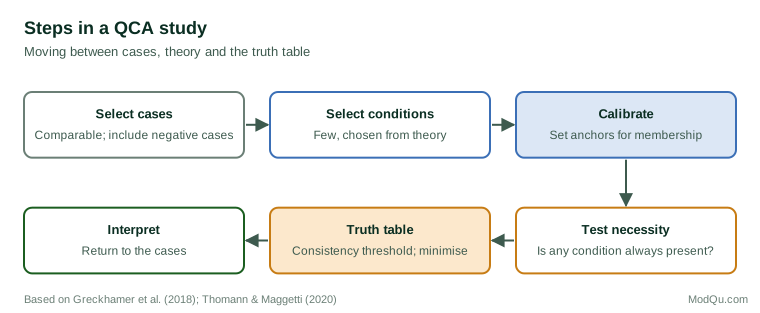
Select cases. QCA typically uses intermediate numbers of cases, from about ten to a few hundred, though it can be applied to larger samples. Cases should be comparable and selected with knowledge of the population. Mahoney and Goertz (2004) argued that negative cases should be chosen from those where the outcome was possible, so that the comparison is informative.
Select conditions. The number of conditions must be kept small relative to the number of cases, because each added condition doubles the number of truth table rows and increases limited diversity. Conditions should be chosen on theoretical grounds.
Calibrate. Assign set membership scores using external standards and case knowledge, and report the anchor points.
Analyse necessity. Test whether any single condition is necessary for the outcome before analysing sufficiency.
Construct and minimise the truth table. Assign cases to rows, apply a consistency threshold, decide how to treat remainders and derive solutions.
Interpret. Return to the cases to understand how each combination produces the outcome. Rihoux and Ragin (2009) emphasised that QCA is a case-oriented method, and that its results should be interpreted with knowledge of the cases, not as abstract formulae.
Software such as the R packages described by Thiem and Duşa (2013) carries out the calculations, but the substantive decisions remain with the researcher.
QCA and regression compared
QCA and regression answer different questions, and neither is simply better. Regression estimates the average change in an outcome associated with a change in each variable, holding the others constant. It assumes, unless interactions are specified, that each variable contributes independently and in the same way in every case. It works best with large samples and treats unexplained variation as random error. QCA looks for combinations of conditions that are consistently linked to an outcome, allows the same condition to matter in one combination and not in another, and treats cases that do not fit as puzzles to be examined. Woodside (2013) argued that many business theories are really configurational, describing combinations that work together, and so are poorly tested by regression. Mahoney and Goertz (2006) described the two approaches as different cultures with different goals, one seeking the average effects of causes across a population and the other seeking the causes of particular outcomes. Many researchers now use both: regression to estimate average effects, and QCA to explore which combinations account for the cases that matter most.
Applications
QCA was first used mainly in comparative politics and sociology, to study questions such as the conditions for democratic stability or welfare state development. Marx et al. (2014) reviewed its first twenty-five years and found rapid growth across political science, sociology, management and public policy.
In management, Fiss (2007) argued that QCA suits the study of organisational configurations, the idea that organisational structures, strategies and environments fit together in coherent combinations. Fiss (2011) used fuzzy-set QCA to study high-performing firms and distinguished core conditions, which are strongly linked to the outcome, from peripheral conditions, which play a supporting role. Woodside (2013) urged business researchers to move from symmetric thinking, in which high values of a variable go with high values of an outcome, to asymmetric thinking, in which particular combinations lead to particular outcomes.
In evaluation, Kahwati and Kane (2020) described how QCA can identify which combinations of programme features and contexts are associated with success, which is useful when the same intervention works in some places and not others.
Criticisms and limitations
QCA has attracted serious criticism. Lucas and Szatrowski (2014) used simulations to argue that QCA often fails to recover known causal structures and can produce misleading results, especially when data contain measurement error or when relevant conditions are omitted. Baumgartner and Thiem (2020) tested QCA's ability to recover true causal models and argued that only certain solution types, particularly parsimonious solutions, could be trusted to avoid including irrelevant conditions. Supporters have responded that simulations often ignore the case knowledge and iterative calibration on which good QCA relies, but the debate has led to clearer standards.
Other limitations include:
- Sensitivity to calibration decisions, consistency thresholds and the choice of conditions;
- Limited diversity, which forces assumptions about combinations not observed;
- Difficulty with time, since standard QCA treats conditions as static;
- Risk of overfitting when many conditions are used with few cases.
Researchers can reduce these risks by justifying each decision, testing how robust results are to alternative calibrations and thresholds, and reporting the full truth table.
Checking robustness
Because QCA results depend on several judgements, good studies test whether conclusions survive reasonable alternatives. Common checks include changing calibration anchors within a plausible range, raising or lowering the consistency threshold, adding or removing borderline cases, and comparing complex, intermediate and parsimonious solutions. Results that hold across these variations can be reported with more confidence; results that change should be presented as tentative. Greckhamer et al. (2018) recommended reporting such checks routinely, together with the full truth table, so that readers can see how solutions were reached.
An applied example
A hypothetical example: a franchise company wants to understand why some of its 40 outlets meet sales targets and others do not. Managers suggest four conditions: an experienced manager, a high-traffic location, local marketing spending above the network median and low staff turnover. After calibrating each condition with managers' input, the analysis finds two sufficient combinations. Outlets with experienced managers and low staff turnover meet targets regardless of location, and outlets in high-traffic locations with above-median local marketing meet targets even with less experienced managers. No single condition is necessary. The findings suggest two different strategies for improving weak outlets, depending on their location, which an average effect for each factor would not have revealed. The figures are illustrative, and the company would need to examine the cases behind each path before acting on them.
Related methods
QCA is one of several set-theoretic methods. Dul (2016) developed necessary condition analysis, which focuses specifically on identifying conditions without which an outcome cannot occur, and on the level of a condition required for a given level of outcome. Wagemann and Schneider (2010) described QCA as both a research approach, involving dialogue between cases and theory, and a data analysis technique, and argued that both aspects must be present for good practice.
Conclusion
QCA and related configurational methods are designed for questions about combinations of conditions, multiple paths to an outcome and asymmetric causation. They treat cases as configurations, express causal relationships as set relations, and use truth tables and Boolean minimisation to identify sufficient combinations. Their results depend on careful case selection, theoretically grounded calibration and transparent choices, and they are best interpreted alongside knowledge of the cases. Used in this way, they offer a useful complement to regression-based methods when the question is not how much each factor matters on average, but which combinations work.
References
Baumgartner, M., & Thiem, A. (2020). Often trusted but never (properly) tested: Evaluating qualitative comparative analysis. Sociological Methods & Research, 49(2), 279–311. https://doi.org/10.1177/0049124117701487
Dul, J. (2016). Necessary condition analysis (NCA): Logic and methodology of "necessary but not sufficient" causality. Organizational Research Methods, 19(1), 10–52. https://doi.org/10.1177/1094428115584005
Fiss, P. C. (2007). A set-theoretic approach to organizational configurations. Academy of Management Review, 32(4), 1180–1198. https://doi.org/10.5465/amr.2007.26586092
Fiss, P. C. (2011). Building better causal theories: A fuzzy set approach to typologies in organization research. Academy of Management Journal, 54(2), 393–420. https://doi.org/10.5465/amj.2011.60263120
Greckhamer, T., Furnari, S., Fiss, P. C., & Aguilera, R. V. (2018). Studying configurations with qualitative comparative analysis: Best practices in strategy and organization research. Strategic Organization, 16(4), 482–495. https://doi.org/10.1177/1476127018786487
Kahwati, L. C., & Kane, H. L. (2020). Qualitative comparative analysis in mixed methods research and evaluation. SAGE.
Lucas, S. R., & Szatrowski, A. (2014). Qualitative comparative analysis in critical perspective. Sociological Methodology, 44(1), 1–79. https://doi.org/10.1177/0081175014532763
Mackie, J. L. (1965). Causes and conditions. American Philosophical Quarterly, 2(4), 245–264.
Mahoney, J., & Goertz, G. (2004). The possibility principle: Choosing negative cases in comparative research. American Political Science Review, 98(4), 653–669. https://doi.org/10.1017/S0003055404041401
Mahoney, J., & Goertz, G. (2006). A tale of two cultures: Contrasting quantitative and qualitative research. Political Analysis, 14(3), 227–249. https://doi.org/10.1093/pan/mpj017
Marx, A., Rihoux, B., & Ragin, C. (2014). The origins, development, and application of qualitative comparative analysis: The first 25 years. European Political Science Review, 6(1), 115–142. https://doi.org/10.1017/S1755773912000318
Misangyi, V. F., Greckhamer, T., Furnari, S., Fiss, P. C., Crilly, D., & Aguilera, R. (2017). Embracing causal complexity: The emergence of a neo-configurational perspective. Journal of Management, 43(1), 255–282. https://doi.org/10.1177/0149206316679252
Ragin, C. C. (1987). The comparative method: Moving beyond qualitative and quantitative strategies. University of California Press.
Ragin, C. C. (2000). Fuzzy-set social science. University of Chicago Press.
Ragin, C. C. (2006). Set relations in social research: Evaluating their consistency and coverage. Political Analysis, 14(3), 291–310. https://doi.org/10.1093/pan/mpj019
Ragin, C. C. (2008). Redesigning social inquiry: Fuzzy sets and beyond. University of Chicago Press.
Rihoux, B., & Ragin, C. C. (Eds.). (2009). Configurational comparative methods: Qualitative comparative analysis (QCA) and related techniques. SAGE. https://doi.org/10.4135/9781452226569
Schneider, C. Q., & Wagemann, C. (2012). Set-theoretic methods for the social sciences: A guide to qualitative comparative analysis. Cambridge University Press. https://doi.org/10.1017/CBO9781139004244
Thiem, A., & Duşa, A. (2013). Qualitative comparative analysis with R: A user's guide. Springer. https://doi.org/10.1007/978-1-4614-4584-5
Thomann, E., & Maggetti, M. (2020). Designing research with qualitative comparative analysis (QCA): Approaches, challenges, and tools. Sociological Methods & Research, 49(2), 356–386. https://doi.org/10.1177/0049124117729700
Wagemann, C., & Schneider, C. Q. (2010). Qualitative comparative analysis (QCA) and fuzzy-sets: Agenda for a research approach and a data analysis technique. Comparative Sociology, 9(3), 376–396. https://doi.org/10.1163/156913210X12493538729838
Woodside, A. G. (2013). Moving beyond multiple regression analysis to algorithms: Calling for adoption of a paradigm shift from symmetric to asymmetric thinking in data analysis and crafting theory. Journal of Business Research, 66(4), 463–472. https://doi.org/10.1016/j.jbusres.2012.12.021