
Research · Research integrity
The Impact of Funding Paradigms on the Direction of Knowledge Generation
How the way research is funded shapes which questions are asked and which knowledge is produced, covering the linear model, competitive grants, mission-oriented and performance-based funding, the Matthew effect, bias against novelty, and alternatives such as lotteries.
Research does not choose its own questions in a vacuum. Someone pays for it, and the way they pay influences what gets studied, by whom and how. A funding system that rewards safe, incremental projects will produce different knowledge from one that rewards bold bets; a system that concentrates money on established stars will produce different knowledge from one that spreads it widely. This article examines the main funding paradigms, the evidence on how they shape knowledge and the reforms being tried.
The linear model and its critics
Modern public research funding was shaped by Bush (1945), whose report to the United States President argued that basic research, pursued without thought of practical ends, was the pacemaker of technological progress. Governments should fund it generously and leave scientists free to choose their problems; applications would follow. This linear model, running from basic research to applied research to development and use, guided the creation of national research funding agencies after the Second World War.
Stokes (1997) argued that the model was misleading. Much important research, such as Pasteur's work on microbiology, was driven both by the quest for understanding and by practical problems. Treating basic and applied research as opposite ends of one scale obscured this use-inspired basic research, and encouraged funding systems that separated curiosity from relevance. Gibbons et al. (1994) went further, describing a new Mode 2 of knowledge production, organised around problems in their context of application, involving many disciplines and partners outside universities, in contrast to traditional discipline-based Mode 1 research.
Main funding paradigms
Several funding models coexist, each with different effects on the questions researchers pursue.
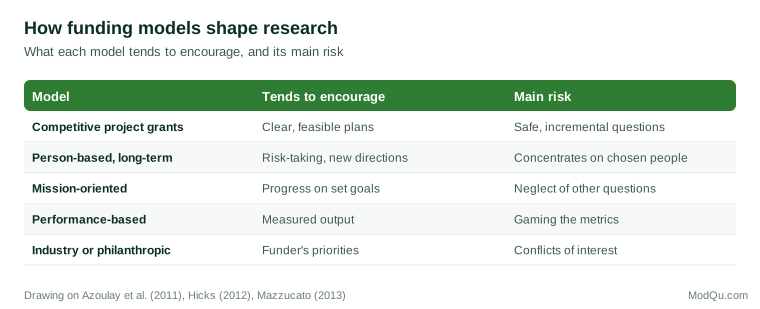
Competitive project grants fund specific proposals judged by peer review. They reward clear plans and preliminary results, which can favour safe, well-defined questions over risky ones.
Person-based, long-term funding supports researchers rather than projects, often for several years, with freedom to change direction. Azoulay et al. (2011) compared scientists funded by a programme of this kind, which tolerated early failure and offered long time horizons, with similar scientists funded through standard project grants. The first group produced more highly cited papers and also more failures, and moved into new research directions more often. The result suggests that funding designed to tolerate risk produces more breakthrough work.
Mission-oriented funding directs money at defined goals, such as a vaccine, a clean energy technology or a space programme. Mazzucato (2013) argued that public mission-oriented investment has been the source of many technologies later commercialised by private firms, and that states can shape the direction of innovation rather than simply correct market failures.
Performance-based institutional funding allocates money to universities according to measures of research output, such as publications, citations or expert assessment of quality. Hicks (2012) reviewed such systems across many countries and found that they create strong incentives, which can raise output but also encourage researchers to focus on whatever the system measures.
Industry and philanthropic funding follows the interests of the funder. It can bring large resources to neglected problems, but can also steer research toward commercially or ideologically favoured questions, and create conflicts of interest. Kearns et al. (2016) documented how sugar industry funding in the 1960s shaped a review of diet and heart disease in the industry's favour.
How funding shapes knowledge
Concentration and the Matthew effect
Merton (1968) described the Matthew effect in science: researchers who are already recognised receive disproportionate credit and resources, while others receive less than their contributions merit. Funding can amplify this pattern.
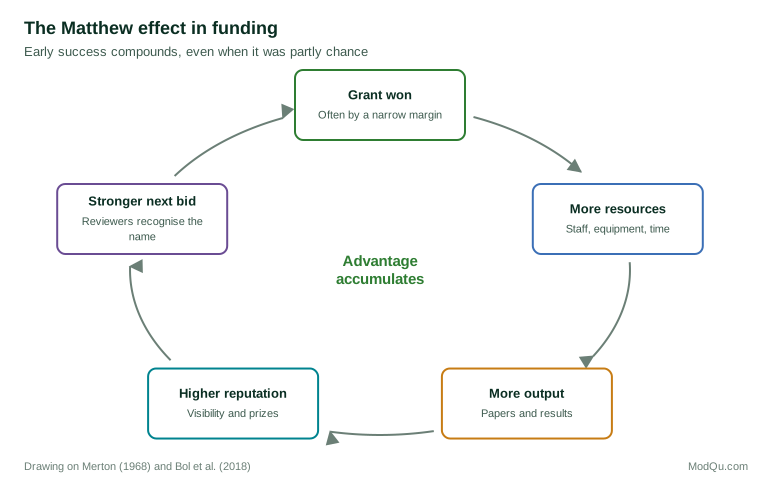
Bol et al. (2018) studied early-career grants in the Netherlands and compared applicants who scored just above the funding threshold with those just below it. The two groups were almost identical in quality, yet over the following years the winners obtained substantially more further funding than the near-misses. Early success, partly a matter of chance, compounded into lasting advantage. Stephan (2012) described how the economics of research, including competition for grants, positions and equipment, concentrates resources in a small number of laboratories and institutions.
Concentration matters because it narrows the range of ideas pursued. If funding flows to established groups working on established questions, alternative approaches may never be tested.
Bias against novelty
Peer review of proposals tends to favour work that reviewers recognise. Boudreau et al. (2016) ran an experiment in which expert evaluators scored research proposals and found that highly novel proposals received systematically lower scores. Wang et al. (2017) found that highly novel papers were more likely to become top cited in the long run, but took longer to be recognised and were more often published in lower-impact journals. A funding system that relies on early signals of impact, or on reviewers' comfort with an idea, will therefore tend to underfund the research most likely to produce breakthroughs.
Unequal access
Funding systems can also disadvantage particular groups of researchers. Ginther et al. (2011) found that Black applicants to the main grant programme of the United States National Institutes of Health were significantly less likely to be funded than white applicants with similar records. Such gaps affect not only careers but which questions are studied, since researchers' backgrounds shape the problems they choose.
Short horizons and metrics
Many grants last only a few years, and researchers must show results quickly to win the next one. This favours questions that can be answered within a grant cycle and discourages long-term studies, such as cohort studies that follow people for decades, or slow theoretical work. Performance-based systems that count publications can have a similar effect, encouraging researchers to divide work into more papers and to avoid projects that may take years to produce anything publishable (Hicks, 2012). The result is a body of knowledge rich in short-term findings and poorer in long-term understanding.
Private funding and public questions
As private and philanthropic funding grows, it plays a larger part in setting research agendas. Private funders can move quickly and back unconventional ideas, but their priorities may differ from public needs. Questions that matter to society but offer no commercial return, or that might produce findings inconvenient to a sponsor, may receive little attention.
Alternatives and reforms
Funders have experimented with ways to counter these effects:
- Partial lotteries. Fang and Casadevall (2016) proposed that once proposals pass a quality threshold, funding should be allocated by lottery. This acknowledges that peer review cannot reliably rank proposals of similar quality, reduces bias and saves reviewers' time.
- Funding people, not projects. Long-term, flexible awards encourage risk-taking (Azoulay et al., 2011).
- Dedicated high-risk programmes. Some funders set aside money for exploratory or unconventional ideas, judged on potential rather than preliminary data.
- Broader evaluation. Assessing researchers on a range of contributions, not only publication counts, reduces pressure to produce safe, publishable results.
- Monitoring equity. Tracking success rates across groups helps funders detect and correct unequal access (Ginther et al., 2011).
Implications for research users
For anyone using research, funding patterns explain why some questions have abundant evidence and others very little. Topics with commercial value or political priority attract more research; topics without a funder may remain unstudied, however important. When evidence on a question is thin, it is worth asking whether that reflects a real absence of effects or simply an absence of funding.
Conclusion
Funding is not a neutral input to research. Its structure, whether competitive grants, long-term awards, missions, performance metrics or private sponsorship, shapes which questions are asked, which ideas survive and who gets to pursue them. The evidence shows that common systems concentrate resources, penalise novelty and can disadvantage some groups. Funders are increasingly testing alternatives, from lotteries to risk-tolerant awards, that aim to widen the range of knowledge produced.
References
Azoulay, P., Graff Zivin, J. S., & Manso, G. (2011). Incentives and creativity: Evidence from the academic life sciences. The RAND Journal of Economics, 42(3), 527–554. https://doi.org/10.1111/j.1756-2171.2011.00140.x
Bol, T., de Vaan, M., & van de Rijt, A. (2018). The Matthew effect in science funding. Proceedings of the National Academy of Sciences, 115(19), 4887–4890. https://doi.org/10.1073/pnas.1719557115
Boudreau, K. J., Guinan, E. C., Lakhani, K. R., & Riedl, C. (2016). Looking across and looking beyond the knowledge frontier: Intellectual distance, novelty, and resource allocation in science. Management Science, 62(10), 2765–2783. https://doi.org/10.1287/mnsc.2015.2285
Bush, V. (1945). Science, the endless frontier: A report to the President. United States Government Printing Office.
Fang, F. C., & Casadevall, A. (2016). Research funding: The case for a modified lottery. mBio, 7(2), Article e00422-16. https://doi.org/10.1128/mBio.00422-16
Gibbons, M., Limoges, C., Nowotny, H., Schwartzman, S., Scott, P., & Trow, M. (1994). The new production of knowledge: The dynamics of science and research in contemporary societies. SAGE.
Ginther, D. K., Schaffer, W. T., Schnell, J., Masimore, B., Liu, F., Haak, L. L., & Kington, R. (2011). Race, ethnicity, and NIH research awards. Science, 333(6045), 1015–1019. https://doi.org/10.1126/science.1196783
Hicks, D. (2012). Performance-based university research funding systems. Research Policy, 41(2), 251–261. https://doi.org/10.1016/j.respol.2011.09.007
Kearns, C. E., Schmidt, L. A., & Glantz, S. A. (2016). Sugar industry and coronary heart disease research: A historical analysis of internal industry documents. JAMA Internal Medicine, 176(11), 1680–1685. https://doi.org/10.1001/jamainternmed.2016.5394
Mazzucato, M. (2013). The entrepreneurial state: Debunking public vs. private sector myths. Anthem Press.
Merton, R. K. (1968). The Matthew effect in science. Science, 159(3810), 56–63. https://doi.org/10.1126/science.159.3810.56
Stephan, P. (2012). How economics shapes science. Harvard University Press.
Stokes, D. E. (1997). Pasteur's quadrant: Basic science and technological innovation. Brookings Institution Press.
Wang, J., Veugelers, R., & Stephan, P. (2017). Bias against novelty in science: A cautionary tale for users of bibliometric indicators. Research Policy, 46(8), 1416–1436. https://doi.org/10.1016/j.respol.2017.06.006