
Research · Qualitative research
Process Tracing Techniques for Within-Case Causal Knowledge Generation
How process tracing uses evidence from within a single case to test whether a causal mechanism operated, covering mechanisms, the four classic tests, Bayesian reasoning, practical steps and uses in evaluation and business research.
A single case can tell us more than whether two things occurred together. It can show how one led to the other. Process tracing is a method for drawing causal conclusions from evidence within a single case, by examining whether the sequence of events and the traces they left fit the steps of a proposed causal mechanism. George and Bennett (2005) defined it as a method that attempts to identify the causal chain and causal mechanism between an independent variable and an outcome. It is widely used in political science, history, policy evaluation and organisational research, and offers a disciplined way to generate within-case causal knowledge. This article explains the main ideas, the tests used to weigh evidence and how a study is carried out.
Mechanisms, not just correlations
Many methods establish causal claims by comparing cases: if outcomes differ when a cause is present and absent, and other factors are controlled, the cause probably matters. Process tracing asks a different question: how did the cause produce the outcome in this case? It focuses on causal mechanisms, the processes through which causes bring about effects.
Hedström and Ylikoski (2010) described mechanisms as the entities and activities, organised in a particular way, that produce a phenomenon. Explaining by mechanism means showing the cogs and wheels that link cause and effect, not only that they are linked. Beach and Pedersen (2019) recommended setting out each part of a mechanism explicitly, as a chain of entities engaging in activities, so that each step can be tested against evidence. Falleti and Lynch (2009) added that mechanisms operate within contexts, and that the same mechanism may produce different outcomes in different settings, which is why process tracing must pay close attention to the circumstances of each case.
Trampusch and Palier (2016) described process tracing as a way of opening the black box between cause and outcome. Where a statistical study may show that a policy is associated with an effect, process tracing can show whether the effect arose through the pathway the policy's designers intended, or through some other route.
Types of process tracing
Beach and Pedersen (2019) distinguished three variants:
- Theory-testing process tracing starts with a theorised mechanism and tests whether it was present in a case where cause and outcome both occurred.
- Theory-building process tracing starts with evidence from a case and works toward a general mechanism that might explain it.
- Explaining-outcome process tracing seeks a full explanation of a particular historical outcome, often combining several mechanisms and case-specific factors.
Allison (1971) provides a classic example of the third type. He explained the Cuban missile crisis using three models of decision-making, showing how each accounted for different parts of the evidence and together gave a fuller explanation than any one model alone.
The four tests
The core of process tracing is weighing evidence. Not all evidence is equally informative. Van Evera (1997) proposed classifying tests according to two properties: whether passing the test is necessary for a hypothesis to survive, and whether passing it is sufficient to confirm the hypothesis. Collier (2011) set out the resulting four tests, shown below.
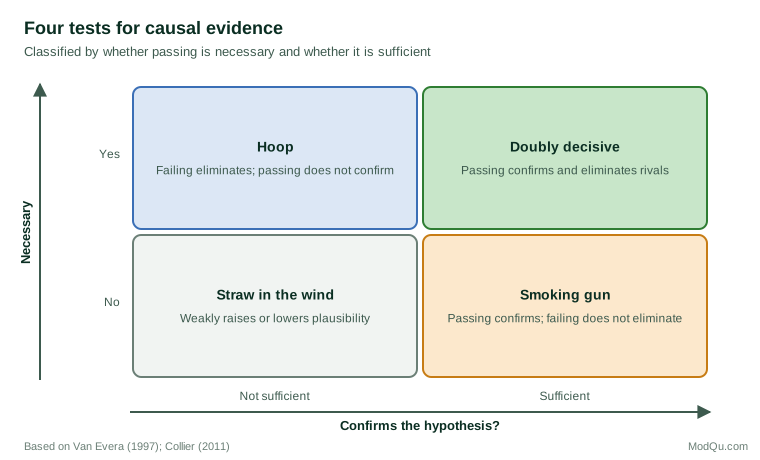
Straw-in-the-wind tests are neither necessary nor sufficient. Passing one makes a hypothesis slightly more plausible; failing one slightly weakens it. Several straws pointing the same way can add up, but none is decisive.
Hoop tests are necessary but not sufficient. A hypothesis must jump through the hoop to remain in contention, so failing eliminates it, but passing does not confirm it. For example, if a manager is suspected of having caused a decision, a hoop test is whether the manager was present when it was made.
Smoking-gun tests are sufficient but not necessary. Passing strongly confirms a hypothesis, but failing does not eliminate it, because the evidence might simply not have survived. A memo in which the manager instructs the decision would be a smoking gun.
Doubly decisive tests are both necessary and sufficient. Passing confirms the hypothesis and eliminates rivals. Such evidence is rare in social research.
Mahoney (2012) argued that these tests correspond to the logic of necessary and sufficient conditions, and that researchers should be explicit about which kind of test each piece of evidence represents.
Bayesian reasoning
Recent work has formalised process tracing in Bayesian terms. In this view, each piece of evidence updates the researcher's confidence in a hypothesis according to how much more likely the evidence is if the hypothesis is true than if it is false. Bennett and Checkel (2015) presented Bayesian reasoning as the underlying logic of the four tests: a smoking gun is evidence that is very unlikely unless the hypothesis is true, while a hoop is evidence that is very likely if the hypothesis is true.
Fairfield and Charman (2017) went further, recommending explicit Bayesian analysis in which researchers state their prior confidence in rival hypotheses and estimate the likelihood of each piece of evidence under each hypothesis. They argued that this makes reasoning transparent, though they noted that assigning probabilities requires judgement and should be reported openly. Humphreys and Jacobs (2015) showed how the same Bayesian framework can integrate within-case evidence from process tracing with cross-case evidence from larger samples.
Carrying out a study
A process-tracing study usually follows several steps:
- State the hypotheses. Set out the proposed mechanism and plausible rival explanations, in enough detail that each implies observable traces.
- Derive predictions. For each hypothesis, list what evidence should exist if it is true, and what would be unlikely.
- Collect evidence. Use documents, interviews, records, timelines and other sources. Bennett and Checkel (2015) emphasised casting the net widely, including sources that might support rival explanations.
- Weigh evidence. Classify each piece using the four tests or Bayesian reasoning, considering the reliability of the source and whether the evidence could have arisen for other reasons.
- Reach a conclusion. Judge which explanation best fits the evidence, and state how confident the conclusion is and what evidence would change it.
Collier (2011) stressed the importance of careful description as the foundation: a detailed, accurate account of the sequence of events is needed before causal inferences can be drawn.
Uses in evaluation
Process tracing is increasingly used in programme and impact evaluation, where randomised experiments are often impossible. Befani and Mayne (2014) combined process tracing with contribution analysis, which asks whether a programme plausibly contributed to observed changes. Mayne (2012) described contribution analysis as building a credible contribution story by setting out a theory of change, gathering evidence on each link and assessing alternative explanations. Process tracing adds a structured way of weighing that evidence. Punton and Welle (2015) described how development evaluators used the four tests to judge whether interventions had contributed to policy changes.
Applied example
A hypothetical example: a company's customer retention improved after it introduced a new onboarding programme. Managers want to know whether the programme caused the improvement. The proposed mechanism is that onboarding helped new customers use key features, which increased their satisfaction, which reduced cancellations. Rival explanations include a competitor's price rise and a seasonal pattern.
The researcher derives predictions. If the onboarding mechanism operated, customers who completed onboarding should show higher feature use in their first month (a hoop test), and support tickets about setup should fall (a straw in the wind). If the competitor's price rise explains the change, retention should have improved among long-standing customers as well as new ones. Evidence shows higher feature use among onboarded customers, fewer setup tickets, and no improvement among long-standing customers. Exit interviews from the previous year cite confusion during setup as a main reason for leaving (a strong piece of supporting evidence). The onboarding explanation passes its hoop test and is supported by other evidence, while the rival explanation fails its key prediction. The illustrative conclusion is that onboarding very probably contributed to improved retention.
Strengths and limitations
Process tracing allows causal inference from a single case, makes the reasoning behind conclusions explicit, and can test mechanisms that cross-case comparisons cannot see. Its limitations include dependence on the availability and reliability of evidence, the risk that researchers favour evidence for their preferred hypothesis, and the difficulty of generalising from a mechanism found in one case to others. Being explicit about rival hypotheses, predictions and the strength of each piece of evidence is the main defence against these risks.
Conclusion
Process tracing produces causal knowledge from within a single case by testing whether the traces left by events fit the steps of a proposed mechanism. The four tests and their Bayesian foundations give a structured way to weigh evidence, and the method's emphasis on rival explanations and explicit reasoning makes conclusions open to scrutiny. It is a valuable tool wherever researchers need to know not only whether something worked, but how.
References
Allison, G. T. (1971). Essence of decision: Explaining the Cuban missile crisis. Little, Brown.
Beach, D., & Pedersen, R. B. (2019). Process-tracing methods: Foundations and guidelines (2nd ed.). University of Michigan Press. https://doi.org/10.3998/mpub.10072208
Befani, B., & Mayne, J. (2014). Process tracing and contribution analysis: A combined approach to generative causal inference for impact evaluation. IDS Bulletin, 45(6), 17–36. https://doi.org/10.1111/1759-5436.12110
Bennett, A., & Checkel, J. T. (Eds.). (2015). Process tracing: From metaphor to analytic tool. Cambridge University Press. https://doi.org/10.1017/CBO9781139858472
Collier, D. (2011). Understanding process tracing. PS: Political Science & Politics, 44(4), 823–830. https://doi.org/10.1017/S1049096511001429
Fairfield, T., & Charman, A. E. (2017). Explicit Bayesian analysis for process tracing: Guidelines, opportunities, and caveats. Political Analysis, 25(3), 363–380. https://doi.org/10.1017/pan.2017.14
Falleti, T. G., & Lynch, J. F. (2009). Context and causal mechanisms in political analysis. Comparative Political Studies, 42(9), 1143–1166. https://doi.org/10.1177/0010414009331724
George, A. L., & Bennett, A. (2005). Case studies and theory development in the social sciences. MIT Press.
Hedström, P., & Ylikoski, P. (2010). Causal mechanisms in the social sciences. Annual Review of Sociology, 36, 49–67. https://doi.org/10.1146/annurev.soc.012809.102632
Humphreys, M., & Jacobs, A. M. (2015). Mixing methods: A Bayesian approach. American Political Science Review, 109(4), 653–673. https://doi.org/10.1017/S0003055415000453
Mahoney, J. (2012). The logic of process tracing tests in the social sciences. Sociological Methods & Research, 41(4), 570–597. https://doi.org/10.1177/0049124112437709
Mayne, J. (2012). Contribution analysis: Coming of age? Evaluation, 18(3), 270–280. https://doi.org/10.1177/1356389012451663
Punton, M., & Welle, K. (2015). Straws-in-the-wind, hoops and smoking guns: What can process tracing offer to impact evaluation? (CDI Practice Paper No. 10). Institute of Development Studies.
Trampusch, C., & Palier, B. (2016). Between X and Y: How process tracing contributes to opening the black box of causality. New Political Economy, 21(5), 437–454. https://doi.org/10.1080/13563467.2015.1134465
Van Evera, S. (1997). Guide to methods for students of political science. Cornell University Press.