
Research · Qualitative research
Arts-Based Research Methods and Non-Traditional Knowledge Forms
What arts-based research is, how drawing, poetry, theatre, fiction and other art forms are used to generate, analyse and share knowledge, how quality is judged, and where the approach is useful in health, education and applied research.
Research usually communicates through tables, statistics and academic prose. Some knowledge does not fit these forms well: the feeling of living with a long-term illness, the texture of a workplace culture, the experience of migration. Arts-based research uses the methods of the creative arts, such as drawing, painting, poetry, fiction, theatre, dance, music and film, to generate, analyse and communicate research knowledge. Leavy (2015) described it as a set of methodological tools used by researchers across disciplines during all phases of research, including data generation, analysis, interpretation and representation. This article explains where arts-based research comes from, what forms it takes, what kinds of knowledge it produces and how its quality can be judged.
Origins and rationale
Barone and Eisner (2012) traced the development of arts-based research to educational research in the 1990s, when Eisner and others argued that the arts could reveal aspects of human experience that conventional research methods missed. Eisner (1997) set out both the promise and the perils of what he called alternative forms of data representation. Their promise was that they could generate empathy, give a sense of particular situations, and open new questions. Their perils included ambiguity, the risk that aesthetic appeal would be mistaken for research quality, and the difficulty of judging work against criteria developed for conventional research.
The rationale rests on a view of knowledge as more than propositions. Polanyi (1966) argued that people know more than they can tell: much of what we know is tacit, held in skills, perceptions and bodily experience rather than in explicit statements. Arts-based methods can make some of this knowledge visible. A drawing may express a relationship that a participant cannot describe; a scene performed on stage may convey the tension of a conversation better than a transcript.
Rolling (2010) described arts-based research as a distinct paradigm alongside quantitative and qualitative approaches, with its own assumptions about what counts as knowledge and how it is produced. Others see it as an extension of qualitative research. Either way, it treats the creative process itself as a way of knowing, not just as decoration added to findings.
Forms of arts-based research
Arts-based research draws on many art forms. Knowles and Cole (2008) brought together examples across literary, performative, visual and new media forms. The main families are as follows.
Literary forms include poetry, fiction and creative non-fiction. Richardson and St. Pierre (2005) argued that writing is itself a method of inquiry: by writing in different forms, researchers discover what they know. Poetic inquiry turns interview transcripts or field notes into poems that condense experience. Faulkner (2009) described how research poems can present findings with emotional force and economy, and Furman (2006) showed how poetic forms can be used to report qualitative health research. Fiction allows researchers to build composite characters and situations from data, protecting confidentiality while conveying patterns that recur across cases.
Performative forms include theatre, dance and music. Ethnodrama and ethnotheatre turn research data into scripts and performances. Saldaña (2011) described how to adapt interview transcripts and field notes into plays, keeping participants' words while shaping them for an audience. Mienczakowski (1995) used ethnographic theatre about mental health and detoxification to present findings to audiences that included patients and health workers, arguing that performance could have an emancipatory effect by giving participants' experiences a public voice. Boal (1979) developed the Theatre of the Oppressed, in which audiences step into scenes to try out alternative actions, an approach later adapted for participatory research.
Visual forms include drawing, painting, collage, photography, sculpture and film. Guillemin (2004) asked women with heart disease and with menopause to draw their illness, and found that the drawings revealed how they understood their condition in ways that interviews alone did not. Gauntlett and Holzwarth (2006) asked participants to build models or make visual artefacts representing their identities, and then to explain them, arguing that taking time to make something allows people to reflect before they speak. Wang and Burris (1997) developed photovoice, in which participants photograph their own communities, as a participatory visual method.
Hybrid forms combine art and research practice. Springgay et al. (2005) described a/r/tography, in which the researcher is at once artist, researcher and teacher, and inquiry proceeds through the making of art and the writing that accompanies it.
Planning an arts-based study
An arts-based study needs the same planning as any other research, with some additional choices. The researcher should begin with the research question and ask whether an art form will help to answer it, rather than starting with a favoured medium. Leavy (2015) recommended matching the art form to the question: visual methods suit questions about how people see or picture something, narrative and poetry suit questions about how experience unfolds and feels, and performance suits questions about interaction and relationships.
The next decisions concern who makes the art and at what stage. If participants make it, the researcher must plan materials, time, instructions and support, and decide how participants will explain their work. Gauntlett and Holzwarth (2006) found that giving participants time to make something before talking about it produced more reflective accounts than an interview alone. If the researcher makes the art, they must decide how closely it will follow the data, and how they will show readers the link between the two.
Finally, the researcher should plan how the work will be analysed and documented. This includes keeping the original material, recording participants' explanations, noting the choices made in turning data into art, and planning how the audience response will be gathered if that is part of the study.
Arts across the research process
Arts-based methods can be used at different stages of research. The diagram below shows the three main points at which they enter.
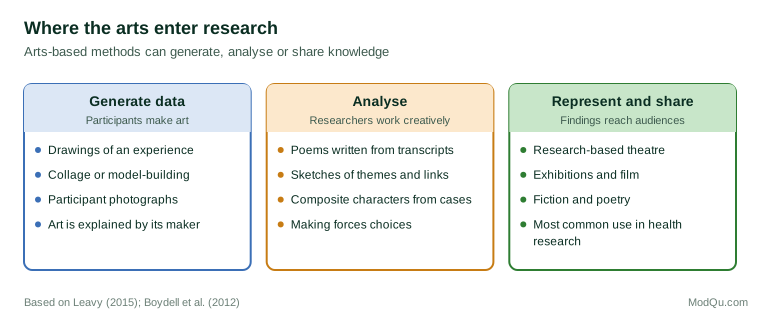
Generating data. Participants create art, such as drawings, collages or photographs, as a way of expressing experience. The art and the participant's explanation of it become data.
Analysing data. Researchers use creative processes to work with data, for example writing poems from transcripts to identify key themes, or sketching relationships between ideas. The act of making forces the researcher to choose what matters.
Representing and sharing findings. Research findings are presented through performance, exhibition, film or fiction, often to reach audiences beyond academia. Boydell et al. (2012) found in a scoping review of arts-based health research that many studies used the arts mainly for dissemination, and fewer used them to generate or analyse data.
Many projects use the arts at only one stage. Others combine them, for example by asking participants to make drawings, analysing these with participants, and then presenting the findings as an exhibition.
What kind of knowledge it produces
Arts-based research aims to produce knowledge that is felt as well as understood. Barone and Eisner (2012) argued that its purpose is not to reach final answers but to enhance perspectives and raise questions, by helping audiences see familiar situations in new ways. A play about care homes may lead audiences to empathise with residents and staff in a way a report would not.
This kind of knowledge has particular value in knowledge translation, the process of moving research findings into practice. Colantonio et al. (2008) developed a research-based play about traumatic brain injury and found that it helped health professionals understand patients' experiences. Kontos and Naglie (2007) evaluated research-based theatre about people with Alzheimer's disease and found that it encouraged health care practitioners to recognise expressions of personhood in residents with dementia.
Fraser and al Sayah (2011) reviewed arts-based methods in health research and found that they were used to build understanding of patients' experiences, to engage communities and to communicate findings. They also noted that many studies gave limited detail about how the art was produced and analysed, which made it hard to judge their rigour.
Judging quality
Because arts-based research differs from conventional research, its quality cannot be judged only by conventional criteria such as reliability. Barone and Eisner (2012) proposed several criteria for judging arts-based work, shown in the table below.
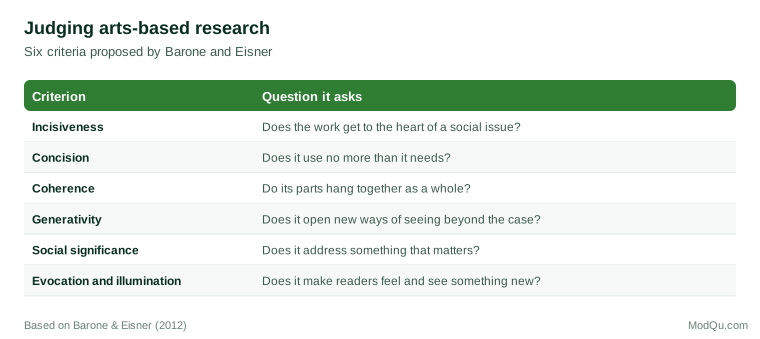
Leavy (2015) added criteria such as resonance, whether the work connects with audiences emotionally and intellectually; usefulness, whether it serves the purpose for which it was created; and transparency, whether the researcher explains how the work was produced and on what data it is based. Lafrenière and Cox (2013) developed a framework for assessing arts-based works that considers both the research process and the artistic product, asking how the work was made, whether it is faithful to the data, and what effect it has on audiences.
A common tension is between artistic quality and research integrity. A poem may be moving but misrepresent participants; a faithful transcript may be dull on stage. Eisner (1997) warned that aesthetic appeal can disguise weak research, and that researchers using the arts should develop artistic skill or collaborate with artists, while remaining accountable for the link between their work and their data.
Working with artists and participants
Few researchers are trained artists. Many arts-based projects are collaborations between researchers, professional artists and participants. Colantonio et al. (2008) developed their play about brain injury with a team that included researchers, clinicians, a playwright and actors, with people affected by brain injury consulted during development. Such collaborations combine research rigour with artistic skill, but they need clear agreements about roles, authorship and who makes final decisions about content.
Arts-based methods also fit participatory research, in which participants shape the research as well as provide data. Boal (1979) designed his theatre techniques so that audiences became actors, rehearsing ways to change their own situations. When participants make art and help interpret it, they gain more control over how their experiences are represented. This can make the research more accurate and more ethical, as long as participants' contributions are acknowledged and their wishes about public display are respected.
Ethics
Arts-based research raises ethical questions beyond those of conventional qualitative research. Participants' art may be personal and revealing. Images, performances and recognisable stories are harder to anonymise than coded text. Public performances or exhibitions may expose participants to audiences they did not anticipate. Researchers need to agree with participants how their work will be used, who owns it, whether it will be shown publicly and whether their names will appear. When fiction or composite characters are used, researchers should explain this to readers, so that the representation is not mistaken for a literal account. Emotional risk also needs attention. Making art about painful experiences can bring strong feelings to the surface, for participants and for audiences. Researchers should plan support, allow participants to stop or withhold work, and consider how audiences, who may include people with the same experiences, will be prepared for and supported after a performance or exhibition.
Strengths and limitations
Arts-based research has several strengths:
- it can access tacit, emotional and embodied knowledge that words and numbers miss;
- it gives participants who are less comfortable with interviews other ways to express themselves;
- it can engage wide and non-specialist audiences;
- it can generate empathy and prompt reflection, supporting changes in practice.
It also has limitations:
- outputs can be ambiguous, and audiences may read them in ways the researcher did not intend;
- quality criteria are still debated, which can make the work hard to evaluate and publish;
- it often requires artistic skills or partnerships that research teams do not have;
- many studies report the process too briefly for others to assess or repeat.
Applied uses
The approach has uses outside academic research. Organisations may ask staff to draw or make models representing their workplace culture, revealing views that are difficult to state openly. Health services may use research-based theatre to train staff in patients' experiences. A hypothetical example: a hospital studying patients' experiences of discharge turns interview data into a short play performed for staff. In discussion after the performance, nurses identify points in the process where patients feel abandoned that had not appeared in satisfaction surveys, and the hospital changes its discharge routine. The play did not replace the analysis; it made the findings vivid enough to act on.
Conclusion
Arts-based research uses creative practices to generate, analyse and share knowledge. It widens what counts as research knowledge to include the tacit, emotional and embodied, and it can reach audiences that conventional reports do not. Its value depends on clear links between the art and the data, transparent accounts of the process, attention to ethics and an honest assessment against criteria suited to its aims. Used in this way, it complements other forms of research rather than replacing them.
References
Barone, T., & Eisner, E. W. (2012). Arts based research. SAGE. https://doi.org/10.4135/9781452230627
Boal, A. (1979). Theatre of the oppressed. Pluto Press.
Boydell, K. M., Gladstone, B. M., Volpe, T., Allemang, B., & Stasiulis, E. (2012). The production and dissemination of knowledge: A scoping review of arts-based health research. Forum Qualitative Sozialforschung / Forum: Qualitative Social Research, 13(1), Article 32. https://doi.org/10.17169/fqs-13.1.1711
Colantonio, A., Kontos, P. C., Gilbert, J. E., Rossiter, K., Gray, J., & Keightley, M. L. (2008). After the crash: Research-based theater for knowledge transfer. Journal of Continuing Education in the Health Professions, 28(3), 180–185. https://doi.org/10.1002/chp.177
Eisner, E. W. (1997). The promise and perils of alternative forms of data representation. Educational Researcher, 26(6), 4–10. https://doi.org/10.3102/0013189X026006004
Faulkner, S. L. (2009). Poetry as method: Reporting research through verse. Left Coast Press.
Fraser, K. D., & al Sayah, F. (2011). Arts-based methods in health research: A systematic review of the literature. Arts & Health, 3(2), 110–145. https://doi.org/10.1080/17533015.2011.561357
Furman, R. (2006). Poetic forms and structures in qualitative health research. Qualitative Health Research, 16(4), 560–566. https://doi.org/10.1177/1049732306286819
Gauntlett, D., & Holzwarth, P. (2006). Creative and visual methods for exploring identities. Visual Studies, 21(1), 82–91. https://doi.org/10.1080/14725860600613261
Guillemin, M. (2004). Understanding illness: Using drawings as a research method. Qualitative Health Research, 14(2), 272–289. https://doi.org/10.1177/1049732303260445
Knowles, J. G., & Cole, A. L. (Eds.). (2008). Handbook of the arts in qualitative research: Perspectives, methodologies, examples, and issues. SAGE. https://doi.org/10.4135/9781452226545
Kontos, P. C., & Naglie, G. (2007). Expressions of personhood in Alzheimer's disease: An evaluation of research-based theatre as a pedagogical tool. Qualitative Health Research, 17(6), 799–811. https://doi.org/10.1177/1049732307302838
Lafrenière, D., & Cox, S. M. (2013). 'If you can call it a poem': Toward a framework for the assessment of arts-based works. Qualitative Research, 13(3), 318–336. https://doi.org/10.1177/1468794112446104
Leavy, P. (2015). Method meets art: Arts-based research practice (2nd ed.). Guilford Press.
Mienczakowski, J. (1995). The theater of ethnography: The reconstruction of ethnography into theater with emancipatory potential. Qualitative Inquiry, 1(3), 360–375. https://doi.org/10.1177/107780049500100306
Polanyi, M. (1966). The tacit dimension. Doubleday.
Richardson, L., & St. Pierre, E. A. (2005). Writing: A method of inquiry. In N. K. Denzin & Y. S. Lincoln (Eds.), The SAGE handbook of qualitative research (3rd ed., pp. 959–978). SAGE.
Rolling, J. H., Jr. (2010). A paradigm analysis of arts-based research and implications for education. Studies in Art Education, 51(2), 102–114. https://doi.org/10.1080/00393541.2010.11518795
Saldaña, J. (2011). Ethnotheatre: Research from page to stage. Left Coast Press.
Springgay, S., Irwin, R. L., & Kind, S. W. (2005). A/r/tographies as living inquiry through art and text. Qualitative Inquiry, 11(6), 897–912. https://doi.org/10.1177/1077800405280696
Wang, C., & Burris, M. A. (1997). Photovoice: Concept, methodology, and use for participatory needs assessment. Health Education & Behavior, 24(3), 369–387. https://doi.org/10.1177/109019819702400309