
Research · Philosophy and paradigms
Positivism, Interpretivism and Pragmatism in Research Design
The three research paradigms most often met in applied work, what each assumes about knowledge, and how each shapes the design of a study.
Every study rests on assumptions about what counts as knowledge and how it can be obtained. Researchers group these assumptions into paradigms, a term Kuhn (1962) used for the shared beliefs and practices of a research community. Guba and Lincoln (1994) argued that a paradigm answers three linked questions: what is real (ontology), how we can know it (epistemology), and which methods follow (methodology). Three paradigms dominate applied social and business research: positivism, interpretivism and pragmatism.
Positivism
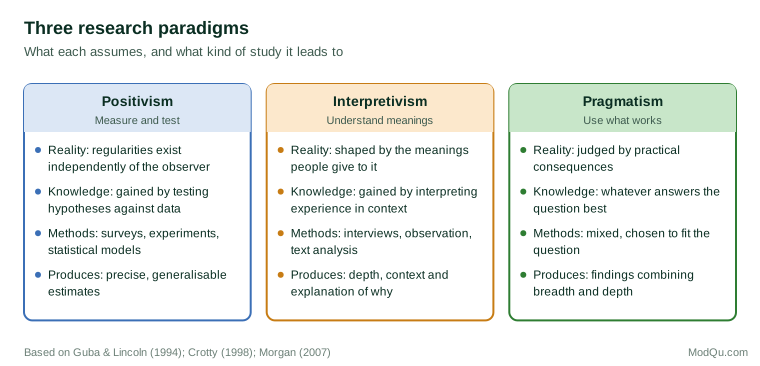
Positivism holds that the social world, like the natural world, has regularities that can be observed and measured objectively. Knowledge advances by testing hypotheses against data, and the researcher aims to stay neutral and detached. Most surveys, experiments and statistical models are designed in this tradition. In practice, many researchers now describe themselves as post-positivists: they accept that all observation is imperfect and that findings are provisional, but they still aim for objective measurement and generalisable results (Crotty, 1998).
The strength of positivist research is that it produces precise, comparable and testable findings. Its weakness is that it can miss the meanings people attach to their actions. A survey can show that customers leave a service, but it may not reveal what leaving means to them.
Interpretivism
Interpretivism holds that people act on the meanings they give to situations, so understanding social life requires grasping those meanings from the inside. Geertz (1973) called this the task of "thick description": interpreting actions within the web of significance in which they occur. Interpretivist researchers favour interviews, observation and analysis of texts, and they treat their own perspective as part of the research rather than something to be eliminated.
Orlikowski and Baroudi (1991) found that research on information systems was dominated by positivist studies and argued that interpretive work would reveal how technology is actually used in organisations. The strength of interpretivism is depth and attention to context. Its weakness is that findings are harder to generalise and to compare across studies.
Pragmatism
Pragmatism sets aside the debate over which view of reality is correct and asks instead which approach best answers the question at hand. Knowledge is judged by its practical consequences. Morgan (2007) argued that pragmatism allows researchers to move between inductive and deductive reasoning, and between subjective and objective perspectives, as a study requires. Johnson and Onwuegbuzie (2004) presented it as the natural foundation for mixed methods research, which combines numerical and textual data in one design.
Critics reply that pragmatism can become an excuse for avoiding hard questions about assumptions. Used well, though, it encourages researchers to state clearly why each method was chosen.
Other positions
These three are not the only options. Guba and Lincoln (1994) also described critical theory, which treats research as a means of exposing and challenging power, and constructivism, which they placed close to interpretivism. Critical realism, discussed in a separate ModQu article, accepts that a real world exists independently of our knowledge but holds that its causes are often unobservable and must be inferred. The labels vary between textbooks, and Crotty (1998) warns that writers often mix terms for philosophical positions with terms for methods. A survey is not positivist in itself; it becomes so when it is used on positivist assumptions.
Choosing a paradigm in applied research
For most commercial studies, the choice follows from the question. Measuring how many customers prefer a product calls for a positivist design with a representative sample. Understanding why a product fails to fit people's routines calls for an interpretive design. A study that needs both, such as interviews to discover issues followed by a survey to measure them, is pragmatic by nature. What matters is that the assumptions are stated, so that readers can judge whether the conclusions are the kind the design can support.
Consider a bank that wants to know why younger customers are closing accounts. A positivist team would define closure precisely, draw a representative sample and model which characteristics predict it. An interpretive team would interview former customers about what the account meant to them and what changed. A pragmatic team would probably do both, in sequence. Each approach produces a different kind of answer, and each is valid for its own purpose. Problems arise only when a study claims more than its paradigm allows, such as generalising from twelve interviews or explaining motives from a single survey percentage.
References
Crotty, M. (1998). The foundations of social research: Meaning and perspective in the research process. SAGE.
Geertz, C. (1973). The interpretation of cultures: Selected essays. Basic Books.
Guba, E. G., & Lincoln, Y. S. (1994). Competing paradigms in qualitative research. In N. K. Denzin & Y. S. Lincoln (Eds.), Handbook of qualitative research (pp. 105–117). SAGE.
Johnson, R. B., & Onwuegbuzie, A. J. (2004). Mixed methods research: A research paradigm whose time has come. Educational Researcher, 33(7), 14–26. https://doi.org/10.3102/0013189X033007014
Kuhn, T. S. (1962). The structure of scientific revolutions. University of Chicago Press.
Morgan, D. L. (2007). Paradigms lost and pragmatism regained: Methodological implications of combining qualitative and quantitative methods. Journal of Mixed Methods Research, 1(1), 48–76. https://doi.org/10.1177/2345678906292462
Orlikowski, W. J., & Baroudi, J. J. (1991). Studying information technology in organizations: Research approaches and assumptions. Information Systems Research, 2(1), 1–28. https://doi.org/10.1287/isre.2.1.1