
Research · Philosophy and paradigms
Thomas Kuhn, Paradigm Shifts and the Structure of Scientific Revolutions
Thomas Kuhn's account of how science changes through paradigms, normal science, crisis and revolution, the debates it provoked, and what it means for researchers and organisations today.
In 1962 a physicist turned historian named Thomas Kuhn published a short book that changed how people think about science. The Structure of Scientific Revolutions argued that science does not progress by steadily adding facts to a growing pile. Instead, long periods of stable, problem-solving research are interrupted by revolutions in which a whole framework of assumptions is replaced (Kuhn, 1962). Kuhn's term for such a framework, the paradigm, escaped into everyday language, and "paradigm shift" is now used for everything from new smartphones to management fashions. This article explains what Kuhn actually argued, why it was controversial, how the debate developed, and what his ideas offer researchers who want to understand how knowledge changes.
Before Kuhn: science as accumulation
The standard picture of science in the mid-twentieth century, shared in different forms by the logical positivists and by Karl Popper, treated science as a rational process governed by method. For the positivists, theories were confirmed by accumulating evidence. For Popper (1959), theories were bold conjectures that scientists tried to refute, and the survivors were provisionally accepted. Both pictures implied that science was cumulative and that the history of science was a story of steady progress towards truth, with errors corrected as soon as evidence revealed them.
Kuhn's training was in physics, but his reading of historical texts, particularly Aristotle's physics, convinced him that this picture was wrong. Aristotle's ideas about motion looked absurd when judged as early attempts at Newtonian physics. They made sense only when read within their own framework of concepts and questions. Kuhn concluded that scientists in different eras did not simply hold different beliefs about the same questions; they worked within different worlds of problems, methods and standards. A similar idea had been developed earlier by the Polish microbiologist Ludwik Fleck, whose 1935 study of the history of the syphilis concept described "thought collectives" with shared "thought styles" (Fleck, 1979). Kuhn acknowledged Fleck's influence in his preface.
The structure of a revolution
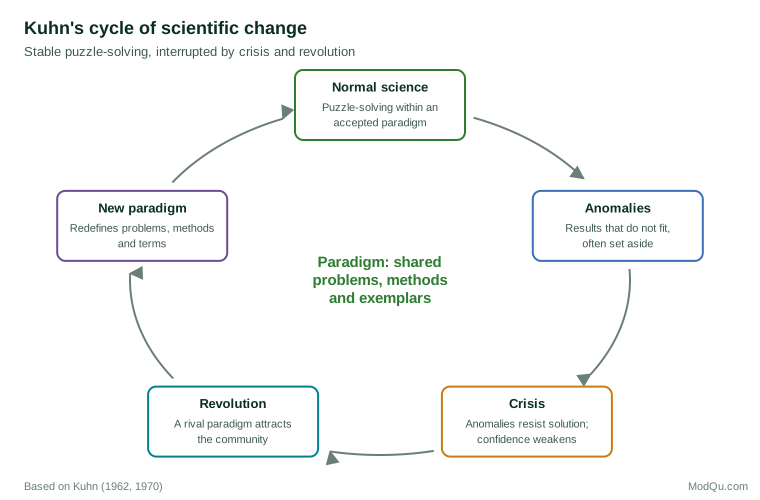
Kuhn proposed that mature sciences move through a recurring sequence of phases.
Normal science
Most of the time, scientists do what Kuhn called normal science: research firmly based on past achievements that a community accepts as the foundation for further work. The accepted framework, or paradigm, tells researchers which problems are worth solving, which methods are legitimate and what a solution should look like. Kuhn (1962) compared normal science to puzzle-solving. The puzzles are hard and require skill, but the existence of a solution is guaranteed by the paradigm, and failure reflects on the scientist rather than on the framework.
This was a provocative claim. Popper had argued that scientists should constantly try to refute their theories. Kuhn argued that, in practice, they do not, and that this is a good thing. Without commitment to a framework, scientists would spend their time debating fundamentals instead of developing the framework far enough to discover its strengths and limits.
Anomaly and crisis
Normal science inevitably throws up anomalies: results that do not fit expectations. Most are resolved with further work or set aside as problems for later. Occasionally, however, anomalies accumulate or resist solution, and confidence in the paradigm begins to weaken. Kuhn called this state crisis. Researchers start to question fundamentals, propose radical alternatives and argue about the nature of their field.
Revolution and incommensurability
A crisis ends when a new paradigm emerges that resolves the key anomalies and attracts a growing share of the community. Kuhn argued that this transition is not a simple matter of evidence settling the question. Rival paradigms differ in their concepts, their standards and even what they count as a problem. Kuhn described them as incommensurable: they cannot be compared point by point on neutral ground, because there is no neutral ground. Scientists who move from one to the other undergo something closer to a change of view, which Kuhn compared to a gestalt switch, than to a step-by-step argument.
The examples Kuhn used included the Copernican revolution in astronomy, the replacement of the phlogiston theory of combustion by Lavoisier's oxygen chemistry, and the move from Newtonian to Einsteinian physics. In each case, he argued, the new framework did not simply add to the old one; it redefined terms such as "planet", "element" or "mass".
Progress through revolutions
If paradigms are incommensurable, in what sense does science progress? Kuhn's answer, developed further in the postscript to his second edition, was that science progresses in the way biological evolution does: away from earlier states rather than towards a fixed goal (Kuhn, 1970). Later paradigms solve more puzzles, and solve them more precisely, than earlier ones. What they do not do, on Kuhn's account, is bring us steadily closer to a final truth about how the world really is.
What is a paradigm?
Kuhn's central term turned out to be slippery. Masterman (1970) analysed the first edition and identified at least 21 different senses in which the word was used, from a concrete scientific achievement to a whole world view. Kuhn accepted the criticism. In the postscript to the second edition, he distinguished two main meanings: the disciplinary matrix, meaning the whole set of shared commitments of a community, including symbolic generalisations, models and values; and exemplars, the concrete problem solutions that students learn and that teach them how to see new problems (Kuhn, 1970). Kuhn came to regard exemplars as the deeper and more original idea. Scientists learn their field less from explicit rules than from working through standard examples, which shape how they recognise similar problems later.
The controversy
Structure provoked fierce reactions, which were collected in a famous volume from a 1965 London colloquium (Lakatos & Musgrave, 1970).
Rationality and relativism
Critics argued that Kuhn had made scientific change irrational, a matter of persuasion, conversion and generational turnover rather than evidence. If paradigms are incommensurable and choices between them cannot be settled by argument, then science looked like a form of mob psychology, as Lakatos (1970) put it. Popper's followers objected that Kuhn had described bad science and called it normal.
Kuhn denied the charge. In a later essay he argued that scientists choose between theories using shared values, including accuracy, consistency, scope, simplicity and fruitfulness, but that these values do not function as an algorithm: different scientists weigh them differently, and this variation is valuable because it spreads a community's bets across alternatives (Kuhn, 1977). Theory choice is rational, on this account, without being mechanical.
Rational reconstructions
Lakatos (1970) offered his methodology of research programmes as a middle way between Popper and Kuhn, retaining standards for judging rival programmes while accepting that scientists rightly persist with theories that face anomalies. Laudan (1977) proposed that science should be judged by its problem-solving effectiveness, which allowed a more historical account of progress without Kuhn's incommensurability. Feyerabend (1975) took Kuhn's historical observations in the opposite direction, arguing that no method had governed scientific progress at all.
Later scholarship
Later historians and philosophers have refined rather than abandoned Kuhn's picture. Hoyningen-Huene (1993) produced a detailed reconstruction showing that Kuhn's views were more consistent and less relativist than many critics assumed. Bird (2000) argued that Kuhn's most lasting contribution lies in his account of how exemplars shape scientific cognition. Wray (2011) developed Kuhn's evolutionary analogy into a social account of how scientific specialties form and divide. Fuller (2000), by contrast, criticised Kuhn for encouraging an uncritical acceptance of the authority of established scientific communities.
Paradigm shifts in practice
Several episodes since 1962 illustrate parts of Kuhn's model.
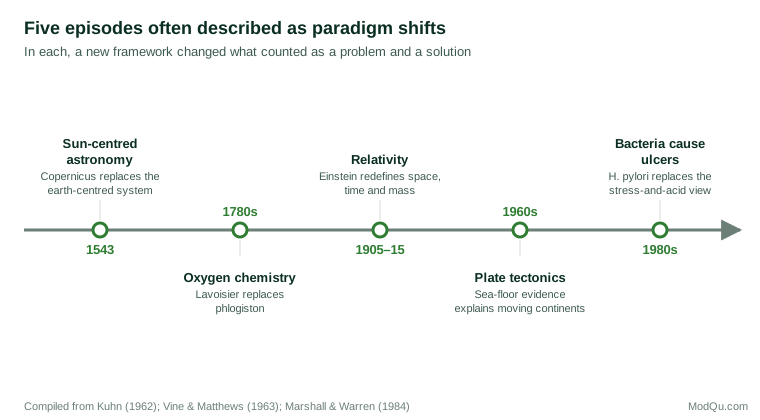
Plate tectonics. Alfred Wegener's proposal of continental drift, made in 1912, was rejected for decades because no mechanism could explain how continents moved. Evidence from the ocean floor in the 1960s, including the symmetric magnetic stripes on either side of mid-ocean ridges described by Vine and Matthews (1963), was explained by sea-floor spreading and led to the rapid acceptance of plate tectonics. Geologists who had dismissed drift came to see the same rocks in a new way.
Stomach ulcers. For most of the twentieth century, peptic ulcers were attributed to stress and stomach acid. Marshall and Warren (1984) reported curved bacteria in the stomachs of patients with gastritis and ulcers. The claim was met with scepticism, partly because it contradicted the established view that bacteria could not survive in the stomach. Within about a decade, Helicobacter pylori was accepted as the main cause, and treatment shifted to antibiotics.
Behavioural economics. Standard economic theory assumed that people make consistent choices to maximise expected utility. Kahneman and Tversky (1979) documented systematic departures from that assumption and proposed prospect theory to describe them. Thaler (2016) has described how behavioural ideas moved from the margins to the mainstream of economics over the following decades, though whether this amounts to a new paradigm or an extension of the old one is still debated.
Kuhn's model also predicts resistance from established researchers. Azoulay et al. (2019) tested a version of Max Planck's remark that science advances one funeral at a time. They found that after the unexpected death of an eminent scientist, the number of articles by outsiders to that scientist's subfield rose, and those articles were disproportionately likely to be highly cited, suggesting that the presence of leading figures can discourage challenges to their ideas.
Do the social sciences have paradigms?
Kuhn wrote in his preface that the idea of paradigms came to him during a year spent among social scientists, where he was struck by how much more they disagreed about the legitimate problems and methods of their fields than natural scientists did (Kuhn, 1962). He suggested that many social sciences might still be in a pre-paradigm state, in which competing schools coexist and no single framework commands the whole community.
Social scientists have taken this suggestion in different directions. Ritzer (1975) argued that sociology is a multiple-paradigm science, in which several frameworks, centred respectively on social facts, social definitions and social behaviour, coexist permanently rather than awaiting a revolution. Pfeffer (1993) argued that organisational science pays a real price for its lack of paradigm consensus: fields with more agreement about questions and methods attract more resources, train students more efficiently and build knowledge more cumulatively. His argument provoked replies from scholars who saw diversity of approaches as a strength rather than a weakness, a debate that continues in many applied disciplines.
For applied research, including market and social research, this debate has a practical side. A field without a dominant paradigm offers more freedom to choose methods to suit the question, but it also makes findings harder to compare and accumulate. Two studies of customer loyalty conducted within different frameworks may not even agree on what loyalty is. Recognising this is the first step towards designing studies whose results can be combined.
How a new paradigm wins
Kuhn's account of how scientists come to accept a new paradigm is often caricatured as irrational conversion. His actual description is more nuanced. Early adherents of a new framework are typically drawn by its ability to solve the particular anomalies that caused the crisis. Others are persuaded as the new framework produces successful predictions that the old one could not, particularly unexpected ones. Some are attracted by its aesthetic qualities, such as simplicity or elegance, before the evidence is decisive. And a minority never convert, so that full acceptance comes as a new generation trained in the new framework replaces the old one (Kuhn, 1970).
What makes this process rational, on Kuhn's later account, is that the values used to judge theories are shared across the community even when their application differs (Kuhn, 1977). A field in which every researcher applied exactly the same weights would never explore promising alternatives; a field in which researchers shared no values at all could never converge. The distribution of judgement across many people allows a community to take risks without abandoning its standards.
Paradigms outside science
The concept has been borrowed widely. Dosi (1982) introduced the idea of technological paradigms: shared models of which technical problems to solve and how, which guide innovation along particular trajectories until a discontinuity opens a new path. Christensen (1997) described how established firms can fail when a disruptive technology changes the basis of competition, because their customers, metrics and processes are built around the old one. Both accounts echo Kuhn's insight that frameworks shape what organisations can see.
Kuhn himself was uneasy about the looser uses of his term, and critics warn that calling every change a paradigm shift empties the concept of meaning. A useful test is whether the change alters what counts as a problem and a solution, not merely which answer is preferred.
Lessons for researchers
Kuhn's account offers several practical lessons.
Know your paradigm. Every field, and every research team, works with assumptions that define good questions and acceptable methods. Making them explicit helps researchers notice when they are limiting what can be found. A market research team that always measures satisfaction on the same scale, in the same way, may be practising efficient normal science, or may be failing to see that the scale no longer captures what matters to customers.
Take anomalies seriously. Results that do not fit should be recorded rather than discarded. Most anomalies will turn out to be errors or noise, but a pattern of unexplained results is often the first sign that a model needs revising.
Expect resistance to new frameworks. New ideas that challenge established assumptions are often judged by the standards of the framework they challenge, and they are likely to look weak by those standards at first. Marshall and Warren's work was initially dismissed for this reason.
Value both stability and challenge. Kuhn's most useful insight may be his account of the "essential tension" between tradition and innovation (Kuhn, 1977). Productive research needs enough shared commitment to make steady progress and enough openness to recognise when the commitments need changing.
Conclusion
Kuhn replaced the image of science as a steady accumulation of facts with a picture of stable frameworks punctuated by revolutions. Critics rightly pressed him on rationality, relativism and the meaning of his central term, and he refined his account in response. Yet the core of his work has endured: scientific communities share frameworks that shape what they see, normal science is productive precisely because it does not question everything, anomalies are the seeds of change, and changes of framework involve more than weighing evidence. For anyone who produces or uses research, the lesson is to understand the paradigm one is working in, because it determines not only the answers one finds but the questions one thinks to ask.
References
Azoulay, P., Fons-Rosen, C., & Graff Zivin, J. S. (2019). Does science advance one funeral at a time? American Economic Review, 109(8), 2889–2920. https://doi.org/10.1257/aer.20161574
Bird, A. (2000). Thomas Kuhn. Princeton University Press.
Christensen, C. M. (1997). The innovator's dilemma: When new technologies cause great firms to fail. Harvard Business School Press.
Dosi, G. (1982). Technological paradigms and technological trajectories: A suggested interpretation of the determinants and directions of technical change. Research Policy, 11(3), 147–162. https://doi.org/10.1016/0048-7333(82)90016-6
Feyerabend, P. (1975). Against method: Outline of an anarchistic theory of knowledge. New Left Books.
Fleck, L. (1979). Genesis and development of a scientific fact (F. Bradley & T. J. Trenn, Trans.). University of Chicago Press. (Original work published 1935)
Fuller, S. (2000). Thomas Kuhn: A philosophical history for our times. University of Chicago Press.
Hoyningen-Huene, P. (1993). Reconstructing scientific revolutions: Thomas S. Kuhn's philosophy of science. University of Chicago Press.
Kahneman, D., & Tversky, A. (1979). Prospect theory: An analysis of decision under risk. Econometrica, 47(2), 263–291. https://doi.org/10.2307/1914185
Kuhn, T. S. (1962). The structure of scientific revolutions. University of Chicago Press.
Kuhn, T. S. (1970). The structure of scientific revolutions (2nd ed.). University of Chicago Press.
Kuhn, T. S. (1977). The essential tension: Selected studies in scientific tradition and change. University of Chicago Press.
Lakatos, I. (1970). Falsification and the methodology of scientific research programmes. In I. Lakatos & A. Musgrave (Eds.), Criticism and the growth of knowledge (pp. 91–196). Cambridge University Press.
Lakatos, I., & Musgrave, A. (Eds.). (1970). Criticism and the growth of knowledge. Cambridge University Press.
Laudan, L. (1977). Progress and its problems: Towards a theory of scientific growth. University of California Press.
Marshall, B. J., & Warren, J. R. (1984). Unidentified curved bacilli in the stomach of patients with gastritis and peptic ulceration. The Lancet, 323(8390), 1311–1315. https://doi.org/10.1016/S0140-6736(84)91816-6
Masterman, M. (1970). The nature of a paradigm. In I. Lakatos & A. Musgrave (Eds.), Criticism and the growth of knowledge (pp. 59–89). Cambridge University Press.
Pfeffer, J. (1993). Barriers to the advance of organizational science: Paradigm development as a dependent variable. Academy of Management Review, 18(4), 599–620. https://doi.org/10.5465/amr.1993.9402210152
Popper, K. R. (1959). The logic of scientific discovery. Hutchinson.
Ritzer, G. (1975). Sociology: A multiple paradigm science. Allyn and Bacon.
Thaler, R. H. (2016). Behavioral economics: Past, present, and future. American Economic Review, 106(7), 1577–1600. https://doi.org/10.1257/aer.106.7.1577
Vine, F. J., & Matthews, D. H. (1963). Magnetic anomalies over oceanic ridges. Nature, 199(4897), 947–949. https://doi.org/10.1038/199947a0
Wray, K. B. (2011). Kuhn's evolutionary social epistemology. Cambridge University Press.