
Research · Philosophy and paradigms
Basic Versus Applied Research: How Knowledge Moves Into Practice
The difference between basic and applied research, why the simple split between them has been questioned, and how knowledge actually moves from discovery into practical use.
Research is often sorted into two kinds. Basic research seeks understanding for its own sake, without a particular use in view. Applied research sets out to solve a practical problem or meet a specific need. The distinction shapes how governments fund science, how universities and companies organise their work, and how research is judged. Yet the history of discovery shows that the two kinds are more tightly connected than the labels suggest, and that the most valuable work often belongs to both at once.
Where the distinction came from
The modern form of the distinction owes much to Vannevar Bush, who directed American wartime research. His 1945 report to the president, Science, the Endless Frontier, described basic research as work carried out without thought of practical ends, and argued that it was the "pacemaker" of technological progress (Bush, 1945). New products and processes, Bush wrote, rest on new principles and conceptions, which come only from the study of nature for its own sake. His report helped justify large public investment in basic science after the war.
The OECD's Frascati Manual, used by governments to measure research spending, formalises a three-way split: basic research, undertaken mainly to acquire new knowledge without any particular application in view; applied research, directed primarily towards a specific practical aim; and experimental development, which uses existing knowledge to produce new products or processes (OECD, 2015). This sequence is often read as a pipeline, the "linear model" of innovation, in which knowledge flows from basic research through applied research to development and production.
Pasteur's quadrant
Stokes (1997) argued that the linear model misdescribes how much important research actually works. He pointed out that research can be motivated by a quest for fundamental understanding, by considerations of use, or by both. Plotting these two motives against each other gives four quadrants.
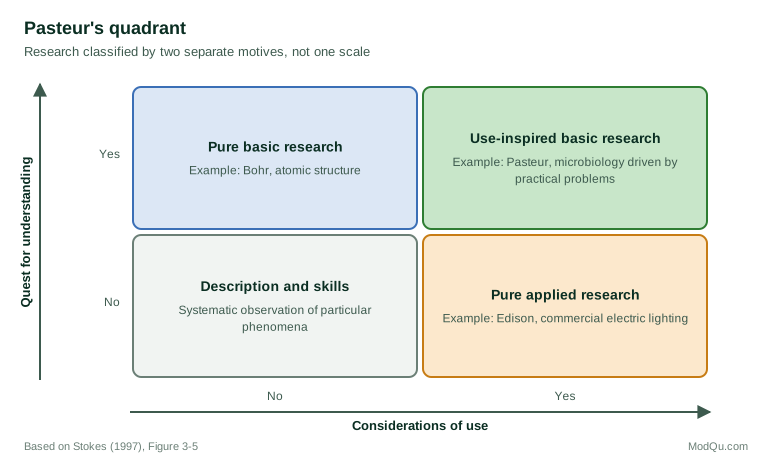
The physicist Niels Bohr, seeking to understand atomic structure, exemplifies pure basic research. The inventor Thomas Edison, who was interested in what worked commercially rather than in the science behind it, exemplifies pure applied research. Louis Pasteur occupies the quadrant that Bush's scheme left out: his work on fermentation and disease was driven by practical problems in the wine, silk and medical industries, yet it produced fundamental advances in microbiology. Stokes called this use-inspired basic research and argued that policy should recognise and fund it deliberately rather than forcing all research into one of two boxes.
How knowledge moves into practice
Empirical studies support a more interactive picture than the linear model. Mansfield (1991) surveyed major American firms and estimated that a meaningful share of their new products and processes could not have been developed, at least not without substantial delay, without recent academic research. Narin et al. (1997) found that patents increasingly cited scientific papers, much of it publicly funded research, suggesting a growing link between technology and public science.
Salter and Martin (2001) reviewed the evidence on the economic benefits of publicly funded basic research. They concluded that the benefits are substantial but come through several channels, not only through new discoveries. Basic research also trains skilled graduates, develops instruments and methods, builds networks of experts, and increases the capacity of firms and governments to use knowledge produced elsewhere. Many of these benefits are indirect and slow, which makes them hard to measure but no less real.
Gibbons et al. (1994) went further, arguing that a new mode of knowledge production had emerged alongside traditional disciplinary science. In this "Mode 2", knowledge is produced in the context of application, by teams that cross disciplines and institutions, and is judged by its usefulness as well as its scientific quality. Not everyone accepts that this mode is new, but the description fits much contemporary research in health, technology and business.
Implications for applied researchers
For commercial and social researchers, the lesson is that the boundary between understanding and use is porous in both directions. Applied studies, such as surveys of customer behaviour, often generate findings of general interest about how people make decisions. Basic findings, such as research on memory or social influence, often transform practical methods, from questionnaire design to advertising testing. Organisations that confine themselves strictly to immediate practical questions may miss the deeper understanding that would make their applied work more effective.
Stokes's framework also offers a practical test for research proposals. Asking both "what will this help us understand?" and "what will this help us do?" tends to produce better-designed studies than asking either question alone.
References
Bush, V. (1945). Science, the endless frontier: A report to the President. United States Government Printing Office.
Gibbons, M., Limoges, C., Nowotny, H., Schwartzman, S., Scott, P., & Trow, M. (1994). The new production of knowledge: The dynamics of science and research in contemporary societies. SAGE.
Mansfield, E. (1991). Academic research and industrial innovation. Research Policy, 20(1), 1–12. https://doi.org/10.1016/0048-7333(91)90080-A
Narin, F., Hamilton, K. S., & Olivastro, D. (1997). The increasing linkage between U.S. technology and public science. Research Policy, 26(3), 317–330. https://doi.org/10.1016/S0048-7333(97)00013-9
OECD. (2015). Frascati manual 2015: Guidelines for collecting and reporting data on research and experimental development. OECD Publishing. https://doi.org/10.1787/9789264239012-en
Salter, A. J., & Martin, B. R. (2001). The economic benefits of publicly funded basic research: A critical review. Research Policy, 30(3), 509–532. https://doi.org/10.1016/S0048-7333(00)00091-3
Stokes, D. E. (1997). Pasteur's quadrant: Basic science and technological innovation. Brookings Institution Press.