
Research · Philosophy and paradigms
What Is Research? Definitions, Purposes and Standards
What separates research from simply looking things up, the main purposes research serves, and the standards that make its findings worth trusting.
The word "research" is used loosely. A shopper comparing prices online says they are doing research, and so does a team running a ten-year clinical trial. Both activities involve seeking information, but only one of them is designed to produce knowledge that others can rely on. This article sets out how research is defined in formal guidance, what purposes it serves, and the standards that distinguish trustworthy research from casual inquiry. Those standards matter to anyone who commissions, conducts or uses research, including businesses deciding whether to act on a survey or a market study.
Defining research
The most widely used formal definition comes from the OECD's Frascati Manual, which governments use to measure research and development spending. It defines research and experimental development as creative and systematic work undertaken to increase the stock of knowledge, including knowledge of people, culture and society, and to devise new applications of available knowledge (OECD, 2015). The manual adds five criteria that an activity must meet to count: it must be novel, creative, uncertain in its outcome, systematic, and transferable or reproducible.
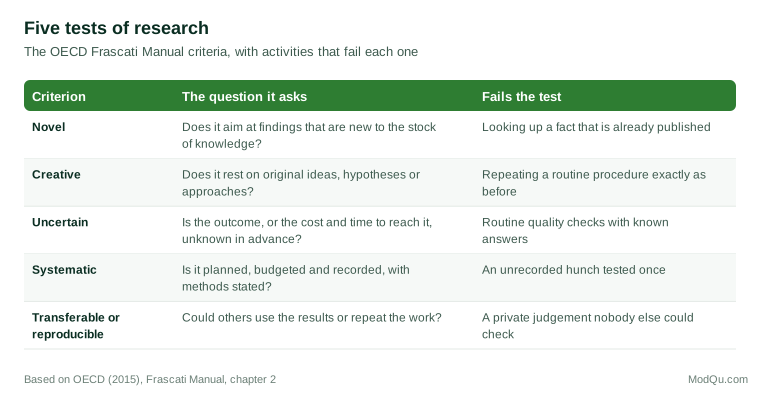
These criteria exclude a good deal of activity that is often called research. Looking up an existing fact is not novel. Routine quality testing is not uncertain. A one-off judgement that nobody else could check is not reproducible. The criteria are written for statistical purposes, but they capture something important: research is an organised attempt to find out something that is not yet known, carried out in a way that others can examine.
Methods textbooks make a similar point in different words. Creswell and Creswell (2018) describe research as a process of posing a question, collecting data to answer it, and presenting an answer, all within an explicit framework of assumptions and procedures. The emphasis on an explicit framework is what separates research from opinion. When the procedure is visible, a reader can judge whether the answer follows from the evidence.
Research and its neighbours
Several activities sit close to research and borrow its tools without sharing all of its aims. Journalism gathers evidence and checks facts, but it usually reports on particular events rather than seeking general knowledge, and it rarely sets out its methods in a form others could repeat. Consulting applies expertise to a client's problem, often drawing on research, but its outputs are recommendations rather than tested findings. Business analytics and monitoring track known measures over time; they become research when they set out to answer a question whose answer is genuinely unknown and use a design capable of answering it. None of these boundaries is a criticism. They simply mark the point at which a reader is entitled to ask for evidence about the method as well as the conclusion. A market study that reports where its sample came from, how its questions were worded and how its estimates were calculated has crossed that line; one that reports only its conclusions has not.
The purposes of research
Research is undertaken for several distinct purposes, and much confusion arises when they are mixed up.
Exploration aims to understand a poorly known topic, generate ideas or identify the right questions to ask. Description aims to measure what exists: how many people hold a view, how often an event occurs, how a process works. Explanation aims to establish why something happens, which usually requires evidence about causes. Prediction and evaluation apply research to practical decisions, such as estimating future demand or judging whether a programme achieved its aims.
A second distinction concerns why the knowledge is sought. Vannevar Bush's influential report to the United States president separated basic research, carried out without thought of practical ends, from applied research aimed at specific uses (Bush, 1945). Stokes (1997) later argued that this division is too simple, because much of the most productive science, such as Louis Pasteur's work on microbiology, was driven both by a quest for understanding and by practical problems. Boyer (1990) made a related argument about universities, proposing that the scholarship of discovery should sit alongside the scholarships of integration, application and teaching rather than above them.
For applied researchers, including commercial ones, the lesson is that the purpose shapes the design. A descriptive survey needs a representative sample; an explanatory study needs a design that can rule out alternative causes; an exploratory study needs flexibility and depth. A study designed for one purpose rarely answers questions of another kind well.
Standards: what makes research trustworthy
If research is a systematic attempt to produce knowledge that others can rely on, then its quality depends on whether others have good reason to rely on it. Several standards have developed to give them that reason.
Systematic and transparent method
The method must be planned and reported in enough detail for others to evaluate it and, in principle, repeat it. Popper (1959) argued that scientific statements must be open to testing by others; a claim that cannot be checked cannot be corrected. Modern open-science guidelines put this into practice by asking researchers to share data, materials and analysis code where they can (Nosek et al., 2015), and by making data findable, accessible, interoperable and reusable (Wilkinson et al., 2016).
Validity and reliability
Quantitative research is judged largely on validity, meaning whether a study measures and concludes what it claims to, and reliability, meaning whether its measurements are consistent. Shadish et al. (2002) divide validity into types that correspond to different questions: whether a relationship is real, whether it is causal, whether the measures represent the intended concepts, and whether results generalise. Qualitative researchers use parallel criteria. Lincoln and Guba (1985) proposed credibility, transferability, dependability and confirmability, and Tracy (2010) set out eight broader markers of quality, including rich rigour, sincerity and meaningful coherence.
Scepticism and peer scrutiny
Merton (1973) described the norms of science as communalism, universalism, disinterestedness and organised scepticism. The last of these means that claims are not accepted on authority but are examined by others before they are trusted. Peer review, replication and open criticism are the mechanisms that put organised scepticism into practice. Kuhn (1962) showed that scientific communities do not always live up to this ideal, since shared assumptions can resist challenge for long periods, but the ideal remains the reference point against which practice is judged.
Integrity
Research must also be honest. Steneck (2006) defines responsible conduct as the practice of research in ways that meet professional standards, and distinguishes outright misconduct (fabrication, falsification and plagiarism) from a much larger grey zone of questionable practices, such as selective reporting. Integrity standards also cover the treatment of participants, conflicts of interest and the accurate reporting of limitations.
When standards slip
The importance of these standards became clearer when they were found to be weaker than assumed. Ioannidis (2005) argued that small studies, small effects and flexible analysis mean that many published findings in some fields are likely to be false. When the Open Science Collaboration (2015) repeated 100 published psychology experiments, far fewer of the repeat studies produced significant results than the originals, and the effects they found were on average about half as large. Munafò et al. (2017) responded with a set of reforms covering methods, reporting, reproducibility, evaluation and incentives.
These findings do not show that research is unreliable in general. They show that research is only as reliable as the standards applied to it, and that standards need to be enforced rather than assumed.
What this means for users of research
For a business reading a research report, these definitions translate into practical questions:
- Is the question clearly stated, and was the study designed to answer that kind of question?
- Is the method described in enough detail to judge, including how participants or data were selected?
- Are the measures valid for the concepts the report claims to measure?
- Were the analysis and conclusions planned in advance, or chosen after looking at the data?
- Are the limitations stated honestly, and are the conclusions proportionate to the evidence?
- Could someone else check or repeat the work?
A report that cannot answer these questions may still be interesting, but it is closer to opinion than to research. The value of research lies not in the label but in the discipline of the process behind it: a systematic, transparent and honest attempt to find out something new, open to checking by others.
References
Boyer, E. L. (1990). Scholarship reconsidered: Priorities of the professoriate. Carnegie Foundation for the Advancement of Teaching.
Bush, V. (1945). Science, the endless frontier: A report to the President. United States Government Printing Office.
Creswell, J. W., & Creswell, J. D. (2018). Research design: Qualitative, quantitative, and mixed methods approaches (5th ed.). SAGE.
Ioannidis, J. P. A. (2005). Why most published research findings are false. PLoS Medicine, 2(8), Article e124. https://doi.org/10.1371/journal.pmed.0020124
Kuhn, T. S. (1962). The structure of scientific revolutions. University of Chicago Press.
Lincoln, Y. S., & Guba, E. G. (1985). Naturalistic inquiry. SAGE.
Merton, R. K. (1973). The sociology of science: Theoretical and empirical investigations. University of Chicago Press.
Munafò, M. R., Nosek, B. A., Bishop, D. V. M., Button, K. S., Chambers, C. D., Percie du Sert, N., Simonsohn, U., Wagenmakers, E.-J., Ware, J. J., & Ioannidis, J. P. A. (2017). A manifesto for reproducible science. Nature Human Behaviour, 1, Article 0021. https://doi.org/10.1038/s41562-016-0021
Nosek, B. A., Alter, G., Banks, G. C., Borsboom, D., Bowman, S. D., Breckler, S. J., Buck, S., Chambers, C. D., Chin, G., Christensen, G., Contestabile, M., Dafoe, A., Eich, E., Freese, J., Glennerster, R., Goroff, D., Green, D. P., Hesse, B., Humphreys, M., … Yarkoni, T. (2015). Promoting an open research culture. Science, 348(6242), 1422–1425. https://doi.org/10.1126/science.aab2374
OECD. (2015). Frascati manual 2015: Guidelines for collecting and reporting data on research and experimental development. OECD Publishing. https://doi.org/10.1787/9789264239012-en
Open Science Collaboration. (2015). Estimating the reproducibility of psychological science. Science, 349(6251), Article aac4716. https://doi.org/10.1126/science.aac4716
Popper, K. R. (1959). The logic of scientific discovery. Hutchinson.
Shadish, W. R., Cook, T. D., & Campbell, D. T. (2002). Experimental and quasi-experimental designs for generalized causal inference. Houghton Mifflin.
Steneck, N. H. (2006). Fostering integrity in research: Definitions, current knowledge, and future directions. Science and Engineering Ethics, 12(1), 53–74. https://doi.org/10.1007/PL00022268
Stokes, D. E. (1997). Pasteur's quadrant: Basic science and technological innovation. Brookings Institution Press.
Tracy, S. J. (2010). Qualitative quality: Eight "big-tent" criteria for excellent qualitative research. Qualitative Inquiry, 16(10), 837–851. https://doi.org/10.1177/1077800410383121
Wilkinson, M. D., Dumontier, M., Aalbersberg, I. J., Appleton, G., Axton, M., Baak, A., Blomberg, N., Boiten, J.-W., da Silva Santos, L. B., Bourne, P. E., Bouwman, J., Brookes, A. J., Clark, T., Crosas, M., Dillo, I., Dumon, O., Edmunds, S., Evelo, C. T., Finkers, R., … Mons, B. (2016). The FAIR Guiding Principles for scientific data management and stewardship. Scientific Data, 3, Article 160018. https://doi.org/10.1038/sdata.2016.18