
Research · Philosophy and paradigms
Ontology and Epistemology for Applied Researchers
A practical guide to ontology and epistemology: what the terms mean, the main positions researchers take, and how these assumptions shape the design and interpretation of applied studies.
Ontology and epistemology sound like topics for philosophy seminars, and many applied researchers are content to leave them there. Yet every study makes assumptions about both, whether or not they are stated. A brand tracker assumes that "brand awareness" is something real enough to be measured. A set of customer interviews assumes that people can describe their experiences in ways a researcher can understand. When these assumptions are left unexamined, studies can be designed in ways that cannot answer their own questions, and their findings can be read as claiming more than they do. This article explains the two terms, sets out the main positions, and shows how they affect practical decisions about design, measurement and interpretation.
Two questions behind every study
Ontology is the study of what exists. For researchers, the ontological question is: what is the nature of the thing I am studying? Is customer satisfaction a real property of a person's mind, waiting to be measured, or is it a label that people construct when asked about their experience? Is an organisation's culture a structure that shapes behaviour, or a pattern of shared meanings that exists only as people enact it?
Epistemology is the study of knowledge: what it is, how it is gained, and how we can tell justified belief from mere opinion. The epistemological question for researchers is: how can I know about the thing I am studying, and what would count as good evidence? Philosophers have long defined knowledge as justified true belief, although Gettier (1963) showed with simple counter-examples that a belief can be justified and true by luck, which suggests that the relationship between evidence and truth needs careful handling. For researchers, the practical issue is less a definition than a standard: what level and kind of evidence are needed before a claim can be treated as known?
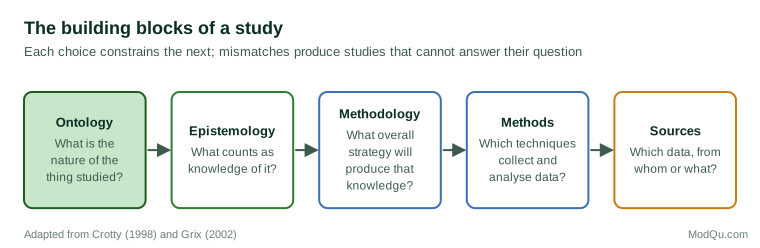
The two questions are linked. If the thing being studied exists independently of anyone's perception of it, then the main task is to observe it without distortion. If it is constructed through people's interpretations, then the task is to understand those interpretations. Crotty (1998) set out a widely used hierarchy in which epistemology informs a theoretical perspective, which informs a methodology, which in turn guides the choice of specific methods. Grix (2002) added ontology at the base, describing these as the building blocks of research and arguing that researchers who skip them often end up with designs whose parts do not fit together.
Ontological positions
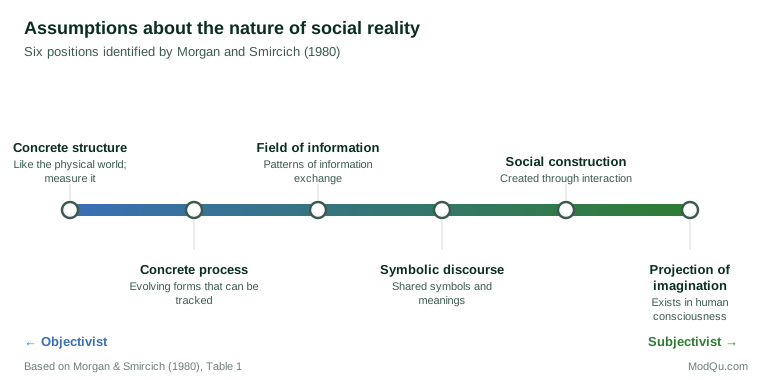
Ontological positions are often described as lying along a continuum. Morgan and Smircich (1980) set out six points on such a continuum, from the view that reality is a concrete structure, like the physical world, to the view that it is a projection of human imagination.
Objectivism and realism
At one end, objectivism holds that social phenomena exist independently of the people who study them. Markets, institutions and social classes are treated as real structures with properties that can be measured, much as a physicist measures temperature. Burrell and Morgan (1979) described this as the "realist" pole of social science, associated with the search for regularities and causal laws.
Constructionism
At the other end, constructionism holds that social reality is produced and reproduced through human interaction and interpretation. Berger and Luckmann (1966) argued that institutions which appear solid and natural, such as marriage or money, are human products that have become taken for granted. Searle (1995) offered a more precise account: some facts, such as the fact that a piece of paper is a banknote, exist only because people collectively accept them, yet they are still objective in the sense that an individual cannot wish them away. Hacking (1999) cautioned that the phrase "socially constructed" is often used carelessly, and asked researchers to say exactly what is being constructed: the idea of a thing, the thing itself, or the way it is classified.
Critical realism
Between these poles sits critical realism, developed from the work of Bhaskar (1975). It holds that a real world exists independently of our knowledge, but that our knowledge of it is always fallible and shaped by our concepts. Reality is divided into layers: the real (underlying structures and causal powers), the actual (events that occur), and the empirical (what we observe). Because causal mechanisms may operate without producing observable regularities, critical realists argue that research should aim to explain mechanisms rather than simply record patterns. Maxwell (2012) showed how this position supports qualitative research that seeks causal explanation, and Tsang (2014) used it to defend the generalisation of findings from case studies.
Epistemological positions
Epistemological positions map loosely onto the ontological ones.
Positivism holds that knowledge comes from observation and measurement, and that the methods of the natural sciences can be applied to social life. Valid knowledge consists of claims that can be tested against evidence. Popper (1959) refined this by arguing that scientific claims can never be proved, only tested and potentially refuted, so that knowledge is always provisional.
Interpretivism holds that studying people differs from studying objects because people act on meanings. Knowledge comes from understanding those meanings in context, which requires the researcher to engage with participants rather than stand apart from them. Lincoln and Guba (1985) argued that this calls for different standards of quality, such as credibility and transferability, in place of internal and external validity.
Pragmatism judges knowledge by its consequences: a claim is worth holding if it helps solve problems. Morgan (2007) presented pragmatism as a way of escaping sterile debates between the other positions, and Johnson and Onwuegbuzie (2004) used it as the basis for mixed methods research.
Kuhn (1962) added a historical dimension to these debates by showing that scientific communities work within shared frameworks that define legitimate problems and methods. What counts as knowledge, on this view, depends partly on the community doing the judging. Chalmers (2013) provides an accessible guide to how these arguments developed and where they leave the idea of scientific method.
Why this matters in applied research
It is possible to run a competent survey without ever using the word "ontology". The assumptions still matter, for at least four reasons.
Measurement
Every measure assumes something about the thing measured. Borsboom et al. (2004) argued that a test is valid only if the attribute it measures exists and if variation in that attribute causes variation in the test scores. This is an ontological claim. If "brand love" or "employee engagement" is not a real attribute but a convenient summary of many different feelings, then a single scale may be measuring different things in different people. Researchers who take this seriously test whether their measures behave as a single construct would, rather than assuming it.
Choice of method
The assumptions shape which methods make sense. If a team believes that customer needs exist as stable preferences, it will choose structured questions and choice experiments. If it believes needs are formed in particular situations and conversations, it will choose observation and in-depth interviews. Neither is wrong, but each produces a different kind of knowledge. Morgan and Smircich (1980) argued that much poor research arises from using methods whose assumptions do not match the nature of the topic. Cunliffe (2011), revisiting their work three decades later, found the argument still relevant and proposed a revised map of the positions researchers take.
Interpretation and generalisation
The assumptions also affect what can be concluded. A finding from a representative survey can be generalised statistically to the population sampled. A finding from interpretive interviews cannot, but it may be transferable to similar settings if the context is described richly enough for readers to judge (Lincoln & Guba, 1985). A critical realist case study may generalise by identifying a mechanism that operates elsewhere, even if the outcomes differ (Tsang, 2014). Confusing these forms of generalisation leads to over-claiming, such as presenting interview themes as if they were population percentages.
The role of the researcher
Finally, the assumptions shape how researchers see their own influence. In a positivist frame, researcher influence is a source of bias to be minimised through standardisation. In an interpretive frame, it is unavoidable and must be reflected upon and reported. Polanyi (1966) argued that all knowledge rests partly on tacit understanding that the knower cannot fully state, which suggests that even the most standardised research depends on judgements that should be made visible.
A worked example: three ways to study loyalty
Suppose a retailer wants to understand customer loyalty. The way the study is designed depends on what loyalty is assumed to be.
A team working from an objectivist and positivist position treats loyalty as a measurable attribute of each customer. It defines loyalty in terms of repeat purchase and stated intention, builds a validated scale, draws a probability sample, and models which factors predict higher scores. Its findings take the form of estimates: for example, that loyalty scores are higher among customers who use the retailer's app, after controlling for age and income. The strength of this approach is precision and comparability over time. Its risk is that the scale captures a single number that may combine very different experiences, from genuine attachment to simple habit or lack of alternatives.
A team working from a constructionist and interpretive position treats loyalty as a meaning that customers create and negotiate. It interviews customers about their relationship with the retailer, perhaps observing them shopping, and analyses the language they use. Its findings take the form of themes: some customers describe loyalty as trust, others as convenience, and others reject the word altogether while continuing to shop. The strength of this approach is that it reveals what the number in the first study might be hiding. Its risk is that the themes cannot show how common each view is.
A team working from a critical realist position asks what mechanisms generate loyal behaviour and under what conditions they operate. It might combine purchase records, which show what customers actually do, with interviews that probe why, and look for mechanisms such as switching costs, habit formation or social identity. Its findings take the form of explanations: habit sustains repeat purchase among busy customers until a disruption, such as a store closure, breaks the routine. Such explanations can guide action even when they do not produce a single headline figure.
None of these studies is the correct one. Each answers a different question, and a business that understands the difference can commission the one it needs or combine them deliberately.
Common mistakes
Several recurring errors arise from leaving assumptions unexamined.
The first is reification: treating a construct as if it were a physical object simply because it has been given a name and a score. An index of "customer centricity" may be useful, but it does not follow that organisations possess a single quantity of customer centricity. Borsboom et al. (2004) argue that this question should be tested, not assumed.
The second is method-driven framing, where the method is chosen first and the question is reshaped to fit it. A business that always runs surveys will tend to define its problems as questions of measurement, even when the real problem is one of understanding.
The third is inconsistent claims, where a study gathers data on interpretive assumptions but reports the findings in the language of measurement, for example by turning the number of interviewees who mentioned a theme into a percentage. Lincoln and Guba (1985) warned that each paradigm needs its own criteria of quality; borrowing the vocabulary of another paradigm does not borrow its warrant.
The fourth is ignoring the researcher. When the researcher's role is invisible, readers cannot judge how the questions asked, the people chosen or the interpretations offered might have shaped the findings.
A practical approach
Few applied researchers need to commit permanently to a single philosophical position. Johnson and Duberley (2000) suggest instead that researchers practise "reflexivity" about their assumptions: recognising them, stating them and considering how they shape the findings. Hammersley (1992) proposed a "subtle realism" that accepts an independent reality while acknowledging that all knowledge of it is shaped by the researcher's perspective, a position close to what many practising researchers assume without naming it.
In practice, this means asking four questions at the start of a study:
- What kind of thing is the topic of the study: a measurable attribute, a shared meaning, a causal mechanism, or a mixture?
- What kind of evidence would show that a claim about it is justified?
- Which methods can produce that evidence?
- What kind of generalisation will the findings support, and how will that be communicated?
Guba and Lincoln (1994) argued that questions of paradigm come before questions of method. In applied work, the order is often reversed: a client asks for a survey or a set of focus groups, and the assumptions are inherited with the method. Asking the four questions early protects against that, and makes it more likely that the study can answer the question it was commissioned to answer.
Conclusion
Ontology asks what exists; epistemology asks how we can know it. Researchers who state their answers make it easier for others to judge their work, and easier for themselves to choose methods that fit their questions. The positions are not a menu of philosophical loyalties but a set of tools for thinking clearly about what a study can and cannot show. For a commissioning business, the payoff is practical: findings that are claimed at the right strength, measured with instruments that fit the topic, and generalised only as far as the design allows.
References
Berger, P. L., & Luckmann, T. (1966). The social construction of reality: A treatise in the sociology of knowledge. Doubleday.
Bhaskar, R. (1975). A realist theory of science. Leeds Books.
Borsboom, D., Mellenbergh, G. J., & van Heerden, J. (2004). The concept of validity. Psychological Review, 111(4), 1061–1071. https://doi.org/10.1037/0033-295X.111.4.1061
Burrell, G., & Morgan, G. (1979). Sociological paradigms and organisational analysis. Heinemann.
Chalmers, A. F. (2013). What is this thing called science? (4th ed.). Hackett.
Crotty, M. (1998). The foundations of social research: Meaning and perspective in the research process. SAGE.
Cunliffe, A. L. (2011). Crafting qualitative research: Morgan and Smircich 30 years on. Organizational Research Methods, 14(4), 647–673. https://doi.org/10.1177/1094428110373658
Gettier, E. L. (1963). Is justified true belief knowledge? Analysis, 23(6), 121–123. https://doi.org/10.1093/analys/23.6.121
Grix, J. (2002). Introducing students to the generic terminology of social research. Politics, 22(3), 175–186. https://doi.org/10.1111/1467-9256.00173
Guba, E. G., & Lincoln, Y. S. (1994). Competing paradigms in qualitative research. In N. K. Denzin & Y. S. Lincoln (Eds.), Handbook of qualitative research (pp. 105–117). SAGE.
Hacking, I. (1999). The social construction of what? Harvard University Press.
Hammersley, M. (1992). What's wrong with ethnography? Methodological explorations. Routledge.
Johnson, P., & Duberley, J. (2000). Understanding management research: An introduction to epistemology. SAGE.
Johnson, R. B., & Onwuegbuzie, A. J. (2004). Mixed methods research: A research paradigm whose time has come. Educational Researcher, 33(7), 14–26. https://doi.org/10.3102/0013189X033007014
Kuhn, T. S. (1962). The structure of scientific revolutions. University of Chicago Press.
Lincoln, Y. S., & Guba, E. G. (1985). Naturalistic inquiry. SAGE.
Maxwell, J. A. (2012). A realist approach for qualitative research. SAGE.
Morgan, D. L. (2007). Paradigms lost and pragmatism regained: Methodological implications of combining qualitative and quantitative methods. Journal of Mixed Methods Research, 1(1), 48–76. https://doi.org/10.1177/2345678906292462
Morgan, G., & Smircich, L. (1980). The case for qualitative research. Academy of Management Review, 5(4), 491–500. https://doi.org/10.5465/amr.1980.4288947
Polanyi, M. (1966). The tacit dimension. Doubleday.
Popper, K. R. (1959). The logic of scientific discovery. Hutchinson.
Searle, J. R. (1995). The construction of social reality. Free Press.
Tsang, E. W. K. (2014). Case studies and generalization in information systems research: A critical realist perspective. Journal of Strategic Information Systems, 23(2), 174–186. https://doi.org/10.1016/j.jsis.2013.09.002