
Research · Philosophy and paradigms
Induction, Deduction and Abduction in Research Reasoning
The three forms of reasoning that research depends on, how each moves from evidence to conclusion, what each can and cannot guarantee, and how they work together in a real study.
Every research project involves reasoning: moving from what is known or observed to something that is not yet known. Logicians distinguish three basic forms of such reasoning. Deduction draws out what must follow from premises that are accepted as true. Induction generalises from observed cases to a wider pattern. Abduction proposes the explanation that would best account for what has been observed. Each has its own strengths, its own risks and its own place in the research process. Understanding the differences helps researchers design studies that use each form appropriately, and helps readers judge how much confidence a conclusion deserves.
Peirce's beans
The American philosopher Charles Sanders Peirce, who gave abduction its name, illustrated the three forms with a simple example involving a bag of beans (Peirce, 1934). Each form combines two of three statements, a rule, a case and a result, to infer the third.
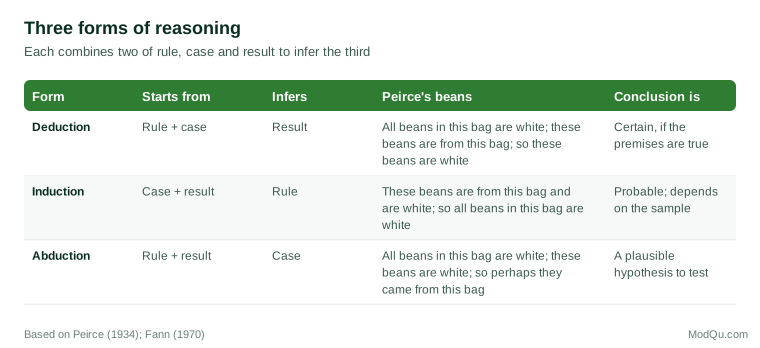
In deduction, if all beans from this bag are white (rule) and these beans are from this bag (case), then these beans must be white (result). In induction, if these beans are from this bag (case) and they are white (result), we generalise that all the beans in this bag are white (rule). In abduction, if all the beans from this bag are white (rule) and these beans are white (result), we conjecture that these beans came from this bag (case). Only the deduction is certain. The induction might be wrong if the sample was unrepresentative, and the abduction might be wrong if white beans come from other bags too.
Deduction
A deductive argument is valid when its conclusion cannot be false if its premises are true. The classic form is the syllogism: all humans are mortal; Socrates is human; therefore Socrates is mortal. Deduction is truth-preserving, but it does not add new information. Everything in the conclusion was already implicit in the premises.
In research, deduction is mainly used to derive testable predictions from a theory. If a theory states that price sensitivity rises when income falls, and a region has experienced a fall in income, then price sensitivity in that region should have risen. Hempel (1966) described this hypothetico-deductive method as the core of scientific testing: a hypothesis is proposed, predictions are deduced from it together with auxiliary assumptions, and the predictions are checked against observation.
Popper (1959) argued that deduction is the only form of inference science needs. Because a single counter-example can refute a universal claim, the logic of testing is deductive: if the prediction fails, then, by valid inference, at least one of the premises used to derive it is false. Deduction cannot tell us which premise is at fault, and it cannot tell us where the hypothesis came from, but it gives testing its logical force.
Induction
Inductive reasoning moves from particular observations to general conclusions, or from observed cases to unobserved ones. Most everyday learning and much empirical research is inductive: we notice that customers who receive a reminder email are more likely to renew, and we conclude that reminders increase renewals.
The weakness of induction was identified by David Hume in the eighteenth century. No number of observations logically guarantees that the next case will conform to the pattern, because the assumption that the future will resemble the past cannot itself be proved without circular reasoning (Hume, 2007). Russell (1912) gave a memorable illustration: a chicken that is fed every day by the farmer comes to expect food each morning, until the day the farmer wrings its neck. Goodman (1955) added a further difficulty, showing that the same observations can support incompatible generalisations depending on how the categories used to describe them are defined.
Despite these philosophical problems, induction is indispensable, and much of the practice of research consists of making it as reliable as possible. Mill (1843) set out methods for drawing causal conclusions from patterns of agreement and difference across cases, ideas that underlie modern comparative and experimental designs. Statistical sampling theory provides a principled way to generalise from a sample to a population, with a stated margin of error, provided the sample was drawn by a known random process. Much of what is taught as research method is, in effect, a set of techniques for making inductive conclusions safer.
Abduction
Abduction is reasoning to an explanation. Faced with a surprising observation, we ask what would make it unsurprising if it were true, and adopt that as a hypothesis worth pursuing. Peirce described its form simply: a surprising fact C is observed; but if A were true, C would be a matter of course; hence there is reason to suspect that A is true (Peirce, 1934; see Fann, 1970).
Harman (1965) described a closely related idea as inference to the best explanation: when several hypotheses could explain the evidence, we infer the one that would provide the best explanation. Lipton (2004) developed this into a detailed account in which the best explanation is the one that would, if true, provide the most understanding, judged by criteria such as scope, precision, simplicity and fit with background knowledge.
A famous example is John Snow's investigation of cholera in London in 1854. Snow noticed that deaths clustered around a water pump in Broad Street and that people who drank from other sources were largely spared, even when they lived nearby. The prevailing theory held that cholera spread through bad air. Snow reasoned that if cholera were carried by contaminated water, the pattern of deaths would be exactly what was observed (Snow, 1855). His conclusion was an abduction: the hypothesis that best explained the evidence. It was later supported by further investigation comparing customers of different water companies.
Abduction is also how detectives, doctors and engineers work. A doctor who sees a set of symptoms considers which condition would best explain them; a mechanic who hears a particular noise considers which fault would produce it. Josephson and Josephson (1994) showed that the same pattern of reasoning can be formalised for computer systems that diagnose faults.
Abduction is the most creative of the three forms and the most fallible. The best available explanation may still be wrong, especially if the right explanation has not yet been thought of. For this reason, abductive conclusions should be treated as hypotheses to be tested, not as findings.
How the three work together
In practice, research uses all three forms in a cycle. Haig (2005, 2014) proposed an abductive theory of scientific method in which researchers first detect empirical phenomena, then construct explanatory theories by abduction, develop them, and appraise them. Box (1976) described a similar alternation between theory and data in statistical work.
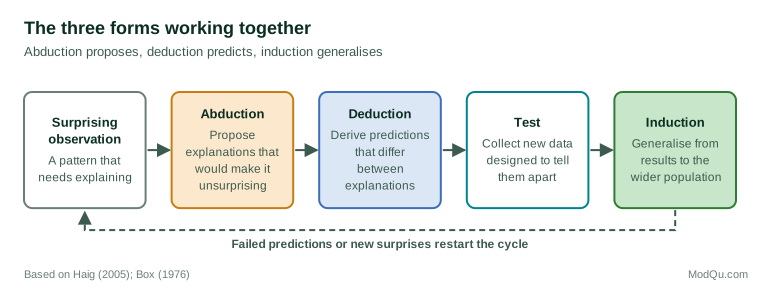
A typical sequence runs as follows. An unexpected pattern in data, perhaps found through exploratory analysis of the kind Tukey (1977) advocated, prompts the question of what could explain it. Abduction generates candidate explanations. Deduction works out what each explanation predicts that the others do not. New data are collected and the predictions checked, and induction generalises from the results to a conclusion about the wider population. If the predictions fail, the cycle starts again with a new abduction.
Abduction in qualitative research
Qualitative researchers have paid particular attention to abduction. Grounded theory, as originally described by Glaser and Strauss (1967), emphasised building theory inductively from data rather than testing existing theory. Timmermans and Tavory (2012) argued that this description understates the role of prior theory, and that the real engine of theory construction is abductive analysis: researchers bring broad theoretical knowledge to the field, notice findings that surprise them in the light of that knowledge, and develop new explanations for the surprises. Dubois and Gadde (2002) described a similar process in business case research, which they called systematic combining, moving back and forth between theory, data and the evolving case.
A worked example from applied research
Consider a subscription business that notices, in its monthly figures, that cancellations among customers in their first three months have risen sharply, while cancellations among longer-standing customers are unchanged. This is the surprising observation that starts the cycle.
The analysts first reason abductively. Several explanations would make the pattern unsurprising: a recent price increase that new customers had not yet accepted; a change in the onboarding process; a new marketing channel that brought in customers with weaker needs; or a competitor targeting newcomers with switching offers. Each is a plausible conjecture, and at this stage none is a finding.
They then reason deductively about what each explanation predicts. If the new marketing channel is responsible, the rise should be concentrated among customers acquired through that channel, and customers from older channels should cancel at the old rate. If onboarding is responsible, the rise should affect all new customers who joined after the change, regardless of channel. If a competitor is responsible, cancellations should cluster in the regions where the competitor is active, and exit surveys should mention its offer. These predictions differ, so the data can discriminate between the explanations.
Next they collect and examine the relevant data: acquisition channel, joining date, region and exit survey responses. Suppose the rise is concentrated among customers from the new channel, across all regions and before and after the onboarding change. The channel explanation survives; the others are weakened.
Finally, they reason inductively to a general conclusion: customers acquired through this channel are more likely to cancel early. The strength of this generalisation depends on how many customers were observed, over how long, and whether the period was typical. Before acting, the team might run a small test, perhaps varying the offer shown to customers from that channel, to see whether the effect can be changed. That test would start a new cycle.
The example shows why none of the three forms is enough on its own. Without abduction, the analysts would have no hypotheses to test. Without deduction, they would not know what evidence to look for. Without induction, they could not move from the particular data they examined to a conclusion they could act on.
Statistics as disciplined induction
Much of modern statistics can be understood as a set of tools for making induction more reliable. Probability sampling allows a researcher to generalise from a sample to a population with a quantified margin of error. Significance tests and confidence intervals express how far an observed pattern might be due to chance. Bayesian methods describe how evidence should change the degree of belief in competing hypotheses. None of these solves Hume's philosophical problem, since each depends on assumptions about how the data were generated, but each makes the assumptions explicit and the uncertainty visible. When the assumptions hold, statistical induction is about as safe as reasoning from evidence can be. When they do not, as with a self-selected online poll, the formal apparatus can give a misleading appearance of precision.
Reasoning errors
Each form of reasoning has characteristic failure modes, and research on human thinking shows that people are prone to all of them.
Deductive errors include affirming the consequent: reasoning that because a theory predicts an outcome, and the outcome occurred, the theory must be true. The outcome might have occurred for other reasons. Johnson-Laird (2010) showed that people reason by constructing mental models of possibilities and often fail to consider models that would reveal an error.
Inductive errors include generalising from too few or unrepresentative cases, and ignoring the cases that do not fit. Wason (1960) asked people to discover a rule governing number sequences. Most tested only sequences that fitted their initial guess, so they never discovered that the true rule was broader. Nickerson (1998) reviewed extensive evidence that this confirmation bias appears across many settings, from scientific reasoning to everyday judgement.
Abductive errors include settling on the first plausible explanation without considering alternatives, and treating the best available explanation as established fact. In applied research, this often appears when a single striking finding is explained by a convenient story that is never tested.
Practical guidance
For researchers designing and interpreting studies, the three forms suggest a set of practical checks.
- When proposing explanations, list several. An abduction is only as good as the alternatives it was compared with.
- When deriving predictions, make them specific enough to distinguish between the explanations. A prediction that every explanation shares tests none of them.
- When generalising, be explicit about the population and the sampling process. An inductive conclusion is only as strong as the link between the cases observed and the cases it is applied to.
- When results surprise, treat them as the starting point for a new abduction rather than as noise to be explained away.
- When reporting, say which conclusions were tested and which were proposed after seeing the data, so readers can judge their strength.
Conclusion
Deduction gives certainty but no new information; induction gives new information but no certainty; abduction gives new ideas but the least security of all. Research needs all three: abduction to propose explanations, deduction to work out what they imply, and induction to generalise from the evidence. Problems arise when one is mistaken for another, such as when an abductive hunch is reported as a tested finding, or a pattern in a convenience sample is generalised to a whole market. A clear sense of which form of reasoning supports each conclusion is one of the most useful habits a researcher can develop.
References
Box, G. E. P. (1976). Science and statistics. Journal of the American Statistical Association, 71(356), 791–799. https://doi.org/10.1080/01621459.1976.10480949
Dubois, A., & Gadde, L.-E. (2002). Systematic combining: An abductive approach to case research. Journal of Business Research, 55(7), 553–560. https://doi.org/10.1016/S0148-2963(00)00195-8
Fann, K. T. (1970). Peirce's theory of abduction. Martinus Nijhoff.
Glaser, B. G., & Strauss, A. L. (1967). The discovery of grounded theory: Strategies for qualitative research. Aldine.
Goodman, N. (1955). Fact, fiction, and forecast. Harvard University Press.
Haig, B. D. (2005). An abductive theory of scientific method. Psychological Methods, 10(4), 371–388. https://doi.org/10.1037/1082-989X.10.4.371
Haig, B. D. (2014). Investigating the psychological world: Scientific method in the behavioral sciences. MIT Press.
Harman, G. H. (1965). The inference to the best explanation. The Philosophical Review, 74(1), 88–95. https://doi.org/10.2307/2183532
Hempel, C. G. (1966). Philosophy of natural science. Prentice-Hall.
Hume, D. (2007). An enquiry concerning human understanding (P. Millican, Ed.). Oxford University Press. (Original work published 1748)
Johnson-Laird, P. N. (2010). Mental models and human reasoning. Proceedings of the National Academy of Sciences, 107(43), 18243–18250. https://doi.org/10.1073/pnas.1012933107
Josephson, J. R., & Josephson, S. G. (Eds.). (1994). Abductive inference: Computation, philosophy, technology. Cambridge University Press.
Lipton, P. (2004). Inference to the best explanation (2nd ed.). Routledge.
Mill, J. S. (1843). A system of logic, ratiocinative and inductive. John W. Parker.
Nickerson, R. S. (1998). Confirmation bias: A ubiquitous phenomenon in many guises. Review of General Psychology, 2(2), 175–220. https://doi.org/10.1037/1089-2680.2.2.175
Peirce, C. S. (1934). Collected papers of Charles Sanders Peirce: Vol. 5. Pragmatism and pragmaticism (C. Hartshorne & P. Weiss, Eds.). Harvard University Press.
Popper, K. R. (1959). The logic of scientific discovery. Hutchinson.
Russell, B. (1912). The problems of philosophy. Williams and Norgate.
Snow, J. (1855). On the mode of communication of cholera (2nd ed.). John Churchill.
Timmermans, S., & Tavory, I. (2012). Theory construction in qualitative research: From grounded theory to abductive analysis. Sociological Theory, 30(3), 167–186. https://doi.org/10.1177/0735275112457914
Tukey, J. W. (1977). Exploratory data analysis. Addison-Wesley.
Wason, P. C. (1960). On the failure to eliminate hypotheses in a conceptual task. Quarterly Journal of Experimental Psychology, 12(3), 129–140. https://doi.org/10.1080/17470216008416717