
Research · Philosophy and paradigms
Feminist and Standpoint Research Methodologies for Situated Knowledge
Feminist and standpoint methodologies hold that what we know depends on where we stand, and that starting from the lives of overlooked groups can make knowledge more complete. This article explains the main ideas, methods, criticisms and practical lessons.
Every research project begins from somewhere: from particular questions, assumptions, categories and people's experiences. Feminist methodologies argue that this starting point matters for what is found. For much of the history of science, research questions and concepts were framed mainly by men, and women's lives were often ignored, treated as deviations from a male norm or described through stereotypes. Feminist researchers set out to correct these gaps. In doing so, they developed broader arguments about how knowledge is produced, which apply to any group whose experience has been overlooked.
Three feminist approaches to knowledge
Harding (1986) distinguished three positions in feminist thinking about science, summarised in Figure 1.
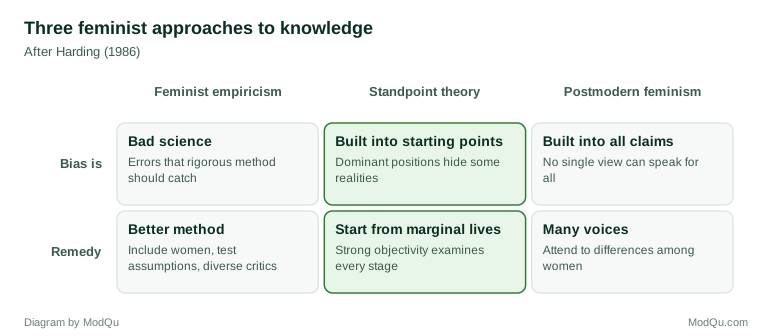
Feminist empiricism holds that sexist bias is bad science that can be corrected by following scientific methods more rigorously, for example by including women in samples and questioning assumptions. Longino (1990) developed a related view: objectivity is a property of scientific communities rather than individuals, achieved when diverse perspectives can criticise each other's assumptions.
Standpoint theory goes further. It argues that people's social positions shape what they can see, and that starting research from the lives of marginalised groups can reveal things that dominant groups overlook. Hartsock (1983) developed a feminist standpoint from Marxist theory, arguing that women's work in caring for others gave them a vantage point from which the limits of dominant views became visible. Smith (1987) argued that sociology should begin from the everyday world as women experience it and trace how that world is organised by institutions and texts that are invisible from within it.
Postmodern feminism questions whether any single standpoint, including a "women's" standpoint, can be privileged, emphasising the variety of women's experiences.
Situated knowledge and strong objectivity
Haraway (1988) argued that all knowledge is situated: it comes from particular embodied positions, and claims to a "view from nowhere" conceal the position from which they are made. Objectivity, on this view, means being accountable for one's location and partial perspective, not escaping it.
Harding (1991) proposed strong objectivity. Conventional objectivity, she argued, is "weak" because it examines bias only in the testing of hypotheses, not in the choice of problems and concepts, where social values have their strongest influence. Strong objectivity requires researchers to examine their own social position and its influence on every stage of research, and to start inquiry from the lives of those outside dominant groups. Intemann (2010) reviewed later debates and concluded that feminist empiricism and standpoint theory had moved closer together, sharing the view that diversity among researchers and attention to social values improve objectivity.
Collins (1990) showed that Black women's experiences provided a distinct standpoint, shaped by race, gender and class together. Crenshaw (1989) introduced the term intersectionality to describe how forms of discrimination combine, so that the experience of Black women could not be understood by adding together what was known about Black people and about women. These ideas broadened standpoint theory beyond gender alone.
Methods in feminist research
There is no single feminist method. Feminist researchers use surveys, experiments and statistics as well as interviews and ethnography (Hesse-Biber, 2012). What makes research feminist is its questions, its attention to power and its relationship with participants. Common features include:
- Asking about overlooked lives. Making women's and other marginalised groups' experiences the subject of research, not an afterthought.
- Questioning categories. Examining whether measures and concepts, such as "work", fit everyone's experience. Unpaid care work, for example, was long excluded from definitions of work in official statistics.
- Attending to power in the research relationship. Oakley (1981) criticised textbook advice that interviewers should remain detached, arguing that in interviews with women, a more reciprocal relationship, including answering participants' questions, produced better understanding and was more ethical.
- Reflexivity. Researchers reflect on how their own position shapes their questions, interactions and interpretations.
- Research for change. Many feminist researchers aim for knowledge that can improve the conditions of the people studied.
Martin (1991) showed how cultural stereotypes entered scientific descriptions of reproduction, which portrayed the egg as passive and the sperm as active, even when evidence pointed to a more interactive process. Her work illustrates how examining language and assumptions can improve accuracy, not only fairness.
Relevance for applied and business research
Standpoint ideas have practical consequences. Criado Perez (2019) documented many cases in which products, services and data systems were designed around a default male user, with costs for women, from safety equipment and medical dosing to transport planning. Data gaps, she argued, often reflect whose lives were considered when deciding what to measure.
For survey and market research, the lessons include: involve the people being studied in framing questions; test whether categories and response options fit different groups; analyse results separately for groups whose experiences may differ, including intersecting groups, rather than reporting only averages; and examine whether the research team's own perspectives limit what it notices.
A worked example
Consider a hypothetical study commissioned by a city transit authority on why ridership is falling. A conventional design might survey riders about journeys to work, measuring trip times, routes and satisfaction with peak-hour service. A standpoint-informed design would start by asking whose travel the system was planned around and whose was not.
Early interviews with carers, part-time workers and older residents reveal a different pattern of travel: short, linked trips during the day, combining school runs, shopping, medical appointments and care for relatives, often with children or shopping bags, and often outside peak hours. These journeys are poorly served by routes designed to bring commuters to the city centre and by fares that charge for each leg of a linked trip. The survey questionnaire is then revised to capture trip chains, off-peak travel, travelling with dependants and safety concerns at stops after dark. Results are analysed by gender, age, income and caring responsibilities, and for groups at their intersection.
The study does not abandon objectivity. It applies the same standards of sampling, measurement and analysis. But by starting from the lives of riders the system overlooked, it measures travel the original design would have missed and produces recommendations, such as time-based transfer fares and better-lit stops, that serve a wider public.
Designing a standpoint-informed study
Researchers who want to apply these ideas can ask a few questions at each stage. At the start: whose problem is this, and who defined it? In design: do our concepts and categories fit the experiences of all the groups we intend to cover, and who tested them? In data collection: who is missing from the sample, and what would make it easier for them to take part? In analysis: are we reporting averages that hide differences between and within groups? In reporting: who will read the findings, and who could be affected by them?
Criticisms
Critics argue that standpoint theory risks implying that members of a group automatically have better knowledge, or that there is a single shared group perspective. Most standpoint theorists reject both claims: a standpoint is achieved through critical reflection and collective work, not simply by belonging to a group (Wylie, 2003). Others worry that emphasising situated knowledge leads to relativism, in which every perspective is as good as any other and evidence cannot settle disagreements. Some quantitative researchers also suspect that feminist research is advocacy rather than inquiry. Haraway's and Harding's responses are that acknowledging position is a way to improve objectivity, not abandon it, and that all research is shaped by values; the question is whether those values are examined openly.
Key takeaways
Feminist and standpoint methodologies show that research begins from particular positions, and that starting from the lives of overlooked groups can reveal assumptions, gaps and errors. Strong objectivity asks researchers to examine their influence on every stage of a study. Applied researchers can use these ideas to design questions, categories and analyses that represent everyone they are meant to cover.
References
Collins, P. H. (1990). Black feminist thought: Knowledge, consciousness, and the politics of empowerment. Unwin Hyman.
Crenshaw, K. (1989). Demarginalizing the intersection of race and sex: A Black feminist critique of antidiscrimination doctrine, feminist theory and antiracist politics. University of Chicago Legal Forum, 1989(1), 139–167.
Criado Perez, C. (2019). Invisible women: Exposing data bias in a world designed for men. Chatto & Windus.
Haraway, D. (1988). Situated knowledges: The science question in feminism and the privilege of partial perspective. Feminist Studies, 14(3), 575–599. https://doi.org/10.2307/3178066
Harding, S. (1986). The science question in feminism. Cornell University Press.
Harding, S. (1991). Whose science? Whose knowledge? Thinking from women's lives. Cornell University Press.
Hartsock, N. C. M. (1983). The feminist standpoint: Developing the ground for a specifically feminist historical materialism. In S. Harding & M. B. Hintikka (Eds.), Discovering reality (pp. 283–310). D. Reidel. https://doi.org/10.1007/0-306-48017-4_15
Hesse-Biber, S. N. (Ed.). (2012). Handbook of feminist research: Theory and praxis (2nd ed.). Sage. https://doi.org/10.4135/9781483384740
Intemann, K. (2010). 25 years of feminist empiricism and standpoint theory: Where are we now? Hypatia, 25(4), 778–796. https://doi.org/10.1111/j.1527-2001.2010.01138.x
Longino, H. E. (1990). Science as social knowledge: Values and objectivity in scientific inquiry. Princeton University Press.
Martin, E. (1991). The egg and the sperm: How science has constructed a romance based on stereotypical male-female roles. Signs, 16(3), 485–501. https://doi.org/10.1086/494680
Oakley, A. (1981). Interviewing women: A contradiction in terms. In H. Roberts (Ed.), Doing feminist research (pp. 30–61). Routledge & Kegan Paul.
Smith, D. E. (1987). The everyday world as problematic: A feminist sociology. Northeastern University Press.
Wylie, A. (2003). Why standpoint matters. In R. Figueroa & S. Harding (Eds.), Science and other cultures: Issues in philosophies of science and technology (pp. 26–48). Routledge.