
Research · Philosophy and paradigms
Critical Realist Approaches to Research and Stratified Knowledge Claims
An introduction to critical realism for researchers: its layered view of reality, its focus on causal mechanisms, how it guides research design and analysis, and what kinds of knowledge claims it supports.
Researchers are often presented with a choice between two philosophies. Positivism treats the social world like the natural world, a set of regularities to be measured and predicted. Interpretivism treats it as a world of meanings to be understood from the inside. Critical realism offers a third position. It holds that there is a real world that exists independently of what we think about it, that this world has structures and causal powers we cannot observe directly, and that our knowledge of it is always fallible and shaped by our concepts. Developed by the British philosopher Roy Bhaskar from the 1970s, critical realism has become influential in sociology, management, information systems, health research and evaluation. This article sets out its core ideas, explains its distinctive account of causation, and shows how it shapes the design and analysis of research and the kinds of claims researchers can make.
Origins
Bhaskar's first book, A Realist Theory of Science, began with a simple question: what must the world be like for scientific experiments to be possible and informative (Bhaskar, 1975)? Experiments work by creating closed conditions in which a single causal mechanism can operate without interference. A physicist isolates a sample from outside influences so that a particular process can be observed. But if the laws of nature were nothing more than regular sequences of events, as the empiricist tradition descending from Hume (2007) held, then the knowledge gained in a laboratory would not apply outside it, because outside the laboratory the regular sequences do not occur. The fact that we successfully apply laboratory knowledge in the open world, where many mechanisms interact, implies that the laws describe causal powers of things, which continue to operate even when their effects are masked or counteracted.
In The Possibility of Naturalism, Bhaskar (1979) extended this argument to the social sciences. Social structures, such as markets, institutions and roles, also have causal powers, but they differ from natural structures in important ways: they exist only through human activity, they depend on people's concepts, and they change over time. Social science can therefore be scientific, but not in the same way as physics. It cannot create closed systems through experiment, so it must rely on explanation rather than prediction.
Introductions by Collier (1994) and the collection of key texts edited by Archer et al. (1998) helped bring these ideas to a wider audience. Gorski (2013) offers a short, accessible summary for social scientists.
A stratified reality
The most distinctive feature of critical realism is its layered, or stratified, view of reality. Bhaskar (1975) distinguished three domains.
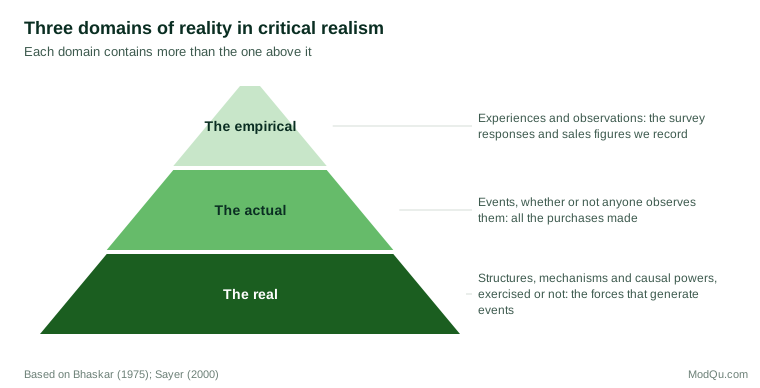
The empirical domain consists of what we experience and observe: the data recorded in a survey, the behaviour seen in an observation, the figures in a sales report. The actual domain consists of events, whether or not anyone observes them: all the purchases made, not only those that were recorded. The real domain consists of the structures and mechanisms that generate events, together with their causal powers, whether or not those powers are exercised at a particular time.
This layering has important consequences. First, what we observe is only a part of what happens, and what happens is only a part of what could happen given the powers that exist. Second, the absence of an observed regularity does not mean the absence of a cause. A mechanism may be operating but be counteracted by other mechanisms. A price rise may push customers towards switching, while loyalty and switching costs push them to stay; the observed outcome, little change in switching, conceals two real tendencies pulling in opposite directions. Third, research cannot stop at describing observations. It must try to infer the mechanisms that produce them.
Causation as mechanism
Critical realism rejects the idea, associated with Hume, that causation is nothing more than regular succession: whenever A, then B. In open social systems, such regularities are rare and unstable. Instead, critical realists explain events in terms of generative mechanisms: the ways in which structures with particular causal powers produce outcomes when they are triggered in particular conditions (Sayer, 1992).
Sayer (2000) summarised the logic in a simple formula: whether a mechanism produces an outcome depends on the conditions in which it operates. Gunpowder has the power to explode, but whether it does depends on whether it is dry, whether a spark is present and whether it is contained. Similarly, a new performance bonus may have the power to increase effort, but whether it does depends on whether staff trust management, understand the scheme and see the targets as fair.
Pawson and Tilley (1997) built a whole approach to programme evaluation on this idea. In realistic evaluation, the question is not simply whether a programme works, but what works, for whom, in what circumstances and why. Programmes are analysed as configurations of context, mechanism and outcome: a mechanism triggered in a particular context produces a particular outcome. This approach is now widely used in health and social policy evaluation.
The emphasis on mechanisms is shared by other traditions. Hedström and Swedberg (1998) argued for mechanism-based explanation in sociology, and Bunge (2004) argued that a full explanation of any social phenomenon must show how it works, not merely that it is associated with something else. What critical realism adds is a philosophical account of why mechanisms are real and why they matter even when they produce no observable regularity.
Structure and agency
A long-standing problem in social science is how to relate social structures to individual action. Do structures determine what people do, or do people create structures through their actions? Archer (1995) developed a critical realist answer in her morphogenetic approach. Structures pre-exist any particular individual and shape the situations in which people act, by providing resources, constraints and incentives. People act within those situations, using their own reflexive judgement, and their actions either reproduce the structures or transform them. Over time, structure and agency interact in cycles: structural conditioning, social interaction, and structural elaboration or reproduction.
Elder-Vass (2010) developed a related account of how social structures can have causal powers of their own, emerging from the relations between their parts. A firm, for example, can do things that none of its employees could do alone, because of the way their roles are organised.
For applied researchers, this has a practical implication: explanations of behaviour should consider both the structural conditions people face and the reasons they give for their actions. A study of why employees resist a new system should examine both the incentives and constraints built into the organisation and how employees interpret and respond to them.
Epistemology: fallible knowledge of a real world
Critical realism combines ontological realism (the world exists independently of our knowledge) with epistemological relativism (our knowledge of it is socially produced, historically situated and fallible) and judgemental rationality (we can nonetheless make reasoned judgements about which accounts are better). This combination distinguishes it from both naive positivism, which assumes we can observe reality directly, and strong constructionism, which can seem to deny that there is anything beyond our accounts.
Because knowledge is fallible, critical realists treat all findings as provisional. But because the world is real, they hold that some explanations are better than others, and that research can make progress by comparing explanations and testing them against evidence.
From epistemology to method
Critical realism does not prescribe particular methods. Sayer (1992) argued that it is compatible with a wide range of methods, quantitative and qualitative, provided they are used in ways that fit the nature of the object studied. What it does prescribe is a particular logic of inquiry, centred on two modes of inference.
Abduction, which critical realists sometimes call theoretical redescription, involves interpreting observed events in terms of a theoretical framework that might explain them: seeing a pattern of customer complaints, for example, as an instance of broken service promises rather than as isolated incidents.
Retroduction involves asking what must be the case for the observed events to occur: what structures and mechanisms would have to exist to produce them? This is the central move of critical realist research. It goes beyond the observations to propose the hidden causes that would make them intelligible, and then looks for further evidence of those causes.
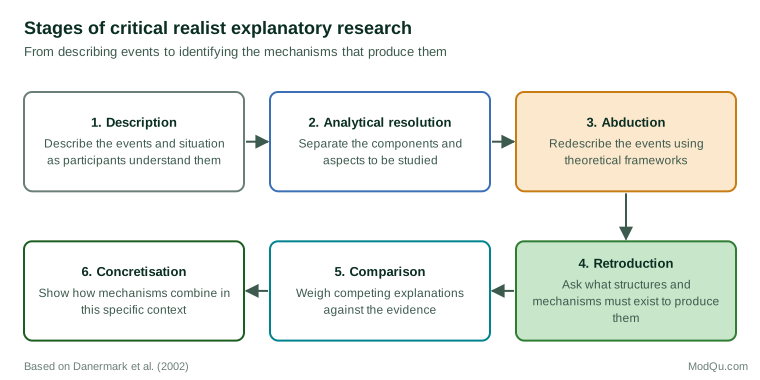
Danermark et al. (2002) set out a stepwise framework for critical realist research that many researchers follow.
Case studies
Critical realism has been particularly influential in case study research. Easton (2010) argued that case studies are well suited to identifying mechanisms because they allow researchers to examine in depth how outcomes are produced in a particular context. Wynn and Williams (2012) proposed principles for critical realist case studies, including explicating the events, explicating structure and context, retroducing mechanisms, confirming them empirically and triangulating across sources. Bygstad et al. (2016) offered a framework for identifying mechanisms in technology research by analysing the affordances that a technology offers to users in particular settings.
Quantitative research
Critical realists are often sceptical of regression-based research that treats statistical associations as causal laws. Lawson (1997) argued that much of economics assumes closed systems that rarely exist in social life. But quantitative data still have a role: they can reveal patterns, which Lawson called "demi-regularities", that point to the operation of mechanisms worth investigating. Survey data showing that a particular group is unusually likely to cancel a service do not explain the cancellations, but they tell the researcher where to look.
Qualitative research
Fletcher (2017) described how she used critical realism in a qualitative study of farm women in Saskatchewan, moving from coding interview data, through abductive redescription using existing theory, to retroductive identification of the mechanisms shaping the women's working lives. Maxwell (2012) argued more generally that a realist approach strengthens qualitative research by legitimising its claims about causes, which interpretivist frameworks often discourage.
Generalisation
A common criticism of case study and qualitative research is that its findings cannot be generalised. Critical realism offers a distinctive answer. The aim is not to generalise from a sample to a population, as in statistical inference, but to identify mechanisms that may operate in other settings. A mechanism identified in one case can be expected to operate elsewhere if the relevant structures are present, though its outcomes will depend on the conditions. Danermark et al. (2002) called the final step of analysis concretisation and contextualisation: examining how mechanisms combine in particular circumstances to produce the outcomes observed.
A worked example
Suppose a retailer introduces the same loyalty programme in two regions. Membership and repeat purchases rise strongly in one region and barely change in the other. A conventional analysis might compare the regions on demographic variables and conclude that the programme works better for some kinds of customer. A critical realist analysis would go further.
Description. The researcher first describes what happened in each region, drawing on sales data, membership records, interviews with staff and customers, and documents describing how the programme was launched.
Abduction. The researcher then interprets the events through relevant theory. The programme can be seen as an attempt to create switching costs and a sense of status among members, two mechanisms described in the literature on customer loyalty.
Retroduction. The researcher asks what must be true for the programme to have worked in one region and not the other. Perhaps the switching-cost mechanism depends on customers having a real choice of nearby stores; where the retailer already dominates, there is no switching to prevent. Perhaps the status mechanism depends on staff actively recognising members at the till; if staff in one region were not trained, the mechanism was never triggered.
Comparison. These candidate mechanisms predict different patterns. If competition is the key condition, the programme should work in towns with competing stores in both regions. If staff behaviour is the key, the difference should follow training records rather than market structure. The researcher examines the data to see which pattern holds, and may find that both mechanisms operate.
Concretisation. Finally, the researcher shows how the mechanisms combined in each region to produce the observed outcomes, and what this implies for rolling the programme out elsewhere: it will work where competition exists and staff are trained, and not otherwise.
The result is not a single estimate of the programme's effect, which would conceal the variation, nor a description of each region's unique story, which would offer no guidance for other places. It is an account of mechanisms and conditions that can be carried to new settings and checked there.
How critical realism compares
It can help to set critical realism alongside the positions it responds to. Positivism, as Sayer (1992) describes it, seeks regularities among observable events and treats explanation as showing that a case fits a general law. Interpretivism, in the tradition described by Lincoln and Guba (1985), seeks to understand the meanings that participants give to their situations and is cautious about causal claims. Critical realism agrees with positivism that there is a real world with causal structure, and with interpretivism that social life is concept-dependent and that knowledge is shaped by those who produce it. It differs from both in locating causation in mechanisms rather than regularities or meanings alone. In practice, this often makes critical realists comfortable with mixed methods, using quantitative data to identify patterns and qualitative data to explore the mechanisms behind them.
Critical realism in organisational and technology research
Fleetwood (2005) argued that organisation and management studies often slip between realist and constructionist positions without noticing, and that critical realism offers a coherent way to treat both material structures and discourses as real. In information systems, Mingers (2004) proposed critical realism as an underpinning philosophy that could reconcile the field's positivist and interpretivist traditions. A special issue introduced by Mingers et al. (2013) showed the range of research it had inspired. Edwards et al. (2014) provide a practical guide to designing organisational studies on critical realist principles, covering case studies, ethnography, interviews, documents and statistics.
Criticisms
Critical realism has its critics. Some argue that its claims about unobservable mechanisms are hard to test, so that retroduction risks producing plausible stories that cannot be checked. Others argue that the distinction between the real, the actual and the empirical is philosophically interesting but adds little to research practice that good researchers do not already do. Interpretivists sometimes object that critical realism underplays the role of language and meaning in constituting social life, while positivists object that it gives up too easily on prediction and measurement.
Critical realists respond that the framework does not replace careful method; it clarifies what method is for. By distinguishing observations from events and events from mechanisms, it reminds researchers that a pattern in data is a clue, not an explanation, and that the absence of a pattern is not proof of the absence of a cause.
Using critical realism in applied research
For applied researchers, critical realism offers several practical lessons.
- Ask what produces the outcome, not only whether it is associated with something. A finding that satisfaction predicts loyalty invites the question of what mechanism links them, and in what conditions it operates.
- Expect context to matter. A mechanism that works in one market or organisation may be blocked in another. Reporting the conditions under which findings were obtained is part of the result.
- Combine methods. Quantitative data can reveal demi-regularities; qualitative data can reveal the mechanisms behind them. Neither alone is usually sufficient.
- Compare explanations. Retroduction should generate several candidate mechanisms, and the research should seek evidence that discriminates between them.
- Be modest about prediction. In open systems, even well-understood mechanisms produce variable outcomes. Explanations that identify mechanisms and conditions may be more useful for decision-makers than predictions that assume conditions will stay the same.
Conclusion
Critical realism holds that the world is real, layered and causally structured, that our knowledge of it is fallible, and that the task of research is to identify the mechanisms that generate what we observe. It accepts the interpretivist point that social life depends on meanings, and the positivist point that there is a reality to be known, while rejecting the assumption that knowledge consists of regularities among observations. Its practical contribution is a logic of explanation, built on abduction and retroduction, that suits the open, context-dependent systems that most applied researchers study. For a business trying to understand why a strategy worked in one place and failed in another, that logic offers more than either a correlation or a story: it offers an account of what was really going on.
References
Archer, M., Bhaskar, R., Collier, A., Lawson, T., & Norrie, A. (Eds.). (1998). Critical realism: Essential readings. Routledge.
Archer, M. S. (1995). Realist social theory: The morphogenetic approach. Cambridge University Press.
Bhaskar, R. (1975). A realist theory of science. Leeds Books.
Bhaskar, R. (1979). The possibility of naturalism: A philosophical critique of the contemporary human sciences. Harvester Press.
Bunge, M. (2004). How does it work? The search for explanatory mechanisms. Philosophy of the Social Sciences, 34(2), 182–210. https://doi.org/10.1177/0048393103262550
Bygstad, B., Munkvold, B. E., & Volkoff, O. (2016). Identifying generative mechanisms through affordances: A framework for critical realist data analysis. Journal of Information Technology, 31(1), 83–96. https://doi.org/10.1057/jit.2015.13
Collier, A. (1994). Critical realism: An introduction to Roy Bhaskar's philosophy. Verso.
Danermark, B., Ekström, M., Jakobsen, L., & Karlsson, J. C. (2002). Explaining society: Critical realism in the social sciences. Routledge.
Easton, G. (2010). Critical realism in case study research. Industrial Marketing Management, 39(1), 118–128. https://doi.org/10.1016/j.indmarman.2008.06.004
Edwards, P. K., O'Mahoney, J., & Vincent, S. (Eds.). (2014). Studying organizations using critical realism: A practical guide. Oxford University Press.
Elder-Vass, D. (2010). The causal power of social structures: Emergence, structure and agency. Cambridge University Press.
Fleetwood, S. (2005). Ontology in organization and management studies: A critical realist perspective. Organization, 12(2), 197–222. https://doi.org/10.1177/1350508405051188
Fletcher, A. J. (2017). Applying critical realism in qualitative research: Methodology meets method. International Journal of Social Research Methodology, 20(2), 181–194. https://doi.org/10.1080/13645579.2016.1144401
Gorski, P. S. (2013). What is critical realism? And why should you care? Contemporary Sociology, 42(5), 658–670. https://doi.org/10.1177/0094306113499533
Hedström, P., & Swedberg, R. (Eds.). (1998). Social mechanisms: An analytical approach to social theory. Cambridge University Press.
Hume, D. (2007). An enquiry concerning human understanding (P. Millican, Ed.). Oxford University Press. (Original work published 1748)
Lawson, T. (1997). Economics and reality. Routledge.
Lincoln, Y. S., & Guba, E. G. (1985). Naturalistic inquiry. SAGE.
Maxwell, J. A. (2012). A realist approach for qualitative research. SAGE.
Mingers, J. (2004). Real-izing information systems: Critical realism as an underpinning philosophy for information systems. Information and Organization, 14(2), 87–103. https://doi.org/10.1016/j.infoandorg.2003.06.001
Mingers, J., Mutch, A., & Willcocks, L. (2013). Critical realism in information systems research. MIS Quarterly, 37(3), 795–802. https://doi.org/10.25300/MISQ/2013/37:3.3
Pawson, R., & Tilley, N. (1997). Realistic evaluation. SAGE.
Sayer, A. (1992). Method in social science: A realist approach (2nd ed.). Routledge.
Sayer, A. (2000). Realism and social science. SAGE.
Wynn, D., & Williams, C. K. (2012). Principles for conducting critical realist case study research in information systems. MIS Quarterly, 36(3), 787–810. https://doi.org/10.2307/41703481