
Research · Philosophy and paradigms
Decolonizing Research Methodologies: Expanding the Boundaries of Knowledge Generation
What decolonizing research means, the history that prompted it, the principles and practices it has produced, including Indigenous data governance, and what it asks of researchers in any field.
Research has never been a neutral activity carried out from nowhere. It is done by particular people, with particular assumptions, for particular purposes, and those who are studied have often had little say in what is asked about them, how the answers are used or who benefits. Decolonizing research methodologies is a body of scholarship and practice that examines how research has been shaped by colonial histories and works to change the relationships that research creates. It began largely in Indigenous scholarship, and it now influences ethics policy, data governance and research practice well beyond Indigenous contexts. This article explains the origins of the field, its main arguments and principles, the practical changes it has produced, and the debates it continues to generate.
Why research needed decolonizing
The Māori scholar Linda Tuhiwai Smith opened her influential book Decolonizing Methodologies with a stark observation: for many Indigenous peoples, the word "research" is linked with European imperialism and colonialism, and is one of the dirtiest words in their vocabulary (Smith, 1999). The reasons are historical. Colonial administrations used research to classify, measure and manage colonised peoples. Collectors removed cultural objects and human remains for museums. Scientists studied communities without consent and published findings that reinforced stereotypes, while the communities received little or nothing in return.
Canada offers well-documented examples. Mosby (2013) uncovered nutrition experiments conducted in the 1940s and 1950s in which researchers studied malnourished Indigenous communities and children in residential schools, in some cases deliberately withholding dietary improvements from control groups to observe the effects. The Truth and Reconciliation Commission of Canada (2015) placed such practices within the wider history of the residential school system and its harms.
Problems have continued into the modern era. Members of the Havasupai Tribe in Arizona gave blood samples in the 1990s for research on diabetes. They later learned that the samples had been used for studies of schizophrenia, inbreeding and population migration, topics they had not agreed to and some of which conflicted with their cultural beliefs. The tribe sued, and the case was settled in 2010 with the return of the samples and a payment to tribal members (Mello & Wolf, 2010). The case showed that formal consent procedures can still fail to respect a community's control over knowledge about itself.
Knowledge, power and whose questions count
Decolonizing scholarship goes beyond particular abuses to question the frameworks of knowledge that research takes for granted. Said (1978) argued that Western scholarship about "the Orient" did not simply describe other societies but constructed them as different and inferior in ways that served imperial power. Connell (2007) showed how social science theory has been built largely from the experience of a small number of wealthy countries and then treated as universal, while theories developed in the global South have been treated as local curiosities. De Sousa Santos (2014) described the suppression of other knowledge systems as "epistemicide", and Mignolo (2009) called for "epistemic disobedience": a refusal to accept that only one tradition defines what counts as knowledge.
These arguments are linked to a broader idea from philosophy. Fricker (2007) described epistemic injustice: the harm done to people when their testimony is given less credibility because of who they are, or when they lack the concepts needed to make sense of their own experience because those concepts were developed by others. Research that treats communities only as sources of data, while reserving interpretation for outside experts, risks committing this kind of injustice.
A related concern is the narrowness of the populations that research draws on. Henrich et al. (2010) showed that much of behavioural science relies on participants from Western, educated, industrialised, rich and democratic societies, yet often presents its findings as describing human nature in general. On many measures, these populations turned out to be unusual rather than typical. The point is not only about fairness but about accuracy: knowledge built from a narrow base may simply be wrong when applied elsewhere.
Tuck and Yang (2012) added a caution. They argued that "decolonization" should not become a metaphor for any reform that makes research more inclusive. For Indigenous scholars, decolonization involves the return of land and life, and using the term loosely can obscure that political meaning. Researchers outside Indigenous contexts who adopt the language need to be clear about what they are and are not claiming.
Indigenous research methodologies
Alongside critique, Indigenous scholars have articulated research approaches grounded in their own knowledge systems. Wilson (2008), a Cree scholar from northern Manitoba, described an Indigenous research paradigm in which knowledge is relational: it exists in relationships between people, the land, ancestors and ideas, and the researcher is accountable to all of those relationships. Research, in this view, is a ceremony that strengthens relationships rather than an extraction of information.
Kovach (2009), a Nêhiyaw and Saulteaux scholar, described Indigenous methodologies that draw on tribal epistemologies, including storytelling and conversational methods, and emphasised that they must be understood on their own terms rather than translated into the categories of Western qualitative research. Chilisa (2012) developed a broader framework for research in formerly colonised societies, including Africa, that combines Indigenous knowledge with critical and participatory methods.
A widely cited bridging approach comes from Mi'kmaw Elder Albert Marshall, who proposed Two-Eyed Seeing: learning to see with one eye the strengths of Indigenous ways of knowing and with the other eye the strengths of Western ways of knowing, and using both together. Bartlett et al. (2012) described how this principle guided an integrative science programme at Cape Breton University and what it taught about co-learning between knowledge systems.
From participation to control
Decolonizing approaches overlap with older traditions of participatory and community-based research, but they go further on the question of who holds power. Arnstein (1969) described a "ladder of citizen participation", from manipulation and tokenistic consultation at the bottom to partnership and citizen control at the top. The same ladder can be applied to research relationships.
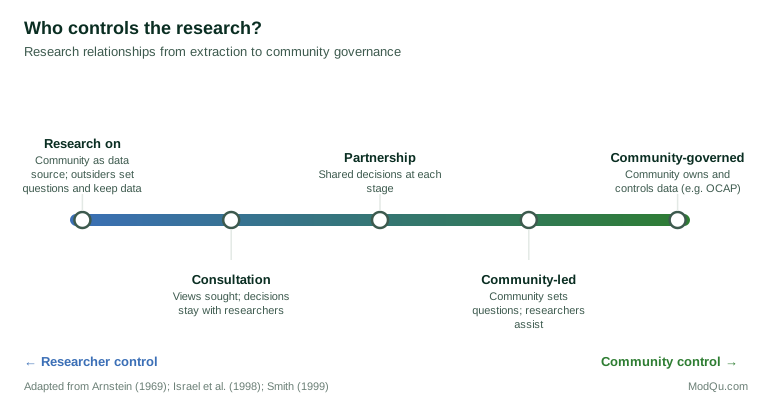
Community-based participatory research seeks to involve communities as partners at every stage, from defining the question to interpreting and using the findings. Israel et al. (1998) set out its principles, including recognising the community as a unit of identity, building on its strengths, sharing control over all phases, and committing to long-term relationships. Wallerstein and Duran (2010) reviewed evidence that such partnerships can improve the relevance, uptake and fairness of health research. Decolonizing approaches push this logic further, asking that communities lead or govern research about themselves rather than simply being consulted.
Indigenous data governance
One of the most concrete outcomes of this movement has been the development of principles for Indigenous control over data. In Canada, the First Nations Information Governance Centre (2014) set out the principles of OCAP®: ownership, control, access and possession. Under these principles, First Nations communities collectively own information about themselves, control how it is collected and used, have access to it wherever it is held, and may physically hold it.
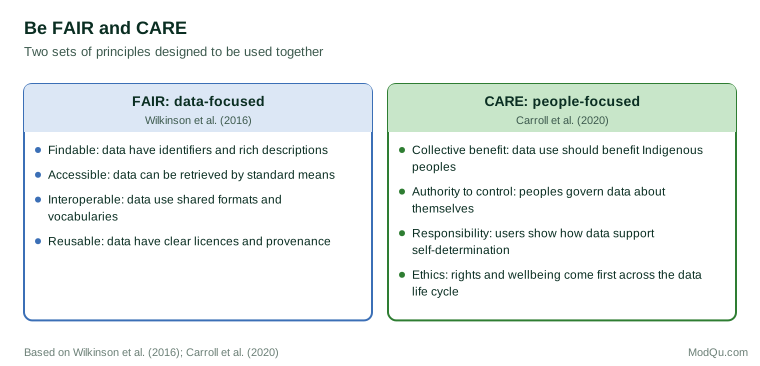
Internationally, the Global Indigenous Data Alliance developed the CARE principles for Indigenous data governance: collective benefit, authority to control, responsibility and ethics (Carroll et al., 2020). The CARE principles were designed to complement the widely adopted FAIR principles, which ask that research data be findable, accessible, interoperable and reusable (Wilkinson et al., 2016). FAIR is about making data easy to share; CARE is about ensuring that sharing respects the rights and interests of the people the data describe.
Canada's national research ethics policy has incorporated many of these ideas. Chapter 9 of the Tri-Council Policy Statement requires researchers to engage with the relevant Indigenous community when research is likely to affect its welfare, to respect community customs and codes of research practice, and to address community interests in the collection, use and storage of data (Canadian Institutes of Health Research et al., 2022).
What changes in the research process
Decolonizing approaches change practice at every stage of a project, not only at the point of ethics review.
Before the project. The question is developed with the community rather than brought to it. This often means a longer start-up period spent building relationships and agreeing how decisions will be made, sometimes formalised in a research agreement that covers ownership of data, review of publications and the sharing of benefits. Smith (1999) lists questions that communities commonly ask of researchers: whose research is it, who owns it, whose interests does it serve, who will benefit, who designed its questions, who will carry it out and who will write it up.
Designing methods. Methods are chosen for their fit with the community's ways of sharing knowledge as well as for their technical properties. Kovach (2009) describes conversational methods in which stories are shared in a relational exchange rather than extracted through a fixed interview schedule. Surveys may still be appropriate, but question wording, categories and response options are developed with community members so that they make sense in local terms.
Collecting data. Community members are often trained and employed as researchers, which builds local capacity and improves the quality of data, since people are more likely to speak openly to someone they trust. Protocols address collective consent where it is customary, as well as individual consent.
Analysing and interpreting. Interpretation is shared. Preliminary findings are taken back to the community for discussion before they are finalised, so that meanings are not imposed from outside. Where findings could stigmatise a group, the community has a say in how they are framed.
Reporting and using results. Results are returned in forms that are useful to the community, such as plain-language summaries, presentations or data the community can use for its own planning, as well as in academic or commercial reports. Data are stored and shared in line with agreed governance principles such as OCAP.
None of these steps is unique to decolonizing research. Many appear in good participatory practice generally. What distinguishes the decolonizing approach is the reason behind them: the recognition that research relationships carry a history, and that changing them is a matter of justice as well as quality.
Debates and tensions
Decolonizing research raises difficult questions that remain under discussion.
Universal standards and local knowledge. Some critics worry that emphasising distinct knowledge systems could undermine shared standards of evidence. Proponents reply that the aim is not to abandon rigour but to recognise that standards have histories, and that knowledge systems can test and enrich one another, as Two-Eyed Seeing proposes.
Open data and community control. The open science movement asks researchers to share data as widely as possible. Indigenous data governance asks that communities decide how data about them are shared. The FAIR and CARE principles were written to be used together, but in practice the balance requires negotiation, project by project.
Who speaks for a community? Communities are not uniform, and decisions about research may be contested within them. Researchers must work through legitimate governance structures while remaining aware of voices that those structures may not represent.
Tokenism. Adding a community advisory board or a land acknowledgement to an otherwise unchanged project can give the appearance of decolonizing without changing the relationships underneath. Arnstein's ladder is a useful test: does the community have real decision-making power, or only the right to be informed?
What it asks of all researchers
Decolonizing methodologies began in Indigenous scholarship and should be understood first on those terms. But several of its lessons apply to any research that studies people, including market and social research.
- Ask whose question it is. Research designed entirely around the needs of the commissioning organisation may miss what matters to the people being studied, and may produce findings that are less accurate as a result.
- Check the sample against the claim. Findings from one population, however large the sample, should not be presented as describing everyone. Henrich et al. (2010) showed how far that assumption can mislead.
- Respect collective as well as individual interests. Individual consent may not be enough when results could affect a whole group's reputation or wellbeing, as the Havasupai case showed.
- Return value. People who give their time and information should benefit, at minimum by learning what was found.
- Share interpretation. Inviting participants to comment on findings, as in member checking, can correct misunderstandings and reduce the risk of epistemic injustice.
Conclusion
Decolonizing research methodologies asks researchers to see their work as part of a history of relationships, some of them deeply harmful, and to take responsibility for the relationships their own research creates. Its contributions range from philosophical critiques of whose knowledge counts, through Indigenous research paradigms such as Wilson's relational approach, to practical tools such as OCAP and the CARE principles that now shape data governance. For researchers in any field, it offers a sharper set of questions about who defines the problem, who benefits from the answer and who controls the knowledge produced. Answering those questions well tends to make research more ethical, and often more accurate as well.
References
Arnstein, S. R. (1969). A ladder of citizen participation. Journal of the American Institute of Planners, 35(4), 216–224. https://doi.org/10.1080/01944366908977225
Bartlett, C., Marshall, M., & Marshall, A. (2012). Two-Eyed Seeing and other lessons learned within a co-learning journey of bringing together indigenous and mainstream knowledges and ways of knowing. Journal of Environmental Studies and Sciences, 2(4), 331–340. https://doi.org/10.1007/s13412-012-0086-8
Canadian Institutes of Health Research, Natural Sciences and Engineering Research Council of Canada, & Social Sciences and Humanities Research Council of Canada. (2022). Tri-Council policy statement: Ethical conduct for research involving humans – TCPS 2 (2022). Government of Canada.
Carroll, S. R., Garba, I., Figueroa-Rodríguez, O. L., Holbrook, J., Lovett, R., Materechera, S., Parsons, M., Raseroka, K., Rodriguez-Lonebear, D., Rowe, R., Sara, R., Walker, J. D., Anderson, J., & Hudson, M. (2020). The CARE principles for Indigenous data governance. Data Science Journal, 19, Article 43. https://doi.org/10.5334/dsj-2020-043
Chilisa, B. (2012). Indigenous research methodologies. SAGE.
Connell, R. (2007). Southern theory: The global dynamics of knowledge in social science. Polity.
de Sousa Santos, B. (2014). Epistemologies of the South: Justice against epistemicide. Paradigm Publishers.
First Nations Information Governance Centre. (2014). Ownership, control, access and possession (OCAP™): The path to First Nations information governance. First Nations Information Governance Centre.
Fricker, M. (2007). Epistemic injustice: Power and the ethics of knowing. Oxford University Press.
Henrich, J., Heine, S. J., & Norenzayan, A. (2010). The weirdest people in the world? Behavioral and Brain Sciences, 33(2–3), 61–83. https://doi.org/10.1017/S0140525X0999152X
Israel, B. A., Schulz, A. J., Parker, E. A., & Becker, A. B. (1998). Review of community-based research: Assessing partnership approaches to improve public health. Annual Review of Public Health, 19, 173–202. https://doi.org/10.1146/annurev.publhealth.19.1.173
Kovach, M. (2009). Indigenous methodologies: Characteristics, conversations, and contexts. University of Toronto Press.
Mello, M. M., & Wolf, L. E. (2010). The Havasupai Indian tribe case: Lessons for research involving stored biologic samples. New England Journal of Medicine, 363(3), 204–207. https://doi.org/10.1056/NEJMp1005203
Mignolo, W. D. (2009). Epistemic disobedience, independent thought and decolonial freedom. Theory, Culture & Society, 26(7–8), 159–181. https://doi.org/10.1177/0263276409349275
Mosby, I. (2013). Administering colonial science: Nutrition research and human biomedical experimentation in Aboriginal communities and residential schools, 1942–1952. Histoire sociale/Social History, 46(91), 145–172. https://doi.org/10.1353/his.2013.0015
Said, E. W. (1978). Orientalism. Pantheon Books.
Smith, L. T. (1999). Decolonizing methodologies: Research and Indigenous peoples. Zed Books.
Truth and Reconciliation Commission of Canada. (2015). Honouring the truth, reconciling for the future: Summary of the final report of the Truth and Reconciliation Commission of Canada. Truth and Reconciliation Commission of Canada.
Tuck, E., & Yang, K. W. (2012). Decolonization is not a metaphor. Decolonization: Indigeneity, Education & Society, 1(1), 1–40.
Wallerstein, N., & Duran, B. (2010). Community-based participatory research contributions to intervention research: The intersection of science and practice to improve health equity. American Journal of Public Health, 100(S1), S40–S46. https://doi.org/10.2105/AJPH.2009.184036
Wilkinson, M. D., Dumontier, M., Aalbersberg, I. J., Appleton, G., Axton, M., Baak, A., Blomberg, N., Boiten, J.-W., da Silva Santos, L. B., Bourne, P. E., Bouwman, J., Brookes, A. J., Clark, T., Crosas, M., Dillo, I., Dumon, O., Edmunds, S., Evelo, C. T., Finkers, R., … Mons, B. (2016). The FAIR Guiding Principles for scientific data management and stewardship. Scientific Data, 3, Article 160018. https://doi.org/10.1038/sdata.2016.18
Wilson, S. (2008). Research is ceremony: Indigenous research methods. Fernwood Publishing.