
Research · Market and business research
Consumer Research: Understanding Needs, Motives and Behaviour
How consumer research studies what customers need, why they act and what they actually do, with the main theories, the evidence on the intention–behaviour gap, and the methods suited to each question.
Consumer research studies how people choose, buy, use and give up products and services, and why. For a business, it answers three related questions: what customers need, what motivates them to act, and how they actually behave. The three do not always line up. People may need something they do not seek, give reasons for a choice that are not the real ones, and say they will buy a product they never buy. Good consumer research is designed with these gaps in mind. This article sets out the main ideas from consumer behaviour research that bear on needs, motives and behaviour, and the methods used to study each.
Needs, motives and behaviour
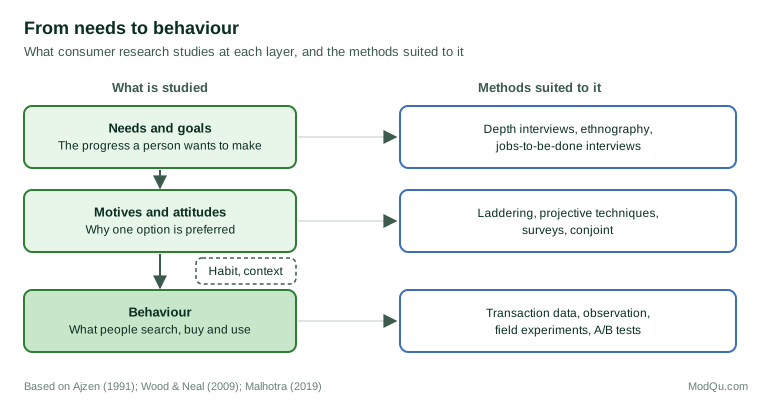
A need is a gap between a person's current state and a desired state, such as hunger, safety or social belonging. A motive is the drive that pushes a person to close that gap in a particular way. Behaviour is what the person actually does: searching, comparing, buying, using, recommending or switching. Between motive and behaviour sit attitudes, intentions, habits and the situation in which the choice is made.
Understanding needs
Maslow (1943) proposed that human needs form a hierarchy, from physiological needs and safety through love and belonging to esteem and self-actualisation, with higher needs becoming more important as lower ones are met. The strict ordering has been widely questioned, but the model remains useful as a reminder that the same product can serve very different needs. A car can meet a need for transport, for safety, for status or for self-expression, and different customers weight these differently.
Holbrook and Hirschman (1982) argued that consumer research had concentrated too heavily on rational problem-solving and had neglected the experiential side of consumption: fantasies, feelings and fun. Many purchases, such as entertainment, travel and food, are chosen for the experience they provide as much as for their function. Belk (1988) showed that possessions also serve as part of a person's identity, an "extended self", which helps explain why people attach meaning to brands and objects beyond their practical use.
A practical framework for needs is the "jobs to be done" approach. Christensen et al. (2016) argue that customers "hire" a product to make progress in a particular circumstance, and that understanding the job, including its functional, social and emotional dimensions, is more useful for innovation than profiling customers by demographics. The approach directs research towards the circumstances in which a purchase happens and the progress the customer is trying to make.
Understanding motives
Motives are harder to observe than behaviour, and people are not always able to report them accurately. Nisbett and Wilson (1977) reviewed evidence that people often cannot correctly identify the influences on their own judgements, and that when asked to explain them, they give plausible reasons that match common beliefs rather than the actual causes. For consumer research, this means that answers to "Why did you buy this?" need to be treated as accounts, not as direct evidence of causes.
Two techniques are designed to reach motives more reliably.
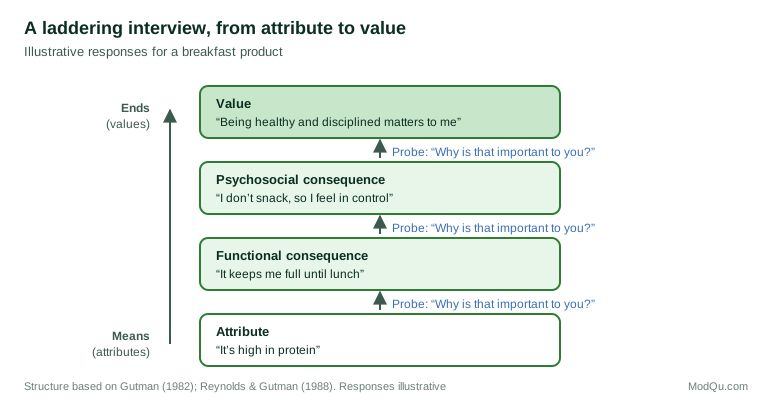
Means-end chains and laddering. Gutman (1982) proposed that consumers link product attributes to the consequences of using the product, and those consequences to personal values. Laddering is the interview method used to uncover these links: the interviewer starts from an attribute the respondent mentions and repeatedly asks why it is important, moving up the chain towards values (Reynolds & Gutman, 1988). The result is a map of the reasons behind a preference that goes beyond the features customers first mention.
Metaphor and projective techniques. Zaltman (2003) argued that much consumer thinking happens below conscious awareness and is expressed through images and metaphors more easily than through direct answers. His approach asks participants to collect pictures that represent their thoughts and feelings about a topic and then explores them in a long interview. Other projective techniques, such as sentence completion or describing a brand as a person, serve a similar purpose: they make it easier for people to express associations they would not state directly.
Understanding behaviour
Attitudes and intentions. The theory of planned behaviour holds that intentions are the most immediate predictor of behaviour, and that intentions depend on a person's attitude towards the behaviour, perceived social pressure and perceived control over performing it (Ajzen, 1991). The theory underpins many survey measures of purchase intention.
However, intentions are an imperfect guide. Sheeran (2002) combined ten earlier meta-analyses and found an average correlation of .53 between intentions and later behaviour: a strong relationship, but one that leaves much of the variation in behaviour unexplained. Sheeran and Webb (2016) describe this as the intention–behaviour gap and conclude that intentions are translated into action about half the time. In consumer markets, Morwitz et al. (2007) found that purchase intentions predicted sales more accurately for existing products than for new ones, and over shorter rather than longer time horizons.
Measuring intentions can itself change behaviour. Chandon et al. (2005) found across three large field studies that the correlation between intentions and later purchases was, on average, about 58% higher among consumers who had been surveyed than among similar consumers who had not. Being asked appears to make people more likely to act in line with what they said, so survey samples can overstate how closely intentions predict behaviour in the wider market.
Habit. Many purchases are not decisions at all in the usual sense. Wood and Neal (2009) describe how repeated purchases in stable settings become habits triggered by context cues, such as the time of day or a particular shelf location, rather than by deliberate intentions. Habitual consumers may continue to buy a product even when their stated attitudes change, and may stop when the context changes, for example after moving house. Research into habitual categories therefore needs to look at the cues and settings of purchase, not only at attitudes.
Judgement and choice. Behavioural research has shown that choices depend on how options are presented. Kahneman and Tversky (1979) found that people evaluate outcomes as gains or losses relative to a reference point and weigh losses more heavily than equivalent gains. Kahneman (2011) summarises research on two modes of thinking: fast, automatic judgement and slower, deliberate reasoning, much of everyday consumer choice relying on the first. These findings explain why prices framed as discounts or surcharges, default options and reference prices can change behaviour even when the underlying offer is the same.
Not every popular finding holds up well. Iyengar and Lepper (2000) reported that shoppers offered 24 varieties of jam were less likely to buy than those offered six, a result widely cited as evidence of "choice overload". A later meta-analysis of 50 experiments found a mean effect size of virtually zero, with considerable variation between studies (Scheibehenne et al., 2010). The lesson for practitioners is to test such effects in their own market rather than assume them.
Methods for consumer research
Because needs, motives and behaviour are different things, each calls for different methods.
- Depth interviews and laddering explore needs and motives in the respondent's own words (Reynolds & Gutman, 1988).
- Focus groups show how people talk about a category and react to ideas, though group dynamics can affect what individuals say.
- Ethnography and observation study consumers in natural settings, such as their homes or stores. Arnould and Wallendorf (1994) showed how comparing what people say with what they do can reveal needs that interviews alone miss.
- Netnography adapts ethnographic methods to online communities, where consumers discuss products in their own terms without prompting from a researcher (Kozinets, 2002).
- Surveys measure how common attitudes, needs and behaviours are across a population, and allow segments to be identified.
- Conjoint and choice experiments estimate how consumers trade off features and price by asking them to choose between realistic product profiles.
- Transaction and behavioural data, such as purchase histories and website activity, record what people actually do.
- Field experiments, including online A/B tests, show whether a change in product, price or message changes behaviour.
Designing a consumer study
A sound consumer study usually combines methods so that the weaknesses of one are covered by another. A common sequence is:
- Explore with interviews, observation or online communities to understand needs and the language customers use.
- Measure with a survey to establish how widespread the needs and attitudes are and which segments hold them.
- Validate against behaviour, using purchase data or an experiment, to check that stated preferences translate into action.
Each step should be guided by the decision the research is meant to inform. A study for a new product will put more weight on exploration and testing; a study of why customers are leaving will put more weight on behavioural data and interviews with those who left.
A worked example
A company selling home fitness equipment sees strong traffic to its website but low conversion, and asks why.
Behaviour first. Website data show that many visitors look at the same two or three products repeatedly over several weeks, then leave without buying. Purchase records show that buyers are concentrated in January and September. This establishes what is happening, but not why.
Needs and motives next. Depth interviews with recent buyers and with visitors who did not buy use laddering to trace the links from product features to personal goals. Buyers describe equipment that is compact and quiet, which lets them exercise at home without disturbing others, which supports a goal of fitting exercise into a busy family life. Non-buyers describe a different chain: uncertainty about whether they would keep using the equipment, which raises the fear of wasting money and of failing at a resolution. The interviews suggest that the barrier is doubt about future behaviour rather than price or features.
Measurement and validation. A survey of site visitors measures how common that doubt is and in which segments. The firm then tests a response in a randomised experiment: half of visitors see an extended return period and a structured first-month programme, half see the existing page. Conversion is compared between the two groups.
Each method answered a different question. Behavioural data identified the problem, interviews explained it, the survey sized it and the experiment tested a solution.
Summary
Consumer research is most useful when it treats needs, motives and behaviour as separate questions. Needs are uncovered through exploration of circumstances and goals. Motives require methods such as laddering and projective techniques, because direct questions often produce rationalisations. Behaviour is best measured directly, because intentions, though informative, predict actions only in part and are shaped by habit and context.
References
Ajzen, I. (1991). The theory of planned behavior. Organizational Behavior and Human Decision Processes, 50(2), 179–211. https://doi.org/10.1016/0749-5978(91)90020-T
Arnould, E. J., & Wallendorf, M. (1994). Market-oriented ethnography: Interpretation building and marketing strategy formulation. Journal of Marketing Research, 31(4), 484–504. https://doi.org/10.1177/002224379403100404
Belk, R. W. (1988). Possessions and the extended self. Journal of Consumer Research, 15(2), 139–168. https://doi.org/10.1086/209154
Chandon, P., Morwitz, V. G., & Reinartz, W. J. (2005). Do intentions really predict behavior? Self-generated validity effects in survey research. Journal of Marketing, 69(2), 1–14. https://doi.org/10.1509/jmkg.69.2.1.60755
Christensen, C. M., Hall, T., Dillon, K., & Duncan, D. S. (2016). Know your customers’ “jobs to be done.” Harvard Business Review, 94(9), 54–62.
Gutman, J. (1982). A means-end chain model based on consumer categorization processes. Journal of Marketing, 46(2), 60–72. https://doi.org/10.1177/002224298204600207
Holbrook, M. B., & Hirschman, E. C. (1982). The experiential aspects of consumption: Consumer fantasies, feelings, and fun. Journal of Consumer Research, 9(2), 132–140. https://doi.org/10.1086/208906
Iyengar, S. S., & Lepper, M. R. (2000). When choice is demotivating: Can one desire too much of a good thing? Journal of Personality and Social Psychology, 79(6), 995–1006. https://doi.org/10.1037/0022-3514.79.6.995
Kahneman, D. (2011). Thinking, fast and slow. Farrar, Straus and Giroux.
Kahneman, D., & Tversky, A. (1979). Prospect theory: An analysis of decision under risk. Econometrica, 47(2), 263–291. https://doi.org/10.2307/1914185
Kozinets, R. V. (2002). The field behind the screen: Using netnography for marketing research in online communities. Journal of Marketing Research, 39(1), 61–72. https://doi.org/10.1509/jmkr.39.1.61.18935
Malhotra, N. K. (2019). Marketing research: An applied orientation (7th ed., global ed.). Pearson.
Maslow, A. H. (1943). A theory of human motivation. Psychological Review, 50(4), 370–396. https://doi.org/10.1037/h0054346
Morwitz, V. G., Steckel, J. H., & Gupta, A. (2007). When do purchase intentions predict sales? International Journal of Forecasting, 23(3), 347–364.
Nisbett, R. E., & Wilson, T. D. (1977). Telling more than we can know: Verbal reports on mental processes. Psychological Review, 84(3), 231–259. https://doi.org/10.1037/0033-295X.84.3.231
Reynolds, T. J., & Gutman, J. (1988). Laddering theory, method, analysis, and interpretation. Journal of Advertising Research, 28(1), 11–31.
Scheibehenne, B., Greifeneder, R., & Todd, P. M. (2010). Can there ever be too many options? A meta-analytic review of choice overload. Journal of Consumer Research, 37(3), 409–425. https://doi.org/10.1086/651235
Sheeran, P. (2002). Intention–behavior relations: A conceptual and empirical review. European Review of Social Psychology, 12(1), 1–36. https://doi.org/10.1080/14792772143000003
Sheeran, P., & Webb, T. L. (2016). The intention–behavior gap. Social and Personality Psychology Compass, 10(9), 503–518. https://doi.org/10.1111/spc3.12265
Wood, W., & Neal, D. T. (2009). The habitual consumer. Journal of Consumer Psychology, 19(4), 579–592. https://doi.org/10.1016/j.jcps.2009.08.003
Zaltman, G. (2003). How customers think: Essential insights into the mind of the market. Harvard Business School Press.