
Research · Qualitative research
Collaborative Autoethnography and Reflexive Knowledge Production
What collaborative autoethnography is, how a group of researchers studies its own shared experience, the stages of the method, its strengths and risks, and how it produces reflexive knowledge.
Most research studies other people. Autoethnography turns the researcher's own experience into data, using personal stories to understand a wider culture or social setting. Collaborative autoethnography extends this to a group: two or more researchers study a shared experience by writing about their own lives, reading one another's accounts, questioning each other and analysing the material together (Chang et al., 2013). The result is a form of reflexive knowledge production, in which the people who hold the knowledge are also the people who examine it. This article explains where the method comes from, how a study is carried out, what it does well and where it needs care.
From autoethnography to collaboration
Ellis et al. (2011) described autoethnography as an approach that seeks to describe and systematically analyse personal experience in order to understand cultural experience. It combines features of autobiography, which tells a life story, and ethnography, which studies a culture. Chang (2008) argued that autoethnography should be more than self-narration: personal stories become research when they are analysed and interpreted against the wider culture they belong to.
Within the field there is a long-running debate between evocative and analytic styles. Evocative autoethnography aims to move the reader and to show experience from the inside, often through literary writing. Anderson (2006) proposed analytic autoethnography, in which the researcher is a full member of the group studied, is visible in the text, and is committed to developing theoretical understanding of broader social phenomena. Collaborative autoethnography can be written in either style, though in practice many studies combine vivid personal accounts with systematic analysis.
Solo autoethnography has a clear limitation: one person examines their own memories, with no one to question them. Collaboration addresses this. Hernandez et al. (2017) described collaborative autoethnography as multivocal, relational and democratic. It is multivocal because several voices are heard; relational because the researchers work through their relationships with one another; and democratic because no single member's account dominates.
How a study is carried out
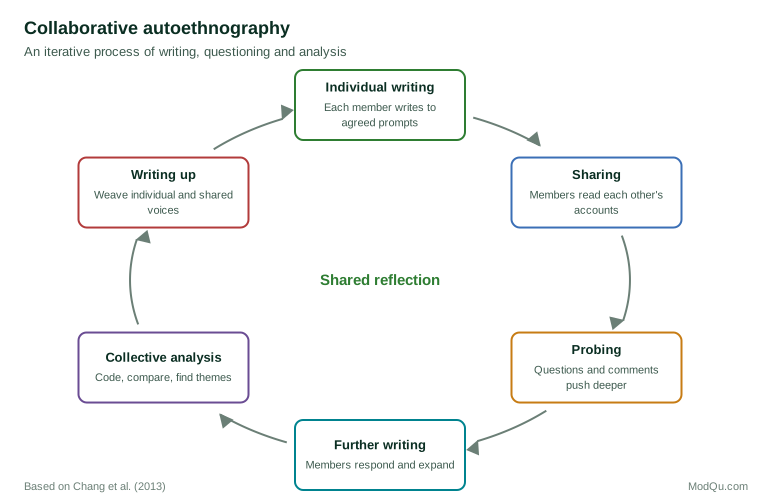
Chang et al. (2013) described collaborative autoethnography as an iterative process rather than a fixed sequence, and identified several common stages. The diagram below summarises them.
Forming the group and the question. A group forms around a shared experience, such as being early-career academics, women in leadership, first-generation university students or members of a project team. The group agrees a research focus and a set of prompts to write about.
Individual writing. Each member writes about their own experience in response to the prompts. Writing alone first allows each member to record their experience before it is shaped by others.
Sharing and probing. Members read one another's writing and respond with questions and comments. This stage is what makes the method collaborative. A question such as "why did you not say anything at that meeting?" can push a member to explain what they had left unexamined, and can reveal assumptions the writer did not see.
Further writing. Members respond to the questions with more writing, deepening their accounts. Several rounds may follow.
Collective analysis. The group codes the material, looks for themes, and compares experiences, noting where they converge and where they differ. Differences are as informative as similarities, because they show how the same setting is experienced from different positions.
Writing up. The final report may weave individual voices together, present them side by side, or combine them into a single collective account.
Reflexive knowledge production
Reflexivity is the practice of examining how the researcher shapes the research. Finlay (2002) described several forms, from introspection to examining the intersubjective dynamics between researcher and researched. Berger (2015) showed how a researcher's position, whether they share the participants' experience or not, affects access, what participants say and how data are interpreted. Mauthner and Doucet (2003) argued that reflexivity should extend into data analysis, so that researchers ask how their own assumptions shaped the meaning they found.
In collaborative autoethnography, reflexivity is built into the design. The researchers are the participants, so their positions are not a source of bias to be managed but the material of the study. The group process makes reflexivity social rather than solitary: each member's interpretation is tested against the others. Knowledge is produced through dialogue, and the research report can show how the group reached its understanding, not only what that understanding is.
Strengths
The method has several strengths:
- Access to inside experience. Members can describe events, feelings and reasoning that an outside researcher would struggle to reach.
- Checks on self-interpretation. Questions from colleagues reduce the risk that a single author's account goes unchallenged.
- Comparison built in. Several accounts of a similar experience allow the group to separate what is personal from what is shared.
- Shared ownership. All members are both researchers and participants, which reduces the power imbalance between those who study and those who are studied.
Limitations and quality
Autoethnography has been criticised as self-indulgent. Delamont (2009) argued that it can focus on the researcher at the expense of the social world, and that researchers should study others rather than themselves. Holt (2003) described how reviewers questioned whether an autoethnographic paper counted as research at all, which shows the problems of legitimation that the method faces. Collaborative designs respond partly to these criticisms, because the group brings comparison and challenge, but they do not remove them.
Quality depends on transparency. A good report explains how the group formed, what prompts were used, how many rounds of writing and response took place, how the analysis was carried out and how disagreements were handled. Readers should be able to see the path from individual accounts to collective claims.
Group dynamics also matter. Members with more seniority or confidence may dominate discussion, and members may soften their accounts to protect colleagues or themselves. Agreeing ground rules in advance, such as equal turns and the right to withhold material, helps the group keep its democratic intent.
Ethics
Writing about one's own life always involves other people: colleagues, family members, managers, students. They have not consented to appear in the research. Ellis (2007) described relational ethics, the obligation researchers owe to the intimate others who appear in their stories, and recommended asking how those people would feel about what was written. Lapadat (2017) noted that collaborative autoethnography adds further questions: members must agree what each may share, who controls each person's story, and what happens if a member wishes to withdraw material after the group has analysed it. A written agreement at the start of the project, revisited as the work develops, is the usual safeguard.
Uses in applied research
Although it began in academic settings, collaborative autoethnography can support applied learning. A hypothetical example: a project team that delivered a difficult system change writes individual accounts of the project, then reads and questions one another's accounts. Collective analysis shows that the team members experienced the same deadlines very differently depending on their role, and that early warnings were raised but not passed upward. The findings explain the project's problems from the inside and suggest changes to reporting.
Conclusion
Collaborative autoethnography allows a group to study its own experience by writing, sharing, questioning and analysing together. It produces knowledge that is grounded in lived experience and tested through dialogue among the people who hold it. It answers some criticisms of solo autoethnography through comparison and challenge, but it still depends on transparent methods, attention to group dynamics and careful ethics toward the people who appear in each story.
References
Anderson, L. (2006). Analytic autoethnography. Journal of Contemporary Ethnography, 35(4), 373–395. https://doi.org/10.1177/0891241605280449
Berger, R. (2015). Now I see it, now I don't: Researcher's position and reflexivity in qualitative research. Qualitative Research, 15(2), 219–234. https://doi.org/10.1177/1468794112468475
Chang, H. (2008). Autoethnography as method. Left Coast Press.
Chang, H., Ngunjiri, F. W., & Hernandez, K.-A. C. (2013). Collaborative autoethnography. Left Coast Press.
Delamont, S. (2009). The only honest thing: Autoethnography, reflexivity and small crises in fieldwork. Ethnography and Education, 4(1), 51–63. https://doi.org/10.1080/17457820802703507
Ellis, C. (2007). Telling secrets, revealing lives: Relational ethics in research with intimate others. Qualitative Inquiry, 13(1), 3–29. https://doi.org/10.1177/1077800406294947
Ellis, C., Adams, T. E., & Bochner, A. P. (2011). Autoethnography: An overview. Forum Qualitative Sozialforschung / Forum: Qualitative Social Research, 12(1), Article 10. https://doi.org/10.17169/fqs-12.1.1589
Finlay, L. (2002). "Outing" the researcher: The provenance, process, and practice of reflexivity. Qualitative Health Research, 12(4), 531–545. https://doi.org/10.1177/104973202129120052
Hernandez, K.-A. C., Chang, H., & Ngunjiri, F. W. (2017). Collaborative autoethnography as multivocal, relational, and democratic research: Opportunities, challenges, and aspirations. a/b: Auto/Biography Studies, 32(2), 251–254. https://doi.org/10.1080/08989575.2017.1288892
Holt, N. L. (2003). Representation, legitimation, and autoethnography: An autoethnographic writing story. International Journal of Qualitative Methods, 2(1), 18–28. https://doi.org/10.1177/160940690300200102
Lapadat, J. C. (2017). Ethics in autoethnography and collaborative autoethnography. Qualitative Inquiry, 23(8), 589–603. https://doi.org/10.1177/1077800417704462
Mauthner, N. S., & Doucet, A. (2003). Reflexive accounts and accounts of reflexivity in qualitative data analysis. Sociology, 37(3), 413–431. https://doi.org/10.1177/00380385030373002