
Investigation · Foundations
The Investigative Mindset: Objectivity, Persistence and Scepticism
Good investigators share a set of habits of mind. This article explains what objectivity, persistence and scepticism mean in practice, what research says about the biases that undermine them, and how organisations can build them into their procedures.
Investigation manuals cover procedures: how to secure a scene, how to record an interview, how to trace a transaction. Yet when investigations go wrong, the cause is often not a failure of procedure but a failure of thinking. Investigators decide too early what happened, stop looking when the first plausible answer appears, or accept a convenient account without checking it. The habits of mind that prevent these errors are often summarised as the investigative mindset. Its three core elements are objectivity, persistence and scepticism. This article explains each one, describes the research on what undermines them, and sets out practical ways to support them.
Why mindset matters
Investigators work under conditions that make biased thinking likely. Information arrives piecemeal and out of order. Early information is often incomplete or wrong. There is pressure from victims, managers, the media or clients to reach an answer quickly. And investigators, like everyone else, rely on mental shortcuts that are usually efficient but can be systematically misleading (Tversky & Kahneman, 1974; Kahneman, 2011).
Reviews of wrongful convictions and failed investigations repeatedly identify the same pattern: a plausible early theory, a suspect who seemed to fit it, and a process that then gathered evidence for that theory while explaining away evidence against it (Findley & Scott, 2006). The individual investigators were rarely dishonest. They were confident, committed and wrong. The investigative mindset is the set of dispositions that guards against that outcome.
Objectivity
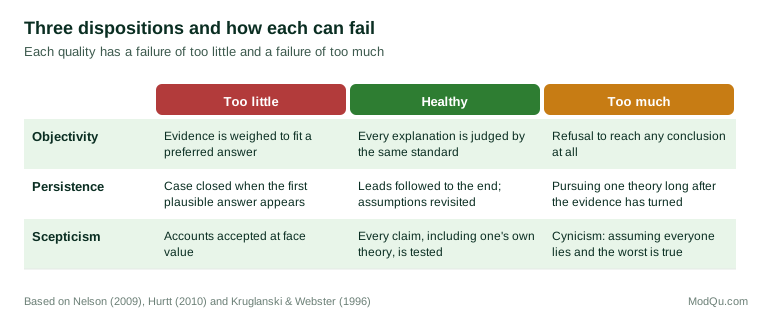
Objectivity means letting the evidence determine the conclusion, rather than letting a preferred conclusion determine which evidence counts. In practice it has three parts: approaching the case without a fixed view of the outcome, weighing evidence for and against each explanation by the same standard, and being willing to reach a conclusion that is inconvenient for the investigator, the client or the organisation.
Objectivity is difficult because the main threat to it is invisible to the person affected. Confirmation bias, the tendency to seek, interpret and remember information in ways that support an existing belief, is one of the most robust findings in psychology (Nickerson, 1998). Wason's (1960) early experiments showed that people testing a rule tend to look for cases that would confirm it rather than cases that could prove it wrong. People are also much better at spotting bias in others than in themselves, a pattern known as the bias blind spot (Pronin et al., 2002). An investigator who feels objective may therefore be no more objective than one who does not.
Research in investigative settings shows how these tendencies play out. In experiments in which participants reviewed a simulated police case file, O'Brien (2009) found that those who were asked to name a prime suspect early later recalled more information consistent with that suspect's guilt and were less open to alternatives. Rassin et al. (2010) found that participants asked to gather evidence about a suspect preferred incriminating information to exculpatory information. Kerstholt and Eikelboom (2007) found that crime analysts who had already formed an interpretation of a case were less able to see an alternative in new material. Similar effects appear in interviews: Kassin et al. (2003) showed that interviewers who presumed guilt asked more guilt-presumptive questions and put more pressure on suspects, which in turn made innocent suspects appear more defensive.
Persistence
Persistence means continuing to work a problem when the obvious leads are exhausted, following leads through to the end, and resisting the temptation to close a case because an acceptable answer has been found. Many investigations succeed because someone checked one more record, re-interviewed a witness or revisited an assumption everyone else had accepted.
Persistence has a less obvious side. The tendency to stop searching once an answer is available is closely linked to the need for cognitive closure, a desire for a firm answer and an aversion to ambiguity (Kruglanski & Webster, 1996). People high in this need, or placed under time pressure, tend to "seize" on early information and then "freeze" on the conclusion it suggests. Ask and Granhag (2005) found that police investigators with a higher need for closure were less likely to consider alternative explanations in a case. Persistence in the investigative sense therefore means persisting with the question, not with the first answer.
Research on perseverance as a personal trait, popularised under the name "grit", initially suggested that it predicted achievement independently of ability (Duckworth et al., 2007). A later meta-analysis found that its effects were more modest and largely overlapped with conscientiousness (Credé et al., 2017). For investigators, the practical lesson is that persistence is best supported by structure: case plans, review points and lists of outstanding actions make it harder to stop early, whatever an individual's temperament.
Scepticism
Scepticism means withholding belief until claims are supported by adequate evidence, and continuing to question evidence that seems to settle the matter. The accounting profession has studied this disposition closely, because auditing standards require auditors to exercise professional scepticism. Nelson (2009) defines it as an indication of the auditor's assessment that a claim needs more evidence before it is accepted, and reviews evidence that sceptical judgments depend on knowledge, incentives and personal traits. Hurtt (2010) developed a scale that measures scepticism as a combination of a questioning mind, suspension of judgment, a search for knowledge, interpersonal understanding, self-confidence and self-determination.
Scepticism in this sense is not cynicism. A cynical investigator assumes that everyone is lying and that the worst explanation is correct, which is simply a different kind of bias. A credulous investigator accepts accounts at face value. A sceptical investigator treats every account, including those that point towards guilt, as a claim to be tested. That includes the investigator's own hypotheses.
Intuition and its limits
Experienced investigators often describe a "feeling" that something is wrong. This intuition is not mystical. It reflects pattern recognition built from many past cases, and research on expert decision-making shows that it can be accurate in settings that provide regular, valid cues and quick feedback (Klein, 1998). Kahneman and Klein (2009) agreed that intuition is trustworthy only when the environment is regular enough to learn from and the expert has had a real opportunity to learn it. Investigation often fails the second test: investigators rarely learn for certain whether their judgments about cases that were never resolved were right. Intuition is therefore a good source of hypotheses and a poor substitute for evidence. A hunch should prompt a line of inquiry, not end one.
A worked illustration
Consider a hypothetical internal investigation at a distribution company. Stock losses at one warehouse have tripled in six months. The warehouse manager points to a recently hired night-shift supervisor, who has been seen leaving late and who has a previous dismissal on their record. The early information fits a familiar story, and the investigator feels the pull of it.
An investigator who lacks objectivity would start by examining the supervisor's shifts, find that losses occurred on some of them, and treat that as confirmation. An investigator who lacks persistence would stop once a suspect and a plausible motive were in view. An investigator who lacks scepticism would accept the manager's account of who was seen where without checking it against access records.
An investigator applying the mindset would begin differently. They would list the explanations that could produce the same pattern: theft by the supervisor, theft by someone else on the night shift, theft on other shifts that is only discovered at night, a counting error introduced by a new stock system, or losses at the supplier that are being recorded at the warehouse. For each explanation, they would identify the evidence that would distinguish it. Theft by one person should cluster on that person's shifts, and should continue when they are on leave only if someone else is involved. A system error should begin on the date the new system went live and should affect all shifts. Supplier shortfalls should appear on delivery records before goods are shelved.
Suppose the records show that the losses began in the week the new stock system was installed and occur at the same rate on every shift. The original theory has not been disproved outright, but it has lost most of its support, and the system explanation now has the least evidence against it. The investigator who tested the leading theory, rather than gathering evidence for it, has avoided an unfair accusation and found the real problem sooner.
Building the mindset into practice
Because biases operate largely outside awareness, telling investigators to "be objective" has little effect. The research points towards procedural safeguards that make the right habits easier and the wrong ones harder.
- Generate alternatives deliberately. At the start of a case and at each review point, list the plausible explanations, including innocent ones, and record what evidence would distinguish them. Lord et al. (1984) found that asking people to "consider the opposite" reduced biased assimilation of evidence more effectively than simply asking them to be unbiased.
- Test the leading theory, not only the alternatives. Ask what evidence would show the main hypothesis to be wrong, and look for it. Heuer (1999) developed the analysis of competing hypotheses for intelligence analysts on exactly this principle: the most likely explanation is the one with the least evidence against it, not the most evidence for it.
- Delay naming a suspect. Where possible, gather and record evidence before focusing on an individual, since early naming changes how later evidence is gathered and remembered (O'Brien, 2009).
- Separate roles. Have someone not involved in the case review it, or give a colleague the explicit task of arguing for an alternative explanation. Fresh eyes are less committed to the existing theory.
- Control information flow. In forensic work, examiners can be shielded from case information they do not need, so that it cannot shape their interpretation of the evidence.
- Plan for time pressure. Because urgency increases the need for closure, organisations should be cautious about deadlines that force premature conclusions and should record which questions remain open when a decision must be made.
Mindset as a professional standard
Different investigative professions have codified parts of the mindset. Auditing standards make scepticism a formal requirement. Intelligence agencies teach structured analytic techniques derived from Heuer's (1999) work. Investigative interviewing models used by police in the United Kingdom and elsewhere require interviewers to keep an open mind and to test the suspect's account against the evidence rather than to seek a confession. Research on expert judgment more generally shows that forecasters who are open to changing their minds and who think in terms of probabilities make more accurate predictions than those who are committed to a single big idea (Tetlock, 2005).
What these standards share is the recognition that good thinking cannot be left to individual virtue. The investigative mindset is partly a matter of personal disposition, but it is mainly a matter of habits, reinforced by procedures that make it normal to question, to keep looking and to change one's mind when the evidence demands it.
Implications beyond investigation
The same dispositions matter wherever people draw conclusions from evidence. Researchers analysing survey data face the temptation to stop analysing when they find the result they expected, and to scrutinise surprising results more harshly than welcome ones. Managers reading a report are inclined to accept findings that confirm their plans and question those that do not. The practical safeguards are the same: state the question and the alternative explanations in advance, apply the same scrutiny to welcome and unwelcome findings, and record what was checked. An organisation that builds these habits into its research and decision-making gains some of the protection that the investigative mindset gives to a well-run investigation.
References
Ask, K., & Granhag, P. A. (2005). Motivational sources of confirmation bias in criminal investigations: The need for cognitive closure. Journal of Investigative Psychology and Offender Profiling, 2(1), 43–63. https://doi.org/10.1002/jip.19
Credé, M., Tynan, M. C., & Harms, P. D. (2017). Much ado about grit: A meta-analytic synthesis of the grit literature. Journal of Personality and Social Psychology, 113(3), 492–511. https://doi.org/10.1037/pspp0000102
Duckworth, A. L., Peterson, C., Matthews, M. D., & Kelly, D. R. (2007). Grit: Perseverance and passion for long-term goals. Journal of Personality and Social Psychology, 92(6), 1087–1101. https://doi.org/10.1037/0022-3514.92.6.1087
Findley, K. A., & Scott, M. S. (2006). The multiple dimensions of tunnel vision in criminal cases. Wisconsin Law Review, 2006(2), 291–397.
Heuer, R. J., Jr. (1999). Psychology of intelligence analysis. Center for the Study of Intelligence, Central Intelligence Agency.
Hurtt, R. K. (2010). Development of a scale to measure professional skepticism. Auditing: A Journal of Practice & Theory, 29(1), 149–171. https://doi.org/10.2308/aud.2010.29.1.149
Kahneman, D., & Klein, G. (2009). Conditions for intuitive expertise: A failure to disagree. American Psychologist, 64(6), 515–526. https://doi.org/10.1037/a0016755
Kahneman, D. (2011). Thinking, fast and slow. Farrar, Straus and Giroux.
Kassin, S. M., Goldstein, C. C., & Savitsky, K. (2003). Behavioral confirmation in the interrogation room: On the dangers of presuming guilt. Law and Human Behavior, 27(2), 187–203. https://doi.org/10.1023/A:1022599230598
Kerstholt, J. H., & Eikelboom, A. R. (2007). Effects of prior interpretation on situation assessment in crime analysis. Journal of Behavioral Decision Making, 20(5), 455–465. https://doi.org/10.1002/bdm.570
Klein, G. (1998). Sources of power: How people make decisions. MIT Press.
Kruglanski, A. W., & Webster, D. M. (1996). Motivated closing of the mind: "Seizing" and "freezing." Psychological Review, 103(2), 263–283. https://doi.org/10.1037/0033-295X.103.2.263
Lord, C. G., Lepper, M. R., & Preston, E. (1984). Considering the opposite: A corrective strategy for social judgment. Journal of Personality and Social Psychology, 47(6), 1231–1243. https://doi.org/10.1037/0022-3514.47.6.1231
Nelson, M. W. (2009). A model and literature review of professional skepticism in auditing. Auditing: A Journal of Practice & Theory, 28(2), 1–34. https://doi.org/10.2308/aud.2009.28.2.1
Nickerson, R. S. (1998). Confirmation bias: A ubiquitous phenomenon in many guises. Review of General Psychology, 2(2), 175–220. https://doi.org/10.1037/1089-2680.2.2.175
O'Brien, B. (2009). Prime suspect: An examination of factors that aggravate and counteract confirmation bias in criminal investigations. Psychology, Public Policy, and Law, 15(4), 315–334. https://doi.org/10.1037/a0017881
Pronin, E., Lin, D. Y., & Ross, L. (2002). The bias blind spot: Perceptions of bias in self versus others. Personality and Social Psychology Bulletin, 28(3), 369–381. https://doi.org/10.1177/0146167202286008
Rassin, E., Eerland, A., & Kuijpers, I. (2010). Let's find the evidence: An analogue study of confirmation bias in criminal investigations. Journal of Investigative Psychology and Offender Profiling, 7(3), 231–246. https://doi.org/10.1002/jip.126
Tetlock, P. E. (2005). Expert political judgment: How good is it? How can we know? Princeton University Press.
Tversky, A., & Kahneman, D. (1974). Judgment under uncertainty: Heuristics and biases. Science, 185(4157), 1124–1131. https://doi.org/10.1126/science.185.4157.1124
Wason, P. C. (1960). On the failure to eliminate hypotheses in a conceptual task. Quarterly Journal of Experimental Psychology, 12(3), 129–140. https://doi.org/10.1080/17470216008416717