
Investigation · Law, ethics and regulation
The Distinction Between Administrative and Criminal Investigation Knowledge Standards
The same conduct can be investigated administratively, by an employer or regulator, and criminally, by police and prosecutors, but the two kinds of investigation work to different standards of proof, powers and safeguards. This article explains the differences, why they exist, the problems that arise when the two overlap, and how to run parallel investigations fairly.
When an employee steals from their employer, a company misleads investors, or a care worker harms a patient, more than one investigation may follow. The employer may hold a disciplinary investigation. A regulator may investigate a breach of its rules. The police may investigate a crime. Each investigation asks broadly the same question, what happened and who was responsible, but each works to different standards of proof, with different powers and different safeguards for the person investigated. These differences are deliberate. They reflect the different consequences of each process. But they create practical and ethical problems when investigations overlap. This article explains the distinction between administrative and criminal investigation standards and how to manage it.
Different purposes, different standards
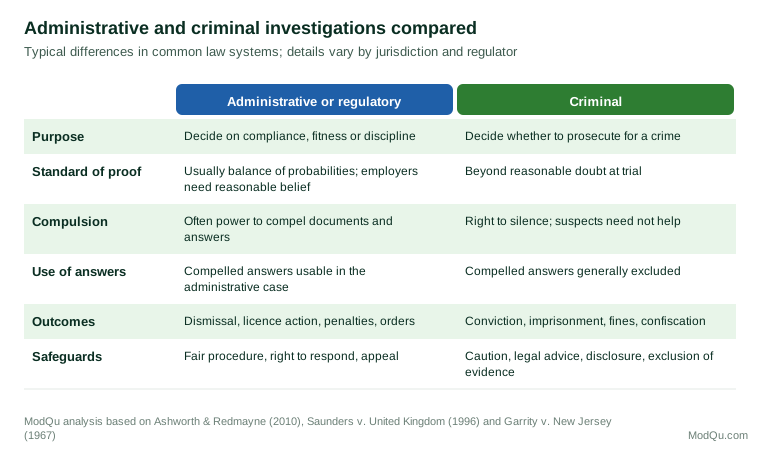
Criminal investigations aim to establish whether a crime has been committed and to gather evidence that can prove guilt in court. Because a criminal conviction can lead to imprisonment and carries lasting stigma, the criminal standard of proof is high: guilt must be proved beyond reasonable doubt. Packer (1964) described how the criminal process balances the aim of controlling crime against the need for safeguards against wrongful conviction, and Ashworth and Redmayne (2010) explain how procedural protections, such as the right to silence and the exclusion of improperly obtained evidence, follow from the seriousness of criminal sanctions.
Administrative investigations, by employers, professional bodies and regulators, aim to decide whether rules have been broken and what action is needed to protect the public, the organisation or others. Their consequences, such as dismissal, loss of a licence or a financial penalty, are serious but generally less severe than criminal punishment. They usually apply the civil standard: the balance of probabilities, meaning that something is more likely than not to have happened. In English law, the House of Lords confirmed that there is only one civil standard of proof, the balance of probabilities, although the inherent improbability of an event may be relevant to whether it is proved (In re B (Children), 2008; In re H (Minors), 1996). In the United States, some civil and administrative matters require an intermediate standard of "clear and convincing evidence", used where interests at stake are particularly important (Addington v. Texas, 1979).
In employment cases, the standard is different again. An employer dismissing for misconduct need not prove the misconduct on the balance of probabilities; it must show a genuine belief in guilt, reasonable grounds for that belief, and a reasonable investigation (British Home Stores Ltd v Burchell, 1980).
Clermont and Sherwin (2002) note that common law systems distinguish clearly between civil and criminal standards, while many civil law systems apply a single high standard of conviction in both, illustrating that these choices are matters of legal design rather than logic alone.
Different powers and safeguards
The difference in standards is matched by differences in powers. Regulators often have power to compel people to produce documents and answer questions, on pain of a penalty for refusing. Employers can require employees to cooperate with investigations as a term of employment. Criminal suspects, by contrast, have a right to remain silent and need not help the prosecution prove its case.
This creates a problem when answers obtained under compulsion in an administrative investigation are later used in a criminal prosecution. In Saunders v. United Kingdom (1996), the European Court of Human Rights held that the use at a criminal trial of statements the applicant had been compelled to give to inspectors investigating a company takeover violated his right to a fair trial, because it undermined the privilege against self-incrimination. United Kingdom law was then amended so that compelled answers generally cannot be used against a person in criminal proceedings, for example under financial services legislation (Financial Services and Markets Act 2000, s. 174). The Serious Fraud Office can compel answers in fraud investigations, but those answers generally cannot be used as evidence against the person who gave them, except in limited circumstances (Criminal Justice Act 1987, s. 2).
The United States reached a similar position for public employees. In Garrity v. New Jersey (1967), the Supreme Court held that statements obtained from police officers under threat of dismissal could not be used against them in criminal prosecutions. In Kastigar v. United States (1972), it held that the government may compel testimony by granting immunity, provided that neither the testimony nor evidence derived from it is used against the witness.
When are administrative proceedings really criminal?
Labels do not settle the question. The European Court of Human Rights has held that whether proceedings involve a "criminal charge", attracting the full protections of a fair criminal trial, depends on the classification in national law, the nature of the offence, and the nature and severity of the penalty (Engel and Others v. the Netherlands, 1976). Large administrative fines with a punitive purpose may therefore count as criminal for this purpose, even if national law calls them administrative.
The same conduct may also lead to both administrative and criminal penalties. In A and B v. Norway (2016), the European Court of Human Rights held that combining tax penalties and criminal prosecution for the same conduct did not breach the prohibition on being tried twice, provided that the proceedings were sufficiently closely connected in substance and time to form a coherent whole. In Hudson v. United States (1997), the United States Supreme Court held that civil penalties imposed by a banking regulator did not prevent a later criminal prosecution.
Problems with parallel investigations
When administrative and criminal investigations run at the same time, several problems arise.
Contamination of the criminal case. If an employer or regulator interviews a suspect under compulsion and shares the answers with police, the criminal case may be compromised. Evidence derived from compelled answers may be challenged.
Prejudice to the person. A person facing both processes may have to choose between defending themselves in the disciplinary case, which may require them to explain their conduct, and protecting their position in the criminal case.
Delay. Employers and regulators are sometimes asked to pause their investigations until criminal proceedings end, which can take years and leave people suspended and matters unresolved.
Different conclusions. Because standards differ, an employer may reasonably dismiss an employee for misconduct, or a regulator may find a breach, even if a criminal court later acquits. This is not inconsistent: the administrative finding answers a different question to a lower standard. But it can seem unfair to the person and confusing to the public.
Privilege. In corporate internal investigations, lawyers' interviews with employees may be protected by legal professional privilege, but the privilege belongs to the company, not the employee. In Upjohn Co. v. United States (1981), the United States Supreme Court held that communications between company lawyers and employees could be privileged, and the case gave rise to the practice of warning employees that the lawyer represents the company and that the company may waive privilege and share what they say with authorities.
Running parallel investigations fairly
Several practices help manage the overlap:
- Identify the overlap early. At the start of an administrative investigation, ask whether the conduct could be criminal and whether police or prosecutors are or may become involved.
- Agree a protocol. Where both processes are active, agree with the criminal investigators what the administrative investigation will do, when, and what information will be shared.
- Separate compelled material. Keep compelled answers and material derived from them separate, and do not pass them to criminal investigators unless the law permits.
- Inform the person. Tell people interviewed what the investigation is for, whether they are required to answer, how their answers may be used, and that they may wish to take legal advice.
- Apply the right standard. Make findings against the standard that applies to the administrative process, and say so, rather than implying a criminal finding.
- Avoid unnecessary delay. Pause administrative action only when there is a real risk of prejudice, and keep the decision under review.
Regulatory theory also suggests that administrative and criminal responses should be coordinated as part of a single strategy. Ayres and Braithwaite (1992) proposed an enforcement pyramid in which regulators begin with persuasion and escalate to sanctions, and to criminal prosecution only for the most serious or persistent cases. Baldwin et al. (2012) describe how regulators choose between administrative and criminal routes depending on the seriousness of the breach, the evidence available and the deterrent effect sought. The United States Securities and Exchange Commission's enforcement manual describes how its staff coordinate parallel civil and criminal proceedings with criminal authorities while observing restrictions on sharing certain material (U.S. Securities and Exchange Commission, Division of Enforcement, 2017).
A short example
The following hypothetical case illustrates the distinction. A finance officer at a survey company is suspected of diverting payments intended for respondents into an account he controls. The company begins a disciplinary investigation and reports the matter to the police. The police ask the company not to interview the officer about the payments until they have done so. The company agrees, suspends the officer on full pay, and limits its own work to securing records. After the police interview, at which the officer declines to answer questions, the company holds its disciplinary interview, explaining that it is an employment process, that the officer is not obliged to answer but that the company may draw conclusions from the evidence if he does not, and that the company may share information with the police where the law allows. On the documentary evidence, the company concludes that it has a reasonable belief that the officer diverted the payments and dismisses him. A year later, a criminal court acquits him because the prosecution cannot exclude the possibility that a colleague with access to his login made some of the transfers. The company's decision stands, because it was reached on a different question and to a different standard, and the company records both outcomes.
Conclusion
Administrative and criminal investigations often examine the same conduct, but they differ in purpose, standard of proof, powers and safeguards. Criminal cases require proof beyond reasonable doubt and protect suspects' right to silence; administrative cases usually apply the balance of probabilities and may compel cooperation, while employment cases require a reasonable belief based on a reasonable investigation. The law limits the use of compelled answers in criminal proceedings, and courts look beyond labels to decide when proceedings are truly criminal. Investigators who recognise overlaps early, coordinate with other authorities, keep compelled material separate, inform people of their position and apply the correct standard can run parallel investigations that are both effective and fair.
References
A and B v. Norway, nos. 24130/11 and 29758/11, 15 November 2016.
Addington v. Texas, 441 U.S. 418 (1979).
Ashworth, A., & Redmayne, M. (2010). The criminal process (4th ed.). Oxford University Press.
Ayres, I., & Braithwaite, J. (1992). Responsive regulation: Transcending the deregulation debate. Oxford University Press.
Baldwin, R., Cave, M., & Lodge, M. (2012). Understanding regulation: Theory, strategy, and practice (2nd ed.). Oxford University Press.
British Home Stores Ltd v Burchell [1980] ICR 303 (EAT).
Clermont, K. M., & Sherwin, E. (2002). A comparative view of standards of proof. The American Journal of Comparative Law, 50(2), 243–275. https://doi.org/10.2307/840821
Criminal Justice Act 1987, c. 38 (UK).
Engel and Others v. the Netherlands, 8 June 1976, Series A no. 22.
Financial Services and Markets Act 2000, c. 8 (UK).
Garrity v. New Jersey, 385 U.S. 493 (1967).
Hudson v. United States, 522 U.S. 93 (1997).
In re B (Children) [2008] UKHL 35.
In re H (Minors) [1996] AC 563.
Kastigar v. United States, 406 U.S. 441 (1972).
Packer, H. L. (1964). Two models of the criminal process. University of Pennsylvania Law Review, 113(1), 1–68. https://doi.org/10.2307/3310562
Saunders v. United Kingdom, 17 December 1996, Reports of Judgments and Decisions 1996-VI.
Upjohn Co. v. United States, 449 U.S. 383 (1981).
U.S. Securities and Exchange Commission, Division of Enforcement. (2017). Enforcement manual.