
Investigation · Law, ethics and regulation
The Role of Expert Witnesses in Translating Investigative Knowledge for Audiences
Expert witnesses turn specialist investigative findings into evidence that judges, juries, tribunals and boards can understand and weigh. This article explains the expert's legal role and duties, the standards for admitting expert evidence, how lay audiences understand technical testimony, lessons from miscarriages of justice, and practical guidance on communicating findings clearly and honestly.
Investigations increasingly depend on specialist knowledge: DNA and fingerprint analysis, digital forensics, accounting, engineering, medicine, statistics and many other fields. The people who must make decisions on the results, such as judges, juries, tribunal members, regulators and company boards, usually lack that knowledge. Expert witnesses stand between the two. Their task is to explain what the specialist evidence shows, what it does not show, and how confident one can be, in terms the decision-maker can understand and test. When they do this well, specialist knowledge improves decisions. When they do it badly, by overstating certainty, misusing statistics or presenting opinion as fact, they can cause grave injustice. This article examines the role of experts, the rules that govern them, how audiences understand expert testimony, and how experts can translate investigative knowledge faithfully.
The expert's role and duties
Most witnesses may only describe what they saw or heard. Expert witnesses are permitted to give opinions, because their specialist knowledge allows them to draw inferences that the decision-maker could not draw unaided. In United States federal courts, a qualified expert may testify in the form of an opinion if the expert's knowledge will help the trier of fact, the testimony is based on sufficient facts or data, it is the product of reliable principles and methods, and the expert has reliably applied those methods to the case (Fed. R. Evid. 702).
The privilege of giving opinion comes with duties. In a leading English case, The Ikarian Reefer (1993), the court set out that expert evidence should be, and should be seen to be, the independent product of the expert uninfluenced by the demands of litigation; that the expert should provide independent assistance by way of objective, unbiased opinion; that the expert should state the facts and assumptions on which the opinion is based and not omit material facts that detract from it; and that the expert should make clear when a question falls outside their expertise or when an opinion is provisional. These duties are now written into procedural rules. In civil cases in England and Wales, the expert's overriding duty is to the court, and it overrides any obligation to the party who instructed or paid them (Civil Procedure Rules, 1998, Part 35). The Criminal Procedure Rules impose similar duties in criminal cases and require experts to disclose anything that might undermine their reliability (Criminal Procedure Rules 2020, Part 19).
Independence is harder to achieve than to state. Murrie et al. (2013) asked forensic psychologists and psychiatrists to score the same case files on standard risk assessment instruments, telling some that they had been retained by the prosecution and others by the defence. Experts who believed they worked for the prosecution assigned higher risk scores than those who believed they worked for the defence, an effect the authors called adversarial allegiance. Kassin et al. (2013) review how contextual information, including knowledge of what investigators expect, can bias forensic judgements.
Standards for admitting expert evidence
Courts act as gatekeepers, deciding whether expert evidence is reliable enough to be heard. In the United States, the older test in Frye v. United States (1923) admitted scientific evidence if the method was generally accepted in the relevant field. In Daubert v. Merrell Dow Pharmaceuticals, Inc. (1993), the Supreme Court held that judges must assess the reliability of scientific evidence directly, considering factors such as whether the method has been tested, whether it has been subject to peer review, its known or potential error rate, the existence of standards controlling its operation, and its general acceptance. In Kumho Tire Co. v. Carmichael (1999), the Court extended this gatekeeping duty to all expert testimony, including technical and experience-based expertise.
In England and Wales, the Law Commission (2011) found that expert evidence was too readily admitted without sufficient scrutiny of its reliability, and recommended a statutory reliability test. Although the recommendation was not enacted as legislation, the Criminal Procedure Rules and associated practice directions now set out factors for courts to consider in assessing reliability.
Scientific reviews have shown why gatekeeping matters. The National Research Council (2009) found that much forensic science other than DNA analysis lacked a rigorous scientific foundation, and the President's Council of Advisors on Science and Technology (2016) found that several feature-comparison methods lacked adequate evidence of validity and known error rates. Garrett and Neufeld (2009), analysing trial transcripts in cases of people later exonerated by DNA, found that in a majority of cases where forensic analysts testified for the prosecution, the testimony was invalid: it misstated the evidence, overstated its significance or presented unsupported conclusions.
How audiences understand expert evidence
The decision-maker's understanding is the point of expert evidence, so research on how people process it is important.
Complexity and credentials. Cooper et al. (1996) found that when expert testimony was highly complex, mock jurors were more influenced by the expert's credentials than by the content of the testimony; when testimony was simpler, they paid more attention to its substance. Complexity thus shifts decisions from evidence to authority, the opposite of what is intended.
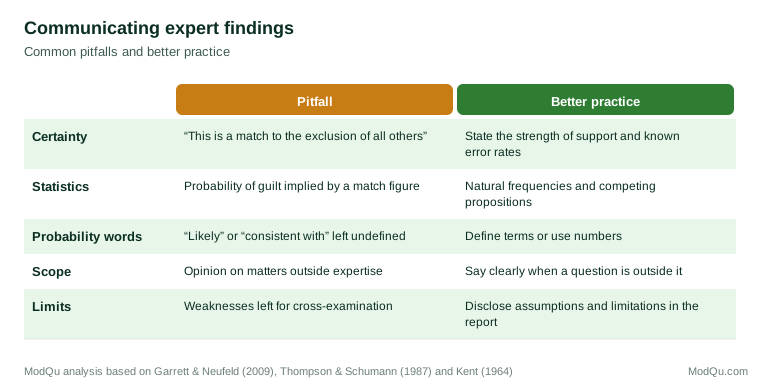
Statistics. People struggle to interpret probabilities. Thompson and Schumann (1987) found that mock jurors frequently confused the probability of the evidence given innocence with the probability of innocence given the evidence, the prosecutor's fallacy. Koehler (2001) found that the way DNA match statistics were framed, for example as a probability for a single person or as a frequency in a population, affected how persuasive people found them. Gigerenzer and Hoffrage (1995) showed that presenting information as natural frequencies, such as "10 out of 10,000 people", greatly improves people's ability to reason with probabilities.
Words of probability. Kent (1964) found that readers interpreted verbal expressions of probability, such as "probable" or "likely", across very wide numerical ranges. Experts who use such terms without defining them may be understood very differently by different listeners.
Expectations. Some commentators have suggested that television dramas lead jurors to expect forensic evidence in every case, the so-called "CSI effect". Shelton et al. (2006), surveying jurors, found that many did expect scientific evidence, but that these expectations did not translate straightforwardly into acquittals in its absence. Schweitzer and Saks (2007) found that viewers of forensic dramas were more critical of the forensic evidence presented to them. The evidence for a simple effect on verdicts is limited, but experts should be prepared to explain why particular tests were or were not done.
Lessons from miscarriages of justice
Several cases show how expert evidence can go wrong.
In the trial of Sally Clark, convicted in 1999 of murdering her two baby sons, a paediatrician told the jury that the chance of two sudden infant deaths in a family like hers was about 1 in 73 million. The figure wrongly assumed that the deaths were independent and was easily heard as the probability that she was innocent. Her conviction was quashed in 2003, principally because evidence of an infection in one child had not been disclosed (R v Clark, 2003). In R v Cannings (2004), another conviction for the murder of infants was quashed, and the Court of Appeal warned against prosecutions that depend on disputed expert opinion about the cause of unexplained infant deaths when there is no other cogent evidence.
The FBI's misidentification of Brandon Mayfield's fingerprint in connection with the 2004 Madrid train bombings, confirmed by several examiners, showed that expert certainty is not proof of accuracy (Office of the Inspector General, 2006).
The common lesson is that experts must stay within the limits of their evidence, state those limits clearly and avoid statements that sound more certain than the science supports.
Translating findings faithfully
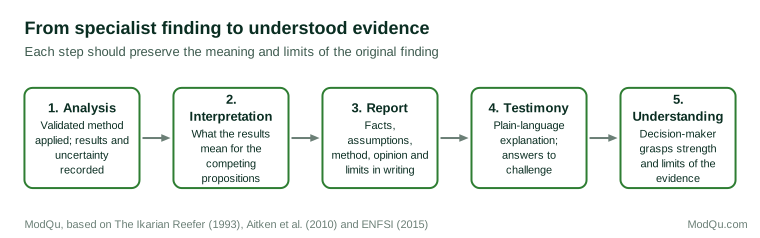
Address the right question. Experts should be clear about which proposition their evidence addresses. A DNA result may show that a person was the likely source of a sample, but say little about how or when it was deposited. Guidance on evaluative reporting recommends that experts consider at least two competing propositions and express the strength of the evidence in terms of how much more probable it is under one than the other, rather than giving a probability that a proposition is true (Aitken et al., 2010; European Network of Forensic Science Institutes [ENFSI], 2015).
Separate observation from opinion. Reports should distinguish what the expert observed or measured, what they inferred and what they assumed, so that the decision-maker can see where judgement enters.
Use plain language and concrete examples. Technical terms should be explained or avoided. Numbers should be given as natural frequencies where possible, and verbal expressions of strength should be tied to defined meanings.
State limitations. Experts should say what their method cannot do, its known error rates, what was not examined and what alternative explanations exist.
Use visual aids carefully. Charts and diagrams can clarify, but they can also exaggerate. Scales should not be truncated to make differences look larger, and illustrations should be clearly identified as illustrations.
Experts outside the courtroom
The same principles apply when specialists report to non-judicial audiences. An internal investigation may rely on a forensic accountant's analysis to decide whether to dismiss an employee; a regulator may rely on an engineer's report to decide whether to close a plant; a board may rely on a data scientist's analysis of survey responses to decide whether fraud has occurred. These audiences, like juries, may be swayed by credentials and complexity. Specialists who write reports for them should follow the same discipline: state the question, separate findings from opinion, explain the strength of the evidence in plain terms, and disclose limitations. Investigators who commission such reports should ask experts to address the competing explanations explicitly and should avoid telling experts which conclusion they expect.
Working with experts
Investigators who instruct experts can improve the quality of what reaches the decision-maker. They should choose experts with demonstrated competence in the specific method, provide clear written instructions setting out the questions, supply all relevant material including material that may undermine the case, avoid sharing irrelevant information that could bias the analysis, ask for the expert's reasoning and limitations in writing, and consider whether a second expert should review key conclusions. Where experts disagree, structured meetings between them to identify points of agreement and disagreement can help decision-makers focus on what matters. In civil proceedings in England and Wales, courts can direct experts to meet and produce a joint statement of the issues on which they agree and disagree, with reasons, and can hear opposing experts together so that they respond to each other directly (Civil Procedure Rules, 1998, Part 35). Investigators can borrow the same approach informally when specialists reach different conclusions in an internal investigation, asking each to state precisely where and why they differ.
A short example
The following hypothetical case illustrates good practice. A market research firm suspects that a subcontractor has supplied fabricated survey responses. The firm instructs a data analyst to examine the data. The analyst's first draft states that the responses "are clearly fabricated". The investigator asks the analyst to set out the competing explanations and the evidence for each. The revised report explains that 600 responses were completed in under two minutes for a survey that takes at least eight minutes to read, that 410 contain identical answer sequences, and that such patterns occurred in fewer than 1 in 1,000 responses from other subcontractors. It states that these findings are many times more likely if responses were fabricated than if they were genuine but rushed, notes that the analyst cannot determine who produced them, and explains the method and its limits in plain language with a simple chart. When the subcontractor disputes the finding at arbitration, the tribunal can see exactly what the analyst found, how strong it is and where judgement was involved.
Conclusion
Expert witnesses translate specialist investigative knowledge into evidence that decision-makers can use. The law gives them the privilege of offering opinions and imposes duties of independence, objectivity and candour. Courts act as gatekeepers on reliability, and scientific reviews have shown why that role matters. Research shows that lay audiences are swayed by complexity and credentials and struggle with probabilities, and miscarriages of justice show the consequences when experts overstate their evidence. Experts who address the right propositions, separate observation from opinion, express strength honestly in plain terms and disclose their limitations allow decision-makers to understand and test the knowledge they bring.
References
Aitken, C., Roberts, P., & Jackson, G. (2010). Fundamentals of probability and statistical evidence in criminal proceedings: Guidance for judges, lawyers, forensic scientists and expert witnesses (Practitioner Guide No. 1). Royal Statistical Society.
Civil Procedure Rules 1998, SI 1998/3132, Part 35 (UK).
Cooper, J., Bennett, E. A., & Sukel, H. L. (1996). Complex scientific testimony: How do jurors make decisions? Law and Human Behavior, 20(4), 379–394. https://doi.org/10.1007/BF01498976
Criminal Procedure Rules 2020, SI 2020/759, Part 19 (UK).
Daubert v. Merrell Dow Pharmaceuticals, Inc., 509 U.S. 579 (1993).
European Network of Forensic Science Institutes. (2015). ENFSI guideline for evaluative reporting in forensic science.
Fed. R. Evid. 702.
Frye v. United States, 293 F. 1013 (D.C. Cir. 1923).
Garrett, B. L., & Neufeld, P. J. (2009). Invalid forensic science testimony and wrongful convictions. Virginia Law Review, 95(1), 1–97.
Gigerenzer, G., & Hoffrage, U. (1995). How to improve Bayesian reasoning without instruction: Frequency formats. Psychological Review, 102(4), 684–704. https://doi.org/10.1037/0033-295X.102.4.684
Kassin, S. M., Dror, I. E., & Kukucka, J. (2013). The forensic confirmation bias: Problems, perspectives, and proposed solutions. Journal of Applied Research in Memory and Cognition, 2(1), 42–52. https://doi.org/10.1016/j.jarmac.2013.01.001
Kent, S. (1964). Words of estimative probability. Studies in Intelligence, 8(4), 49–65.
Koehler, J. J. (2001). When are people persuaded by DNA match statistics? Law and Human Behavior, 25(5), 493–513. https://doi.org/10.1023/A:1012892815916
Kumho Tire Co. v. Carmichael, 526 U.S. 137 (1999).
Law Commission. (2011). Expert evidence in criminal proceedings in England and Wales (Law Com No 325, HC 829). The Stationery Office.
Murrie, D. C., Boccaccini, M. T., Guarnera, L. A., & Rufino, K. A. (2013). Are forensic experts biased by the side that retained them? Psychological Science, 24(10), 1889–1897. https://doi.org/10.1177/0956797613481812
National Research Council. (2009). Strengthening forensic science in the United States: A path forward. National Academies Press. https://doi.org/10.17226/12589
Office of the Inspector General. (2006). A review of the FBI's handling of the Brandon Mayfield case. U.S. Department of Justice.
President's Council of Advisors on Science and Technology. (2016). Forensic science in criminal courts: Ensuring scientific validity of feature-comparison methods. Executive Office of the President.
R v Cannings [2004] EWCA Crim 1.
R v Clark [2003] EWCA Crim 1020.
Schweitzer, N. J., & Saks, M. J. (2007). The CSI effect: Popular fiction about forensic science affects the public's expectations about real forensic science. Jurimetrics, 47(3), 357–364.
Shelton, D. E., Kim, Y. S., & Barak, G. (2006). A study of juror expectations and demands concerning scientific evidence: Does the "CSI effect" exist? Vanderbilt Journal of Entertainment and Technology Law, 9(2), 331–368.
The Ikarian Reefer (National Justice Compania Naviera SA v Prudential Assurance Co Ltd) [1993] 2 Lloyd's Rep 68.
Thompson, W. C., & Schumann, E. L. (1987). Interpretation of statistical evidence in criminal trials: The prosecutor's fallacy and the defense attorney's fallacy. Law and Human Behavior, 11(3), 167–187. https://doi.org/10.1007/BF01044641