
Investigation · Law, ethics and regulation
Ethical Guidelines for Undercover and Confidential Source Handling
Undercover officers and confidential informants can reach information no other method can, but they involve deception, risk and the possibility of serious abuse. This article explains the ethical principles and legal safeguards for covert work, the lessons of scandals and miscarriages of justice, and practical guidelines for authorising, managing and reviewing covert sources.
Some information can be obtained only from inside. Organised criminal groups, corrupt networks and closed communities rarely reveal themselves to outsiders, so investigators use undercover officers, who pose as someone else, and confidential sources, often called informants, who pass on what they know while remaining part of the group. These methods have solved serious crimes and prevented harm. They also involve deliberate deception, intrude deeply into people's private lives, place sources and officers at risk, and create opportunities for manipulation and abuse. This article sets out the ethical principles and legal safeguards that should govern covert work.
Why covert methods raise ethical problems
Marx (1988), in a classic study of undercover policing in the United States, described the method as a necessary evil: effective against hidden crime but carrying inherent risks, including the creation of crimes that would not otherwise have occurred, damage to innocent third parties, harm to the officers themselves and the erosion of trust. Joh (2009) examined how undercover officers are authorised to take part in crimes in order to maintain their cover, and argued that this "authorised criminality" needs clearer limits and oversight.
Informants raise further problems. They are often involved in crime themselves, may be motivated by money, revenge or leniency, and have strong incentives to tell investigators what they want to hear. Natapoff (2009) documented how reliance on criminal informants in the United States has contributed to wrongful convictions, allowed informants to continue offending, and concentrated harm in poor communities. Dunnighan and Norris (1999) found in England that the management of informants was often poorly controlled, and that the benefits claimed for informant use were not always matched by results.
Lessons from scandals
The United Kingdom's experience shows what can go wrong. Undercover officers from specialist police units infiltrated protest and campaign groups for decades. Some formed long-term intimate relationships with women in those groups, using false identities. In DIL v Commissioner of Police of the Metropolis (2014), the High Court allowed claims by women deceived into relationships to proceed, and the police later apologised and acknowledged that such relationships were wrong. An independent review found that an undercover officer had been deployed within the campaign of the family of murdered teenager Stephen Lawrence (Ellison, 2014). A public inquiry into undercover policing since 1968 concluded in its first interim report that many of these deployments could not be justified and that the intrusion into people's lives was not proportionate to any benefit (Undercover Policing Inquiry, 2023).
Legal safeguards
Most democracies now regulate covert methods. In the United Kingdom, the Regulation of Investigatory Powers Act 2000 requires that the use of covert human intelligence sources, including undercover officers and informants, be authorised in advance by a senior officer, and that the authorising officer be satisfied that the use is necessary and proportionate. A statutory code of practice sets out requirements for risk assessment, record keeping and oversight (Home Office, 2022). The Covert Human Intelligence Sources (Criminal Conduct) Act 2021 created a framework for authorising sources to participate in crime, with limits.
Courts also set limits on how far covert operations can go. Entrapment, in which officers induce someone to commit an offence they would not otherwise have committed, is a defence or ground for excluding evidence in many systems. In Jacobson v. United States (1992), the United States Supreme Court held that the government had failed to prove that the defendant was predisposed to commit the offence before government agents spent more than two years encouraging him. In R v Looseley (2001), the House of Lords held that it would be an abuse of process to prosecute where police had caused a crime rather than providing an unexceptional opportunity to commit it. The European Court of Human Rights found a violation of the right to a fair trial where undercover officers had incited an offence in Teixeira de Castro v. Portugal (1998).
Ethical principles
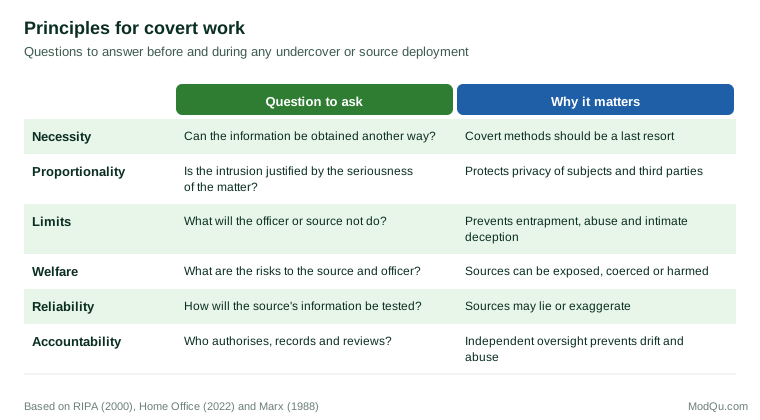
Drawing on law, inquiries and research, several principles emerge:
Necessity and last resort. Covert methods should be used only when the information cannot reasonably be obtained by open means.
Proportionality. The intrusion into the private lives of the subject and of third parties must be justified by the seriousness of the matter. Infiltrating lawful political or campaigning groups requires particularly strong justification.
Clear limits. Deployments should specify what the officer or source may and may not do. Intimate or sexual relationships under a false identity are now widely regarded as unacceptable. Participation in crime should be authorised only within defined limits.
Welfare. Sources often face serious danger if exposed and may be vulnerable, including young people and those dependent on drugs. Handlers have a duty of care, and risk assessments should be recorded and reviewed.
Testing reliability. Information from sources should be graded, corroborated and never relied on alone for important decisions. Rewards and other benefits given to sources must be recorded and disclosed where required, because they affect credibility.
Separation of roles. The officer who handles a source should be separate from the officer who controls the operation and from the investigation team, to reduce the risk of manipulation and over-reliance.
Accountability. Every deployment should be authorised in advance, documented, reviewed regularly and subject to independent oversight.
A short example
The following hypothetical case shows these principles in an organisational setting. A distribution company suspects that staff at one depot are selling stolen stock to a local trader. An employee approaches the investigator and offers to report on colleagues in return for a promotion. The investigator declines to offer any reward, records the approach, and considers whether open methods would work first. Stock audits and camera footage narrow the losses to two shifts but do not identify who is involved. With legal advice and senior approval, the company authorises the employee to report what they observe in the normal course of their work, but not to encourage anyone to steal, not to take part in theft and not to search colleagues' belongings. The handler meets the employee regularly, records each meeting, assesses the risks to the employee and reviews the arrangement after four weeks. The employee's reports are tested against footage and stock records, which confirm the involvement of two staff members. The final report relies on the footage and records, and the employee's identity is protected throughout.
Covert methods outside policing
Private investigators, journalists and organisations conducting internal investigations sometimes use covert methods, such as test purchases or employees posing as customers. The same ethical questions apply, and the legal constraints can be stricter, because private bodies lack the statutory powers of the police. Deception in research is generally permitted only when it is essential, causes no significant harm and is followed by debriefing.
Conclusion
Undercover officers and confidential sources can reach knowledge that other methods cannot. Their use involves deception, intrusion and risk, and history shows that without firm limits they can cause serious harm to innocent people, to sources and to public trust. Legal frameworks now require authorisation, necessity, proportionality and oversight, and courts exclude evidence obtained through entrapment. Investigators who treat covert methods as a last resort, set clear limits, care for sources, test their information and record every decision can use these methods ethically.
References
Covert Human Intelligence Sources (Criminal Conduct) Act 2021, c. 4 (UK).
DIL v Commissioner of Police of the Metropolis [2014] EWHC 2184 (QB).
Dunnighan, C., & Norris, C. (1999). The detective, the snout, and the Audit Commission: The real costs in using informants. The Howard Journal of Criminal Justice, 38(1), 67–86. https://doi.org/10.1111/1468-2311.00117
Ellison, M. (2014). The Stephen Lawrence independent review: Possible corruption and the role of undercover policing in the Stephen Lawrence case (HC 1094). The Stationery Office.
Home Office. (2022). Covert human intelligence sources: Revised code of practice.
Jacobson v. United States, 503 U.S. 540 (1992).
Joh, E. E. (2009). Breaking the law to enforce it: Undercover police participation in crime. Stanford Law Review, 62(1), 155–198.
Marx, G. T. (1988). Undercover: Police surveillance in America. University of California Press.
Natapoff, A. (2009). Snitching: Criminal informants and the erosion of American justice. NYU Press.
Regulation of Investigatory Powers Act 2000, c. 23 (UK).
R v Looseley [2001] UKHL 53.
Teixeira de Castro v. Portugal, no. 25829/94, ECHR 1998-IV.
Undercover Policing Inquiry. (2023). Tranche 1 interim report.