
Investigation · Law, ethics and regulation
Competition and Antitrust Investigations
Competition authorities investigate cartels, abuses of market power and other practices that harm competition. This article explains what they investigate, how cartels are detected, the powers and methods used, the role of leniency programmes and economic analysis, landmark cases, and what businesses should know.
When competitors secretly agree to fix prices, divide customers or rig bids, or when a dominant company uses its power to exclude rivals, customers pay more, choice shrinks and innovation slows. Competition law, known in the United States as antitrust law, prohibits such conduct, and competition authorities investigate and punish it. Their investigations are among the most demanding in any field of regulation. The conduct is usually secret, the evidence is spread across many companies and countries, and the economic questions are often complex. Penalties can reach billions of dollars, and in some countries individuals can be imprisoned.
This article explains what competition authorities investigate, how they detect and prove cartels, how they analyse abuses of dominance, the powers and tools they use, and the lessons for businesses.
What is investigated
Competition law in most countries addresses three main kinds of conduct.
Agreements between competitors. The most serious are cartels: secret agreements to fix prices, limit output, share markets or customers, or rig bids. In the United States, section 1 of the Sherman Act prohibits contracts, combinations and conspiracies in restraint of trade (Sherman Act, 1890). In the European Union, Article 101 of the Treaty on the Functioning of the European Union prohibits agreements and concerted practices that restrict competition (Treaty on the Functioning of the European Union [TFEU], 2012). Canada, the United Kingdom and most other countries have similar rules.
Abuse of dominance or monopolisation. Companies with substantial market power may be prohibited from using it to exclude competitors or exploit customers, for example through exclusive dealing, predatory pricing, tying one product to another or refusing to supply essential inputs. Article 102 TFEU and section 2 of the Sherman Act address such conduct, although the legal tests differ.
Mergers. Most authorities review large mergers before they are completed, to prevent combinations that would substantially reduce competition. Merger review is investigative but forward-looking, assessing likely effects rather than past conduct, and is not the main subject of this article.
Why cartels matter
Cartels are often called the most serious violation of competition law. Connor (2008), studying hundreds of international cartels, found that they raised prices substantially above competitive levels, with median overcharges in the range of 20 to 30 per cent, and that many operated for years before being detected. Levenstein and Suslow (2006) reviewed the economic literature on cartels and found that successful cartels tend to develop organisational structures, such as regular meetings, monitoring of sales and mechanisms for punishing cheaters, that allow them to survive for long periods. Connor and Lande (2012) argued that, given the low probability of detection, the penalties imposed on cartels in many jurisdictions were too low to deter them, so that for many participants "crime pays".
The harm from cartels goes beyond higher prices. Customers who cannot afford the inflated price go without, cartel members have less reason to improve their products or reduce their costs, and potential new competitors may be excluded by agreements to share markets. Because cartels are often in intermediate goods, such as chemicals, components or freight, their overcharges are passed down supply chains and reach consumers in the prices of many everyday products. Public budgets are also affected, since governments are among the largest buyers of goods and services, and bid rigging in public procurement wastes taxpayers' money directly. These wider effects are one reason why competition authorities treat cartels as their highest enforcement priority.
Detecting cartels
Because cartels are secret, the first challenge is detection. Authorities use several methods.
Leniency programmes. The most important tool is the leniency programme, which offers immunity or reduced penalties to the first member of a cartel that reports it and cooperates. The United States Department of Justice introduced its modern corporate leniency policy in 1993, granting automatic immunity to the first qualifying company (U.S. Department of Justice [DOJ], 1993), and the European Commission adopted a similar notice (European Commission, 2006). Leniency creates a race to confess: each cartel member fears that another will report first. Miller (2009) found evidence that the 1993 United States policy increased the rate at which cartels were detected and reduced the rate at which they formed. Most major cartel cases in the United States and Europe now begin with a leniency application.
Whistleblowers and complaints. Employees, customers and competitors report suspected cartels. Some authorities, such as those in the United Kingdom and South Korea, pay rewards for information. The lysine price-fixing cartel of the 1990s was exposed when an executive at Archer Daniels Midland, Mark Whitacre, became an informant and recorded meetings with competitors for the FBI. The recordings provided rare direct evidence of price fixing, and the case led to criminal convictions of executives (Eichenwald, 2000).
Screening. Authorities and procurement agencies increasingly analyse market data to detect patterns consistent with collusion. Harrington (2008) reviews methods for detecting cartels from data, such as looking for sudden price increases unrelated to costs, unusually stable market shares, or prices that move together without explanation. Porter and Zona (1993) showed that bids submitted in highway construction auctions in New York could reveal bid rigging, because cartel members' "cover bids" did not behave like genuinely competitive bids. Abrantes-Metz et al. (2006) found that the variance of prices fell sharply during a known cartel period and rose after it collapsed, suggesting that low price variance could be used as a screen. The Organisation for Economic Co-operation and Development has published guidelines to help public buyers recognise and prevent bid rigging (Organisation for Economic Co-operation and Development [OECD], 2009).
Powers and methods
Competition authorities have substantial investigative powers.
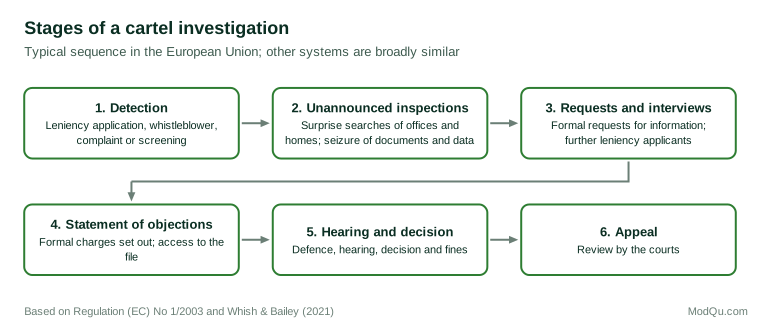
Unannounced inspections. Often called "dawn raids", these are surprise searches of business premises, and sometimes of homes, to obtain documents and electronic data before they can be destroyed. In the European Union, the Commission may conduct inspections of business premises and, with a court's authorisation, other premises including homes (Council Regulation (EC) No 1/2003, 2003, arts. 20–21). Inspectors copy email accounts, hard drives and mobile phones, and may seal offices overnight. Breaking a seal or obstructing an inspection can lead to substantial fines.
Formal requests and interviews. Authorities can require businesses to provide information and documents and, in some systems, compel individuals to answer questions. In the United States, criminal antitrust investigations use grand jury subpoenas and, in some cases, wiretaps and cooperating witnesses.
Economic analysis. Proving a cartel usually depends on documents and testimony, but economic analysis helps establish its effects and the size of fines and damages. In abuse of dominance cases, economic analysis is central, because the question is often whether conduct that could be competitive, such as low prices or exclusive contracts, has in fact excluded rivals and harmed consumers. Motta (2004) sets out the economic theory that underlies such analysis.
Abuse of dominance cases
Abuse cases are typically long and complex, and they involve detailed analysis of markets, market power and effects. In the United States, the government's case against Microsoft resulted in a ruling by the Court of Appeals that the company had unlawfully maintained its monopoly in personal computer operating systems through restrictive agreements and the integration of its web browser (United States v. Microsoft Corp., 2001). In the European Union, the General Court upheld the Commission's decision that Microsoft had abused its dominance by refusing to supply interoperability information to competitors and by tying its media player to Windows (Microsoft Corp. v. Commission, 2007).
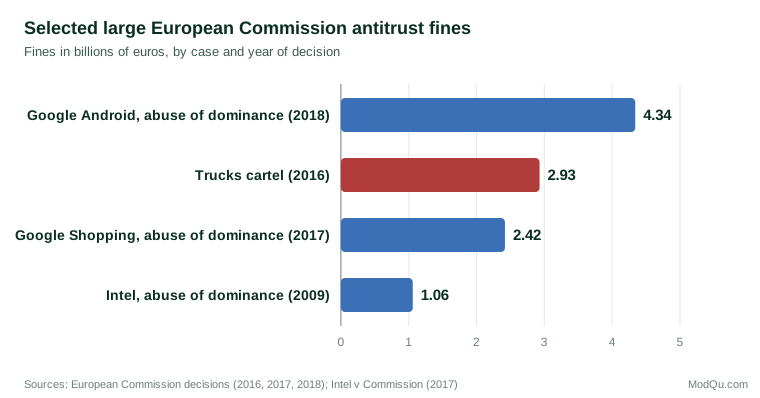
More recent cases have concerned digital platforms. The Commission fined Google €2.42 billion in 2017 for favouring its own comparison shopping service in search results (European Commission, 2017) and €4.34 billion in 2018 for restrictions imposed on manufacturers of devices using its Android operating system (European Commission, 2018). The Intel case, in which the Commission fined the company €1.06 billion in 2009 for loyalty rebates, showed the importance of economic analysis: the Court of Justice held that the Commission must examine whether such rebates were actually capable of excluding equally efficient competitors (Intel Corp. v. Commission, 2017), and the fine was later annulled in part.
Sanctions
Sanctions differ between jurisdictions. In the European Union, fines on companies can reach 10 per cent of worldwide turnover. In 2016, the Commission fined five truck manufacturers a total of €2.93 billion for colluding for fourteen years on prices and on passing on the costs of meeting emission rules (European Commission, 2016). In the United States, cartel conduct is a criminal offence, and executives can be imprisoned. In the United Kingdom, the Enterprise Act 2002 created a criminal cartel offence for individuals. Customers harmed by cartels can also bring claims for damages, and these private actions have become a significant additional consequence in both the United States and Europe.
Whish and Bailey (2021) note that competition authorities also use non-financial remedies, such as requiring a company to change its conduct, sell parts of its business or give competitors access to its systems, especially in abuse of dominance cases.
International cooperation
Many cartels operate across borders, and the same conduct may be investigated by authorities in several countries at once. The vitamins cartel of the 1990s, for example, involved companies from Europe and Asia and affected customers worldwide, and was pursued by authorities in the United States, the European Union, Canada, Australia and elsewhere (Connor, 2008). Authorities now coordinate closely: they may time unannounced inspections to happen on the same day in several countries, share information where the law allows and the companies consent, and align their approaches to leniency so that a company applying in one jurisdiction is encouraged to apply in others. Networks such as the European Competition Network, which links the European Commission and the national authorities of member states, allocate cases and share evidence. For businesses, this means that a problem in one country is likely to become a problem in many, and that decisions about leniency must be made on a global basis.
Digital markets and new rules
The investigations into Google and other large technology companies took many years, and critics argued that by the time a decision was reached, the market had already changed and competitors had been harmed. This experience led the European Union to adopt the Digital Markets Act, which imposes specific obligations in advance on designated "gatekeeper" platforms, such as bans on favouring their own services and requirements to allow interoperability, rather than relying only on case-by-case investigation after the event (Regulation (EU) 2022/1925, 2022). Other countries have considered or adopted similar approaches. These rules do not replace investigation, because regulators must still monitor compliance and investigate suspected breaches, but they shift the emphasis from proving harm in each case to enforcing clear rules.
Compliance and internal investigation
Businesses can reduce their risk through compliance programmes: training for staff who deal with competitors or set prices, clear policies on contacts with competitors and attendance at trade association meetings, regular audits of high-risk areas, and channels through which employees can report concerns. When a concern arises, an internal investigation carried out with legal advice allows the business to establish the facts quickly and decide whether to apply for leniency. Some authorities take account of genuine compliance efforts when setting fines, while others do not, but all agree that the most effective compliance programme is one that prevents the conduct in the first place.
What businesses should know
Competition investigations have several lessons for businesses.
- Avoid contacts with competitors about prices, customers, capacity or bids. Many cartels began with informal conversations at trade association meetings. Businesses should train staff to leave any meeting where such topics arise and record that they did so.
- Prepare for dawn raids. A written procedure, a trained reception team and immediate access to legal advice help a business cooperate lawfully while protecting its rights, including legal privilege.
- Consider leniency early. If a business discovers that its staff have taken part in a cartel, the first to report may obtain immunity, while later applicants receive smaller reductions.
- Investigate internally. Internal investigations, carried out under legal privilege where possible, help a business understand its exposure and decide how to respond.
- Dominant firms carry special responsibility. Practices that are normal for small firms, such as exclusive contracts or loyalty rebates, may be unlawful for a dominant company.
- Watch for signs of bid rigging as a buyer. Public and private purchasers can use the OECD (2009) checklist of warning signs, such as bids that are suspiciously close, the same company always winning in a region, or losing bidders becoming subcontractors to the winner.
A short example
The following hypothetical case illustrates the process. A regional authority that buys road salt notices that, for several winters, the same three suppliers have bid, each has won in one area, and the losing bids have been consistently about 8 per cent above the winning one. Prices have risen faster than costs. Using the OECD checklist, the authority reports its concerns to the national competition authority.
The competition authority analyses tender data from several regions and finds similar patterns. It conducts unannounced inspections at the three suppliers' offices and copies email accounts and phones. Within days, one supplier applies for leniency and provides notes of meetings at which the companies agreed which of them would win each tender. The other two then apply for reduced fines. The authority issues a statement of objections, hears the companies' defences and imposes fines. The regional authority later sues the suppliers for the overcharge, using the authority's decision as evidence, and changes its tendering to encourage new bidders.
Conclusion
Competition investigations aim to detect and stop conduct that raises prices and reduces choice, from secret cartels to abuses by dominant firms. Because cartels are hidden, authorities rely heavily on leniency programmes that reward insiders for reporting, supported by whistleblowers, complaints and data screening, and use strong powers such as unannounced inspections to gather evidence. Abuse cases depend on detailed economic analysis and are often contested in the courts. For businesses, the lessons are to avoid improper contacts with competitors, prepare for investigations, act quickly if a problem is discovered and recognise the special responsibility that comes with market power.
References
Abrantes-Metz, R. M., Froeb, L. M., Geweke, J., & Taylor, C. T. (2006). A variance screen for collusion. International Journal of Industrial Organization, 24(3), 467–486. https://doi.org/10.1016/j.ijindorg.2005.10.003
Connor, J. M. (2008). Global price fixing (2nd ed.). Springer.
Connor, J. M., & Lande, R. H. (2012). Cartels as rational business strategy: Crime pays. Cardozo Law Review, 34(2), 427–490.
Council Regulation (EC) No 1/2003 of 16 December 2002 on the implementation of the rules on competition laid down in Articles 81 and 82 of the Treaty. (2003). Official Journal of the European Communities, L 1, 1–25.
Eichenwald, K. (2000). The informant: A true story. Broadway Books.
Enterprise Act 2002, c. 40 (UK).
European Commission. (2018). Commission decision of 18 July 2018 relating to a proceeding under Article 102 TFEU (Case AT.40099 – Google Android).
European Commission. (2016). Commission decision of 19 July 2016 relating to a proceeding under Article 101 TFEU (Case AT.39824 – Trucks).
European Commission. (2017). Commission decision of 27 June 2017 relating to proceedings under Article 102 TFEU (Case AT.39740 – Google Search (Shopping)).
European Commission. (2006). Commission notice on immunity from fines and reduction of fines in cartel cases (2006/C 298/11). Official Journal of the European Union, C 298, 17–22.
Harrington, J. E., Jr. (2008). Detecting cartels. In P. Buccirossi (Ed.), Handbook of antitrust economics (pp. 213–258). MIT Press.
Intel Corp. v. Commission, Case C-413/14 P, EU:C:2017:632.
Levenstein, M. C., & Suslow, V. Y. (2006). What determines cartel success? Journal of Economic Literature, 44(1), 43–95. https://doi.org/10.1257/002205106776162681
Microsoft Corp. v. Commission, Case T-201/04, EU:T:2007:289.
Miller, N. H. (2009). Strategic leniency and cartel enforcement. American Economic Review, 99(3), 750–768. https://doi.org/10.1257/aer.99.3.750
Motta, M. (2004). Competition policy: Theory and practice. Cambridge University Press.
Organisation for Economic Co-operation and Development. (2009). Guidelines for fighting bid rigging in public procurement. OECD.
Porter, R. H., & Zona, J. D. (1993). Detection of bid rigging in procurement auctions. Journal of Political Economy, 101(3), 518–538. https://doi.org/10.1086/261885
Regulation (EU) 2022/1925 of the European Parliament and of the Council of 14 September 2022 on contestable and fair markets in the digital sector (Digital Markets Act). (2022). Official Journal of the European Union, L 265, 1–66.
Sherman Act, 15 U.S.C. §§ 1–7 (1890).
Treaty on the Functioning of the European Union, consolidated version. (2012). Official Journal of the European Union, C 326, 47–390.
United States v. Microsoft Corp., 253 F.3d 34 (D.C. Cir. 2001).
U.S. Department of Justice, Antitrust Division. (1993). Corporate leniency policy.
Whish, R., & Bailey, D. (2021). Competition law (10th ed.). Oxford University Press.