
Investigation · Scientific and technical investigation
Scientific Misconduct Investigations
When researchers are suspected of fabricating data, falsifying results or plagiarising, universities, funders and journals must investigate. This article explains how research misconduct is defined, how it is detected, how investigations are conducted and what landmark cases show.
Science depends on trust. Readers of a research paper usually cannot check every measurement, so they rely on the authors to have reported honestly what they did and found. When that trust is broken, the damage reaches beyond one paper: other scientists build on false results, money is wasted, and in medicine patients can be harmed. Investigating suspected misconduct is therefore an essential part of protecting the integrity of research.
What counts as misconduct
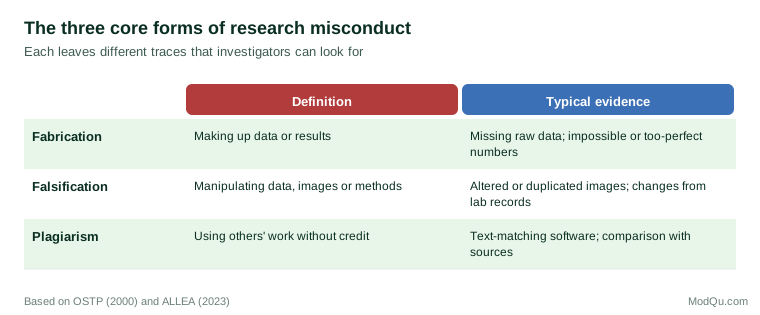
In the United States, the federal definition of research misconduct covers three acts: fabrication, making up data or results; falsification, manipulating materials, equipment or processes, or changing or omitting data, so that the research is not accurately represented; and plagiarism, taking another person's ideas, processes, results or words without giving appropriate credit (Office of Science and Technology Policy [OSTP], 2000). Honest error and differences of opinion are excluded. The European Code of Conduct for Research Integrity uses the same three core categories and also lists other unacceptable practices, such as manipulating authorship and hiding conflicts of interest (All European Academies [ALLEA], 2023).
How common is misconduct? Fanelli (2009) pooled surveys and found that about 2 per cent of scientists admitted to having fabricated or falsified data at least once, and about 14 per cent said they had seen colleagues do so. Fang et al. (2012) examined more than 2,000 retracted articles in the biomedical literature and found that about two-thirds were retracted because of misconduct, including suspected fraud, rather than honest error.
How misconduct is detected
Most cases come to light through whistleblowers, often junior colleagues who notice irregularities. Increasingly, they are also found by close examination of published work. Bik et al. (2016) visually screened more than 20,000 biomedical papers and found that about 4 per cent contained inappropriately duplicated images, some of which suggested deliberate manipulation. Statistical methods can detect data that are too consistent or otherwise unlikely to have arisen from real experiments. Simonsohn (2013) identified two cases of fabrication from statistical patterns in published summary data alone, and Carlisle (2017) analysed more than 5,000 clinical trials and found that some reported baseline characteristics of patients that were too similar or too different to have arisen by chance.
How investigations work
In most systems, an allegation is first assessed to see whether it falls within the definition of misconduct and is supported by enough evidence. If so, an inquiry and then a formal investigation follow, usually conducted by a committee at the researcher's institution. The committee secures the original data, laboratory notebooks and computer files, interviews the people involved, and decides whether misconduct occurred, typically on the balance of probabilities. The accused researcher has the right to respond. Funders and government bodies may oversee the process, and journals may retract the affected papers.
Fairness and difficulty
Misconduct investigations are difficult to conduct well. Institutions may have an interest in protecting a successful researcher or their own reputation, so independent members on investigation committees and external oversight help ensure that findings are credible. The accused researcher's career is at stake, so the process must be fair, confidential while it is under way and based on evidence rather than suspicion. Whistleblowers also need protection, because they are often junior and vulnerable to retaliation. Investigators must distinguish deliberate deception from carelessness, poor record-keeping or honest disagreement about methods, which can produce similar warning signs but call for different responses. Where original data have been lost or destroyed, it may be impossible to prove what happened, and the failure to keep records may itself be treated as a serious breach of research standards.
Landmark cases
The investigation into the Dutch social psychologist Diederik Stapel found that he had fabricated data in dozens of published studies over many years. The committees' report identified not only his fraud but a research culture in which co-authors, reviewers and editors had failed to question results that were too good to be true (Levelt Committee et al., 2012).
In medicine, a 1998 paper by Andrew Wakefield suggested a link between the MMR vaccine and autism. Investigative reporting by Deer (2011) found that the data had been misrepresented, and the BMJ concluded that the paper was fraudulent (Godlee et al., 2011). The paper had already been retracted, but its effects on vaccine confidence persisted for years.
Conclusion
Misconduct investigations protect science by establishing what happened, correcting the record and holding individuals accountable. They work best when institutions act promptly and fairly, protect whistleblowers, secure original data and look at the conditions that allowed misconduct to go unnoticed. Statistical and image-screening tools now help detect problems that once relied entirely on insiders coming forward.
References
All European Academies. (2023). The European code of conduct for research integrity (Rev. ed.). ALLEA.
Bik, E. M., Casadevall, A., & Fang, F. C. (2016). The prevalence of inappropriate image duplication in biomedical research publications. mBio, 7(3), Article e00809-16. https://doi.org/10.1128/mBio.00809-16
Carlisle, J. B. (2017). Data fabrication and other reasons for non-random sampling in 5087 randomised, controlled trials in anaesthetic and general medical journals. Anaesthesia, 72(8), 944–952. https://doi.org/10.1111/anae.13938
Deer, B. (2011). How the case against the MMR vaccine was fixed. BMJ, 342, Article c5347. https://doi.org/10.1136/bmj.c5347
Fanelli, D. (2009). How many scientists fabricate and falsify research? A systematic review and meta-analysis of survey data. PLoS ONE, 4(5), Article e5738. https://doi.org/10.1371/journal.pone.0005738
Fang, F. C., Steen, R. G., & Casadevall, A. (2012). Misconduct accounts for the majority of retracted scientific publications. Proceedings of the National Academy of Sciences, 109(42), 17028–17033. https://doi.org/10.1073/pnas.1212247109
Godlee, F., Smith, J., & Marcovitch, H. (2011). Wakefield's article linking MMR vaccine and autism was fraudulent. BMJ, 342, Article c7452. https://doi.org/10.1136/bmj.c7452
Levelt Committee, Noort Committee, & Drenth Committee. (2012). Flawed science: The fraudulent research practices of social psychologist Diederik Stapel. Tilburg University.
Office of Science and Technology Policy. (2000). Federal policy on research misconduct. Federal Register, 65(235), 76260–76264.
Simonsohn, U. (2013). Just post it: The lesson from two cases of fabricated data detected by statistics alone. Psychological Science, 24(10), 1875–1888. https://doi.org/10.1177/0956797613480366