
Investigation · Market and consumer investigation
Root Cause Investigation of Customer Complaints
A complaint tells a business that something went wrong; a root cause investigation finds out why. This article explains how to move from individual complaints to the underlying causes, which tools help, and how to avoid the common traps of blaming individuals and stopping too soon.
Every complaint is a piece of evidence. A customer who writes to say that an order arrived late, a product broke or a bill was wrong is reporting a failure that the business may not otherwise have seen. Most businesses respond to the complaint itself: they apologise, refund or replace, and close the case. Far fewer ask why the failure happened, and whether it will happen again to customers who did not complain. Root cause investigation is the discipline of asking those questions systematically.
This article explains why complaints are valuable evidence, how to analyse them to find patterns, the main tools for tracing causes, and the pitfalls that lead investigations to the wrong answer.
Complaints as evidence
What complaints reveal and what they hide
Complaints are a biased sample of customer problems. Many dissatisfied customers never complain; they simply leave or reduce their purchases. Hirschman (1970) described this choice between "exit" and "voice", and noted that customers are more likely to complain when they expect the organisation to respond and when leaving is difficult. The complaints a business receives therefore under-represent problems among customers who find it easy to switch, and over-represent those who are persistent, articulate or heavily affected.
This has two implications. First, the volume of complaints understates the size of most problems, sometimes greatly. Second, the mix of complaints may not reflect the mix of problems. A business that investigates only the issues customers complain about most may miss serious problems that customers have stopped bothering to report.
Why complaints are worth investigating
Research on complaint management shows that handling complaints well can retain customers who would otherwise leave. Fornell and Wernerfelt (1987) argued that complaint management is a cost-effective defensive strategy, since retaining a dissatisfied customer is often cheaper than attracting a new one. Studies of service recovery have found that customers judge the response to a complaint by the fairness of the outcome, the process and their treatment (Tax et al., 1998; Smith et al., 1999). Homburg and Fürst (2005) found that firms with clear guidelines and processes for handling complaints achieved higher customer satisfaction with complaint handling, which in turn supported loyalty.
But recovery deals with the effects of a failure on one customer. Root cause investigation deals with the failure itself. International guidance on complaints handling recommends that organisations analyse complaints to identify systemic, recurring and single-incident problems and trends, and use the results to eliminate their underlying causes (International Organization for Standardization [ISO], 2018). Stauss and Seidel (2019) describe this as the information function of complaint management: turning individual complaints into knowledge for improving products and processes.
From complaints to patterns
The first step is to make complaints analysable. Each complaint should be recorded with consistent information: date, product or service, channel, customer type, location and a classification of the problem. Free-text descriptions should be kept, since they often contain details that fixed categories miss.
With consistent records, patterns can be found. The Pareto principle, popularised in quality management by Juran, holds that a small number of causes usually account for a large share of problems (Juran & Godfrey, 1999). Ranking complaint categories by frequency, and by cost or severity, shows where investigation will have the most effect.
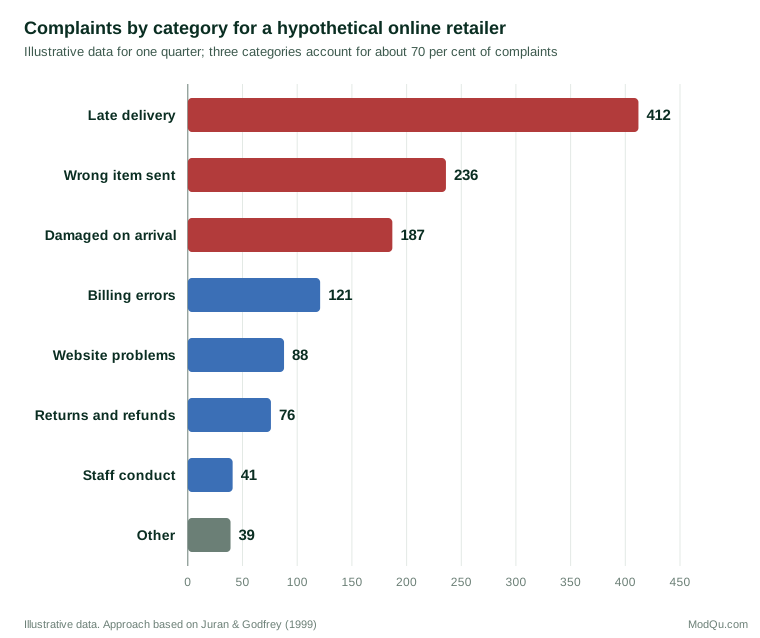
Patterns over time and across groups are equally informative. A sudden rise in complaints about one product after a supplier change, or complaints concentrated in one warehouse or region, points towards specific causes. Comparing complaint rates with sales volumes, rather than looking at raw counts, avoids mistaking growth in sales for a growth in problems.
Tracing causes
Define the problem precisely
A root cause investigation begins with a precise statement of the problem. "Late deliveries" is a category; "orders placed after 2 p.m. on Fridays from the northern warehouse arriving two or more days late since March" is a problem that can be investigated. Defining what is and is not affected, where, when and to what extent narrows the possible causes before any analysis begins (Andersen & Fagerhaug, 2006).
Gather evidence beyond the complaints
Complaints identify the symptom, but the causes are usually found in operational data, records and the experience of the people who do the work. Investigators should examine order and delivery records, quality inspection results, system logs, supplier data and staffing records, and should talk to front-line staff, who often know where processes break down.
Use structured tools
Several tools help investigators consider causes systematically. The cause-and-effect or fishbone diagram, developed by Ishikawa, groups possible causes into categories such as methods, materials, machines, people, measurement and environment, so that the team considers the full range of possibilities rather than the first explanation that occurs to them (Ishikawa, 1990).
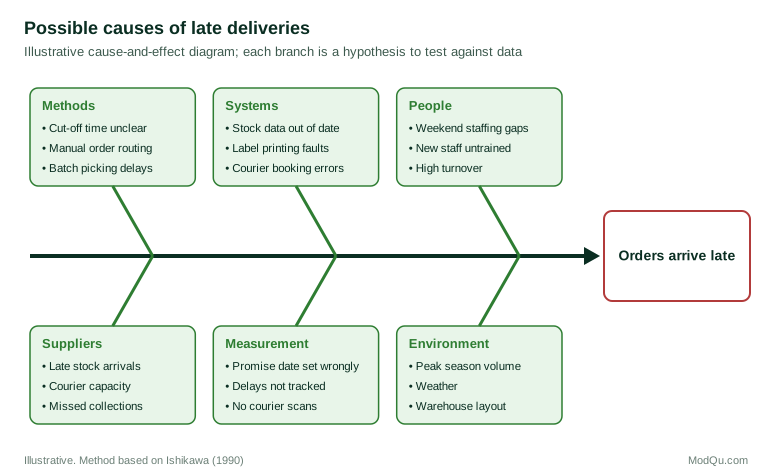
The "five whys" technique, associated with the Toyota Production System, asks why a problem occurred, then why that cause occurred, and so on, until a cause is reached that can be fixed (Ohno, 1988). It is simple and useful for focusing discussion, but it has well-documented weaknesses. Card (2017) argues that it tends to follow a single chain of causes when most problems have several, that different people asking the same questions reach different answers, and that it often stops at a point that reflects the investigators' assumptions rather than the evidence.
Test the candidate causes
Tools such as the fishbone diagram and five whys generate hypotheses. The investigation must then test them. If late deliveries are thought to result from weekend staffing gaps, delivery times for orders placed on weekdays and weekends can be compared. If a new supplier is suspected, defect rates before and after the change can be examined, along with rates for products that did not change supplier. A cause is confirmed when the evidence shows that the problem occurs when the cause is present, does not occur when it is absent, and stops when the cause is removed.
In the late delivery example, the team might find that delays are concentrated in orders placed after the afternoon cut-off on Fridays. Records show that the courier's last collection on Fridays was moved earlier in March, but the website still promised next-day delivery for orders placed up to the old cut-off time. Orders placed in the gap missed the collection and waited until Monday. Staffing and weather, which several staff had suspected, show no consistent relationship with late deliveries once this cause is accounted for. Updating the cut-off time on the website, and adding an automatic check whenever courier schedules change, removes the cause; complaint data in the following months confirm that Friday delays have fallen.
Common pitfalls
Blaming individuals
The most common error is to stop the investigation at the person who made the mistake. A warehouse worker picked the wrong item; a call centre agent gave incorrect information. Research on error in complex systems shows that individual errors are usually the result of conditions created by the system: unclear procedures, poor design, time pressure, inadequate training or conflicting goals (Reason, 1990, 2000). Dekker (2014) argues that "human error" is a label that ends inquiry rather than an explanation, and that investigators should ask why the person's actions made sense to them at the time. Blaming individuals leaves the system unchanged and makes staff less willing to report problems.
Stopping too soon or going too far
An investigation can stop at a cause that is too close to the symptom ("the label was wrong") or go back so far that the cause cannot be acted on ("the market is competitive"). A useful test is whether the identified cause, if fixed, would prevent the problem from recurring, and whether the organisation can fix it.
Treating root cause analysis as the end
In health care, where root cause analysis has been widely used to investigate patient safety incidents, researchers have found that investigations often produce weak recommendations, such as retraining or reminders, rather than changes to systems, and that the same problems recur (Peerally et al., 2017). The value of an investigation lies in the changes it produces. Each recommendation should be assigned to someone, implemented and checked, and complaint data should be monitored to confirm that the problem has actually declined.
Closing the loop
The final step is to tell people what was learned. Staff who handle complaints should know what was found and what changed, so that they can explain it to customers and recognise if the problem returns. Where a problem affected many customers, the organisation may contact those who did not complain. And the findings should feed into the design of products and processes, so that the next generation does not repeat the same failures.
Treated this way, complaints stop being a cost to be managed and become a source of knowledge about where the business fails its customers, and why.
References
Andersen, B., & Fagerhaug, T. (2006). Root cause analysis: Simplified tools and techniques (2nd ed.). ASQ Quality Press.
Card, A. J. (2017). The problem with '5 whys'. BMJ Quality & Safety, 26(8), 671–677. https://doi.org/10.1136/bmjqs-2016-005849
Dekker, S. (2014). The field guide to understanding 'human error' (3rd ed.). Ashgate.
Fornell, C., & Wernerfelt, B. (1987). Defensive marketing strategy by customer complaint management: A theoretical analysis. Journal of Marketing Research, 24(4), 337–346. https://doi.org/10.1177/002224378702400401
Hirschman, A. O. (1970). Exit, voice, and loyalty: Responses to decline in firms, organizations, and states. Harvard University Press.
Homburg, C., & Fürst, A. (2005). How organizational complaint handling drives customer loyalty: An analysis of the mechanistic and the organic approach. Journal of Marketing, 69(3), 95–114. https://doi.org/10.1509/jmkg.69.3.95.66367
International Organization for Standardization. (2018). Quality management — Customer satisfaction — Guidelines for complaints handling in organizations (ISO Standard No. 10002:2018).
Ishikawa, K. (1990). Introduction to quality control. 3A Corporation.
Juran, J. M., & Godfrey, A. B. (Eds.). (1999). Juran's quality handbook (5th ed.). McGraw-Hill.
Ohno, T. (1988). Toyota production system: Beyond large-scale production. Productivity Press.
Peerally, M. F., Carr, S., Waring, J., & Dixon-Woods, M. (2017). The problem with root cause analysis. BMJ Quality & Safety, 26(5), 417–422. https://doi.org/10.1136/bmjqs-2016-005511
Reason, J. (1990). Human error. Cambridge University Press. https://doi.org/10.1017/CBO9781139062367
Reason, J. (2000). Human error: Models and management. BMJ, 320(7237), 768–770. https://doi.org/10.1136/bmj.320.7237.768
Smith, A. K., Bolton, R. N., & Wagner, J. (1999). A model of customer satisfaction with service encounters involving failure and recovery. Journal of Marketing Research, 36(3), 356–372. https://doi.org/10.1177/002224379903600305
Stauss, B., & Seidel, W. (2019). Effective complaint management: The business case for customer satisfaction (2nd ed.). Springer.
Tax, S. S., Brown, S. W., & Chandrashekaran, M. (1998). Customer evaluations of service complaint experiences: Implications for relationship marketing. Journal of Marketing, 62(2), 60–76. https://doi.org/10.1177/002224299806200205