
Investigation · Law, ethics and regulation
Multi-Agency and Cross-Jurisdictional Investigations for Comprehensive Knowledge
Many problems are visible only when the knowledge of several agencies or jurisdictions is combined. This article explains why multi-agency investigations are needed, how failures to share information have led to tragedies, the main models of cooperation, the legal and practical barriers, and how to make joint investigations work.
No single agency sees everything. Police hold criminal records, social services hold information about families, hospitals hold medical records, tax authorities hold financial records, regulators hold compliance histories, and agencies in other regions and countries hold their own pieces of the picture. A pattern that is invisible to each agency alone may be obvious when their knowledge is combined. Multi-agency and cross-jurisdictional investigations aim to produce this combined, more comprehensive knowledge. This article explains why they matter, what goes wrong, how they are organised, and how to make them work.
Why knowledge is fragmented
Agencies are organised by function and territory, and each collects information for its own purposes, in its own systems, under its own legal rules. Egger (1984) coined the term "linkage blindness" to describe the failure of police agencies to recognise that crimes in different jurisdictions were committed by the same offender, because information was not shared or compared. Sheptycki (2004) identified a series of "organisational pathologies" in police intelligence systems, including information hoarding, duplication, and competition between units, that prevent knowledge from flowing to where it is needed.
Lessons from failure
Public inquiries have repeatedly found that tragedies followed failures to combine what agencies knew.
The inquiry into the death of Victoria Climbié, an eight-year-old girl killed by her carers in London in 2000, found that she had been seen by several social services departments, police child protection teams and hospitals, and that there had been many missed opportunities to save her, largely because information was not shared and no one took responsibility for the whole picture (Laming, 2003). The inquiry led to major reforms of child protection arrangements, and later reviews emphasised that effective protection depends on professionals sharing information and exercising judgement together, not only on following procedures (Munro, 2011).
The Bichard inquiry, following the murders of two girls in Soham in 2002 by a school caretaker, found that police forces had held information about previous allegations against him, but that it had not been retained properly or shared with the force that vetted him for his job (Bichard, 2004). The inquiry led to a national police information system in the United Kingdom.
On a larger scale, the 9/11 Commission found that United States intelligence and law enforcement agencies had held information about some of the attackers that, if shared and combined, might have revealed the plot, and recommended structural changes to promote information sharing (National Commission on Terrorist Attacks Upon the United States, 2004). The earlier "Yorkshire Ripper" investigation in England had shown how information overload and poor coordination between forces could allow a serial offender to remain free (Byford, 1981).
Models of cooperation
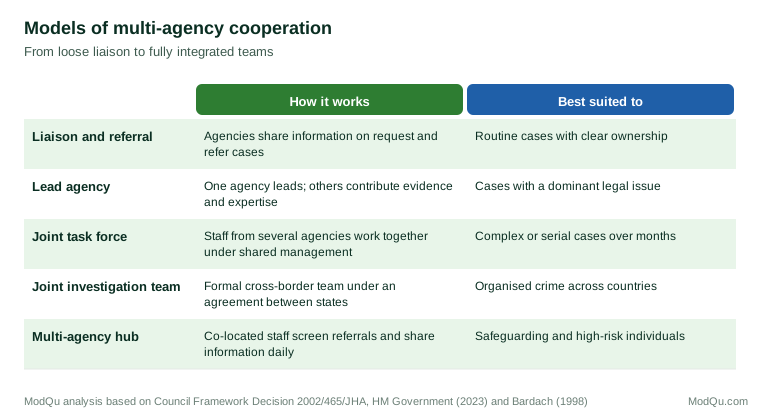
Cooperation ranges from informal liaison to fully integrated teams. In the European Union, joint investigation teams allow police, prosecutors and judges from two or more member states to work together on a specific case for a defined period under a written agreement, sharing information and evidence directly (Council Framework Decision 2002/465/JHA, 2002). In child protection in England, statutory guidance requires local authorities, police and health services to work together and share information to protect children (HM Government, 2023). For emergencies, the United States National Incident Management System provides a common structure and terminology so that agencies can coordinate (Federal Emergency Management Agency [FEMA], 2017).
Barriers
Multi-agency work faces several barriers. Legal rules on data protection, confidentiality and evidence may limit what can be shared and how it can be used. Different agencies have different standards of proof, priorities and timescales: a regulator may want to stop harm quickly, while a prosecutor wants evidence that will stand up in court. Information systems are often incompatible. Professional cultures differ, and agencies may distrust each other or compete for credit. Across borders, differences in law and language add further obstacles, and formal requests for evidence through mutual legal assistance can take months. Deflem (2002) traces how international police cooperation developed historically through professional networks that worked around these political and legal barriers.
Bardach (1998) argues that successful interagency collaboration depends on building shared purpose, trust and practical working arrangements over time, rather than on formal structures alone. Ansell and Gash (2008), reviewing collaborative governance, identify face-to-face dialogue, trust building, commitment to the process and shared understanding as key factors, along with clear ground rules and leadership.
Sharing information lawfully
Fear of breaking data protection law is one of the most common reasons professionals give for not sharing information, but the law usually permits sharing that is necessary and proportionate for protecting people or investigating offences. In the European Union, a specific directive governs the processing of personal data by authorities for the prevention, investigation and prosecution of crime, allowing such processing where it is necessary and subject to safeguards (Directive (EU) 2016/680, 2016). Child protection guidance in England states plainly that data protection law is not a barrier to sharing information where it is needed to keep a child safe (HM Government, 2023). The practical lesson is to identify the legal basis for sharing at the start of a joint investigation, record what is shared, with whom and why, and limit onward use to the agreed purposes.
Evidence across borders
Cross-border investigations add a further layer. Evidence gathered in one country must usually meet the rules of the country where it will be used, so investigators need to agree in advance how interviews will be conducted, how digital evidence will be copied and how chain of custody will be recorded. Joint investigation teams were created partly to reduce these problems by allowing members to share evidence directly and to request investigative measures in their own country on the team's behalf. Even so, differences in rules on disclosure, privilege and the rights of suspects can affect admissibility, and early involvement of prosecutors from each country helps prevent evidence being gathered in a form that cannot be used.
Making joint investigations work
Practical experience and research suggest several principles:
- Agree the purpose and lead. Define the questions the investigation will answer, who leads, and how decisions will be made.
- Write it down. Set out roles, information-sharing rules, evidence handling, media handling and how disagreements will be resolved.
- Share information lawfully and early. Identify the legal basis for sharing at the start, and share as much as the law allows rather than as little as possible.
- Use a common record. Keep a shared log of decisions and evidence, or ensure records can be reconciled.
- Plan for different outcomes. Agree how criminal, regulatory, civil and disciplinary proceedings will be coordinated so that one does not damage another.
- Build relationships. Invest in contact between staff before a crisis, through liaison officers, joint training and exercises.
- Review together. Hold joint debriefs and share lessons.
Intelligence-led policing similarly emphasises analysis that combines information from different sources and agencies to identify priority problems (Ratcliffe, 2016).
A short example
The following hypothetical case shows the value of combined knowledge. A regulator receives complaints that a care home is understaffed. Separately, the local hospital has seen several residents admitted with untreated pressure sores, the police have a report from a relative alleging theft from a resident's account, and the tax authority is investigating the owner's companies for unpaid payroll taxes. Each agency alone sees a modest concern. When they meet under local safeguarding arrangements and share what they know, a pattern emerges of financial distress leading to cuts in staff and care. The agencies agree that the regulator will lead on the immediate protection of residents, the police on the alleged theft, and the tax authority on the tax matter, with a shared timetable and a single point of contact for families. The combined knowledge allows earlier action than any one agency could have justified on its own.
Conclusion
Comprehensive knowledge often requires combining what several agencies or jurisdictions know. Inquiries into tragedies from child deaths to terrorist attacks have found that failures to share and connect information allowed harm to continue. Models of cooperation range from liaison to integrated teams, and legal, technical and cultural barriers must be managed. Clear agreements on purpose, leadership and information sharing, combined with sustained relationships and joint review, allow multi-agency investigations to see the whole picture.
References
Ansell, C., & Gash, A. (2008). Collaborative governance in theory and practice. Journal of Public Administration Research and Theory, 18(4), 543–571. https://doi.org/10.1093/jopart/mum032
Bardach, E. (1998). Getting agencies to work together: The practice and theory of managerial craftsmanship. Brookings Institution Press.
Bichard, M. (2004). The Bichard inquiry report (HC 653). The Stationery Office.
Byford, L. (1981). The Yorkshire Ripper case: Review of the police investigation of the case. Home Office.
Council Framework Decision 2002/465/JHA of 13 June 2002 on joint investigation teams. (2002). Official Journal of the European Communities, L 162, 1–3.
Deflem, M. (2002). Policing world society: Historical foundations of international police cooperation. Oxford University Press.
Directive (EU) 2016/680 of the European Parliament and of the Council of 27 April 2016 on the protection of natural persons with regard to the processing of personal data by competent authorities for the purposes of the prevention, investigation, detection or prosecution of criminal offences or the execution of criminal penalties. (2016). Official Journal of the European Union, L 119, 89–131.
Egger, S. A. (1984). A working definition of serial murder and the reduction of linkage blindness. Journal of Police Science and Administration, 12(3), 348–357.
Federal Emergency Management Agency. (2017). National incident management system (3rd ed.). U.S. Department of Homeland Security.
HM Government. (2023). Working together to safeguard children 2023: A guide to multi-agency working to help, protect and promote the welfare of children.
Laming, H. (2003). The Victoria Climbié inquiry: Report of an inquiry by Lord Laming (Cm 5730). The Stationery Office.
Munro, E. (2011). The Munro review of child protection: Final report. A child-centred system (Cm 8062). Department for Education.
National Commission on Terrorist Attacks Upon the United States. (2004). The 9/11 Commission report. W. W. Norton.
Ratcliffe, J. H. (2016). Intelligence-led policing (2nd ed.). Routledge.
Sheptycki, J. (2004). Organizational pathologies in police intelligence systems: Some contributions to the lexicon of intelligence-led policing. European Journal of Criminology, 1(3), 307–332. https://doi.org/10.1177/1477370804044005