
Investigation · Law, ethics and regulation
Legal Thresholds for Initiating versus Continuing Investigations
The evidence needed to open an investigation is lower than the evidence needed to continue it, escalate it or bring charges. This article explains the legal thresholds that govern each stage in criminal, regulatory and workplace investigations, why the thresholds rise as intrusion increases, how investigators should review whether to continue, and the psychological traps that keep weak investigations alive.
Every investigation begins with a decision to look into something, and every investigation eventually reaches decisions about whether to go further, use more intrusive powers, bring charges or stop. These decisions are governed by thresholds: the level of suspicion or evidence that the law, or an organisation's rules, require before a step can be taken. The threshold for starting an investigation is deliberately low, because investigation is how facts are discovered. The thresholds for later steps are higher, because each step intrudes further into people's lives and carries greater consequences. Understanding these thresholds, and reviewing them as an investigation progresses, protects both the people investigated and the integrity of the investigation. This article explains the main thresholds, how they differ between criminal, regulatory and workplace settings, and why the decision to continue deserves as much attention as the decision to begin.
Why thresholds rise
Investigation involves a tension between two values. On one side is the public interest in discovering wrongdoing, which requires that investigators be able to make enquiries on limited information. On the other is the interest of individuals in being left alone, in privacy and in the presumption of innocence. Packer (1964) described two models of the criminal process: a "crime control" model that emphasises efficient discovery and processing of offenders, and a "due process" model that emphasises safeguards against error and abuse. Legal thresholds are one way the law balances these models. Ashworth and Redmayne (2010) explain how, in the criminal process, each additional power, from stopping a person to arresting, searching, charging and convicting, requires a higher degree of justification because it imposes a greater burden on the individual.
The presumption of innocence also shapes how investigations are conducted. European Union law requires member states to ensure that, until proved guilty, suspects are not referred to by public authorities as being guilty (Directive (EU) 2016/343, 2016). Being investigated is not the same as being guilty, and investigators must act accordingly.
Thresholds in criminal investigation
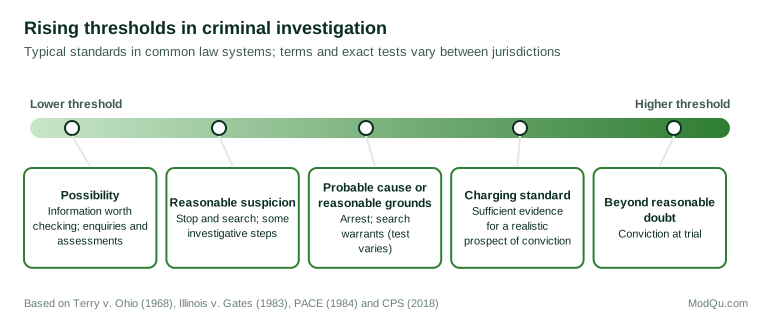
Opening an enquiry. In most systems, police may begin making enquiries on very limited information, such as a report, a tip or an observation, as long as their actions do not intrude on rights. In the United States, the Attorney General's Guidelines for Domestic FBI Operations distinguish between "assessments", which may be opened without any particular factual basis for a proper purpose using only limited methods; "preliminary investigations", which require information or an allegation indicating possible criminal activity or a threat; and "full investigations", which require an articulable factual basis reasonably indicating that a crime or threat exists (U.S. Department of Justice, 2008). Each level permits more intrusive methods.
The importance of these predication thresholds was highlighted by a review of the FBI's investigation of links between the 2016 Trump presidential campaign and Russia. The Department of Justice Inspector General found that the opening of the investigation met the low predication threshold in the FBI's rules, but identified many significant errors and omissions in later applications for surveillance, which required a much higher standard (Office of the Inspector General, 2019). The case illustrates that meeting the threshold to begin does not justify every later step.
Reasonable suspicion. Many coercive powers require reasonable suspicion: an objective basis, grounded in specific facts, for suspecting that a person is involved in crime. In Terry v. Ohio (1968), the United States Supreme Court held that a police officer may briefly stop and frisk a person if the officer has reasonable suspicion, based on specific and articulable facts, that the person is armed and involved in crime. In England and Wales, stop and search powers under the Police and Criminal Evidence Act 1984 require reasonable grounds for suspicion, which must be based on facts, information or intelligence and cannot rest on personal factors such as appearance alone. The European Court of Human Rights has held that "reasonable suspicion" for arrest presupposes facts or information that would satisfy an objective observer that the person may have committed the offence (Fox, Campbell and Hartley v. United Kingdom, 1990).
Reasonable grounds to believe and probable cause. More intrusive steps, such as arrest and search warrants, generally require a higher level of justification. In the United States, a search warrant requires probable cause, which the Supreme Court in Illinois v. Gates (1983) described as a fair probability, in the totality of the circumstances, that evidence of a crime will be found. In England and Wales, the power of arrest requires reasonable grounds for suspecting an offence and reasonable grounds for believing that arrest is necessary for one of the listed reasons (Home Office, 2012).
Charging. The decision to charge requires much more. In England and Wales, prosecutors must be satisfied that there is sufficient evidence to provide a realistic prospect of conviction and that a prosecution is required in the public interest (Crown Prosecution Service [CPS], 2018). United States federal prosecutors must believe that the person's conduct constitutes a federal offence and that the admissible evidence will probably be sufficient to obtain and sustain a conviction (U.S. Department of Justice, n.d.).
Conviction. Finally, conviction requires proof beyond reasonable doubt.
Thresholds in regulatory and workplace investigations
Regulators also use staged thresholds. The United States Securities and Exchange Commission's enforcement manual describes how staff may open a preliminary inquiry on limited information to determine whether further investigation is warranted, and may seek a formal order of investigation, which grants subpoena power, only when the facts suggest possible violations (U.S. Securities and Exchange Commission, Division of Enforcement, 2017). Other regulators follow similar patterns, typically requiring more justification before using compulsory powers or announcing an investigation publicly.
In the workplace, the thresholds are set by employment law and good practice rather than criminal law. In the United Kingdom, the Acas code of practice requires employers to carry out necessary investigations to establish the facts of a disciplinary case without unreasonable delay, and to inform employees of the allegations and evidence before a hearing (Advisory, Conciliation and Arbitration Service [Acas], 2015). In British Home Stores Ltd v Burchell (1980), the Employment Appeal Tribunal held that an employer dismissing an employee for misconduct must show that it genuinely believed the employee was guilty, had reasonable grounds for that belief, and had carried out as much investigation as was reasonable in the circumstances. The threshold for beginning a workplace investigation is a credible allegation; the threshold for a disciplinary finding is a reasonable belief based on a reasonable investigation.
Whistleblowing law adds a duty to follow up. In the European Union, organisations that receive reports through internal channels must follow them up diligently and give feedback within a set period (Directive (EU) 2019/1937, 2019). Credible reports therefore cannot simply be ignored.
The decision to continue
Much attention is paid to whether an investigation was properly opened. Less is paid to whether it should continue. Yet continuing an investigation has costs: it uses resources, it prolongs uncertainty and stress for the people investigated, it may involve continuing intrusion, and it may delay attention to more important matters. An investigation that was justified at the outset may cease to be justified if the evidence fails to develop, if the original information proves unreliable, or if the matter turns out to be minor.
Several legal frameworks build in review. Covert surveillance authorisations in the United Kingdom must be reviewed regularly and cancelled as soon as they are no longer necessary or proportionate (Regulation of Investigatory Powers Act 2000; Home Office, 2018). Prosecutors have a continuing duty to review cases and to stop a prosecution if the evidential or public interest test is no longer met (CPS, 2018). Disclosure obligations require investigators to record and reveal material that undermines the case, which can itself prompt a decision to stop (Criminal Procedure and Investigations Act 1996).
Psychological traps
Investigators often find it hard to stop. Several well-documented psychological effects push towards continuation.
Confirmation bias. Once investigators believe a suspect is guilty, they tend to seek and interpret evidence in ways that support that belief (Nickerson, 1998). Kassin et al. (2003) found that interviewers who expected guilt asked more guilt-presumptive questions and pressed harder, and that this made innocent suspects appear more defensive, which in turn confirmed the interviewers' expectations.
Tipping points. Fahsing and Ask (2013) found that detectives were aware of decisional "tipping points" in investigations, after which alternatives receive less attention and the investigation becomes focused on a single suspect. Rossmo (2009) identifies this tunnel vision as a common cause of investigative failure.
Escalation of commitment. Staw (1976) found that people who had made a decision that turned out badly tended to invest further resources in it, rather than cutting their losses, particularly when they were personally responsible for the original decision. Arkes and Blumer (1985) showed that people are influenced by sunk costs, continuing an activity because they have already invested in it. Investigations that have consumed months of work are vulnerable to both effects.
These effects mean that the decision to continue should not be left to the original investigators alone.
Structured review
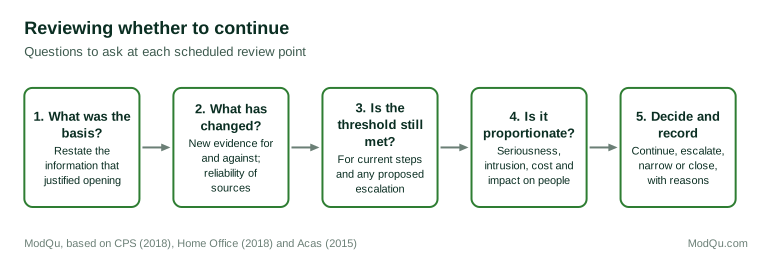
Organisations can build continuation decisions into their processes:
- Record the predicate. At the start, write down what information justified opening the investigation and what threshold it met.
- Schedule reviews. Set review dates at the outset, and review at key points such as before using new powers.
- Involve someone independent. Have a supervisor or reviewer who is not part of the investigation assess whether the threshold for continuing is met.
- Test the original information. Ask whether the source of the allegation has proved reliable and whether its key claims have been corroborated.
- Consider alternatives. Record what other explanations exist and what has been done to test them.
- Apply proportionality. Weigh the seriousness of the matter against the intrusion and cost of continuing.
- Close properly. When an investigation is closed, record the reasons, inform the people affected where appropriate, and retain the records as required.
Common errors in applying thresholds
Several errors recur. The first is treating the threshold for opening as if it justified everything that follows, so that intrusive steps are taken on the strength of an initial allegation that has never been tested. The second is the reverse: refusing to open any enquiry until there is already strong evidence, which means that credible concerns are never checked and the evidence that could meet a higher threshold is never gathered. The third is circular reasoning, in which the fact that an investigation exists is treated as evidence that something is wrong, or the results of an intrusive step are used to justify having taken it. The fourth is failing to record the basis for each decision, so that when the investigation is later challenged, no one can show what was known at the time. Finally, investigators sometimes apply the standard of a different setting, for example demanding proof beyond reasonable doubt in a workplace case, where the law requires only a reasonable belief based on a reasonable investigation, or applying the lower workplace standard when the findings will be passed to the police.
Telling people where they stand
The people affected by an investigation often do not know whether it is still open, what stage it has reached or what threshold has been met. Prolonged uncertainty can cause serious harm, particularly when a person has been suspended or publicly named. Where it will not prejudice the investigation, people should be told when an investigation begins, what it concerns, and when it ends, with the outcome. When an investigation is closed because the threshold for continuing is not met, the record and any communication should make clear that the allegation was not substantiated, rather than leaving the impression that it was proved but not pursued. This respects the presumption of innocence and makes it more likely that people will cooperate with future investigations.
A short example
The following hypothetical case illustrates these thresholds. A company's ethics line receives an anonymous report that a procurement manager is receiving payments from a supplier. The report is specific about the supplier's name and the approximate period. The compliance team records that this credible, specific allegation meets the company's threshold for opening a preliminary review, which permits checking procurement records but not searching the manager's emails or interviewing colleagues.
The review finds that the supplier's prices are higher than competitors' and that the manager overrode the usual tender process twice. The compliance head decides that this meets the higher threshold for a full investigation, authorising a review of the manager's business emails under the company's policy. The emails show friendly contact with the supplier but no evidence of payments. At the scheduled review, an independent reviewer notes that the price differences can be explained by the supplier's faster delivery times, which the business had requested, and that the tender overrides were approved by the manager's director for that reason. The reviewer concludes that the threshold for continuing is no longer met. The investigation is closed, the manager is told that an allegation was investigated and not substantiated, and the company tightens its documentation of tender overrides. The investigation's records show at each stage what threshold was applied and why.
Conclusion
Legal thresholds for investigation rise with the intrusiveness and consequences of each step: a bare possibility may justify enquiries, reasonable suspicion permits limited coercive steps, reasonable grounds or probable cause permit arrest and search, a realistic prospect of conviction permits charging, and conviction requires proof beyond reasonable doubt. Regulatory and workplace investigations follow similar staged logic. The threshold met at the start does not justify everything that follows; continuing, escalating and concluding each require their own justification. Because confirmation bias, tunnel vision and escalation of commitment make investigators reluctant to stop, organisations should record the basis for each stage, review it regularly with independent input, and close investigations when the threshold is no longer met.
References
Advisory, Conciliation and Arbitration Service. (2015). Code of practice on disciplinary and grievance procedures.
Arkes, H. R., & Blumer, C. (1985). The psychology of sunk cost. Organizational Behavior and Human Decision Processes, 35(1), 124–140. https://doi.org/10.1016/0749-5978(85)90049-4
Ashworth, A., & Redmayne, M. (2010). The criminal process (4th ed.). Oxford University Press.
British Home Stores Ltd v Burchell [1980] ICR 303 (EAT).
Criminal Procedure and Investigations Act 1996, c. 25 (UK).
Crown Prosecution Service. (2018). The code for Crown prosecutors (8th ed.).
Directive (EU) 2016/343 of the European Parliament and of the Council of 9 March 2016 on the strengthening of certain aspects of the presumption of innocence and of the right to be present at the trial in criminal proceedings. (2016). Official Journal of the European Union, L 65, 1–11.
Directive (EU) 2019/1937 of the European Parliament and of the Council of 23 October 2019 on the protection of persons who report breaches of Union law. (2019). Official Journal of the European Union, L 305, 17–56.
Fahsing, I., & Ask, K. (2013). Decision making and decisional tipping points in homicide investigations: An interview study of British and Norwegian detectives. Journal of Investigative Psychology and Offender Profiling, 10(2), 155–165. https://doi.org/10.1002/jip.1384
Fox, Campbell and Hartley v. United Kingdom, 30 August 1990, Series A no. 182.
Home Office. (2018). Covert surveillance and property interference: Revised code of practice.
Home Office. (2012). Police and Criminal Evidence Act 1984 (PACE) Code G: Revised code of practice for the statutory power of arrest by police officers.
Illinois v. Gates, 462 U.S. 213 (1983).
Kassin, S. M., Goldstein, C. C., & Savitsky, K. (2003). Behavioral confirmation in the interrogation room: On the dangers of presuming guilt. Law and Human Behavior, 27(2), 187–203. https://doi.org/10.1023/A:1022599230598
Nickerson, R. S. (1998). Confirmation bias: A ubiquitous phenomenon in many guises. Review of General Psychology, 2(2), 175–220. https://doi.org/10.1037/1089-2680.2.2.175
Office of the Inspector General. (2019). Review of four FISA applications and other aspects of the FBI's Crossfire Hurricane investigation. U.S. Department of Justice.
Packer, H. L. (1964). Two models of the criminal process. University of Pennsylvania Law Review, 113(1), 1–68. https://doi.org/10.2307/3310562
Police and Criminal Evidence Act 1984, c. 60 (UK).
Regulation of Investigatory Powers Act 2000, c. 23 (UK).
Rossmo, D. K. (2009). Criminal investigative failures. CRC Press.
Staw, B. M. (1976). Knee-deep in the big muddy: A study of escalating commitment to a chosen course of action. Organizational Behavior and Human Performance, 16(1), 27–44. https://doi.org/10.1016/0030-5073(76)90005-2
Terry v. Ohio, 392 U.S. 1 (1968).
U.S. Department of Justice. (n.d.). Justice manual, § 9-27.000: Principles of federal prosecution.
U.S. Department of Justice. (2008). The Attorney General's guidelines for domestic FBI operations.
U.S. Securities and Exchange Commission, Division of Enforcement. (2017). Enforcement manual.