
Investigation · Foundations
Investigative Interviewing: The PEACE Model
The PEACE model replaced confession-focused interrogation in England and Wales with an approach built on gathering accurate information. This article explains its five stages, the evidence behind it and how it compares with accusatorial methods.
For much of the twentieth century, police questioning of suspects in many countries aimed at a single outcome: a confession. Interviewers used pressure, persuasion and psychological manipulation to overcome denials. The approach produced confessions, but some of them were false, and several notorious miscarriages of justice in England in the 1970s and 1980s were traced in part to unreliable interviews. In response, police in England and Wales introduced a new framework in the early 1990s, known by the acronym PEACE. It has since been adopted or adapted in many other countries and influenced interviewing well beyond policing. This article explains what PEACE is, why it was introduced and what research says about it.
From interrogation to investigative interviewing
Two developments drove the change. The first was legal. The Police and Criminal Evidence Act 1984 introduced mandatory tape recording of suspect interviews and set rules on detention and questioning. Recording made interview practice visible for the first time, to researchers, supervisors and the courts, and it allowed the quality of questioning to be judged against what was actually said rather than against the interviewer's later summary. The second was research. Baldwin (1993) analysed several hundred recorded police interviews and found that many interviewers were poorly prepared, assumed guilt from the outset and were unskilled at questioning; few suspects who denied an offence changed their account during the interview. Williamson (1993) described the resulting shift in strategy from "interrogation" aimed at a confession to "investigative interviewing" aimed at obtaining accurate and reliable information.
The PEACE model was developed by police officers, psychologists and lawyers and introduced nationally in 1992 (Milne & Bull, 1999). Its central principle is that the purpose of an interview is to obtain accurate and reliable information in order to discover the truth, not to obtain a confession. A confession that emerges from a fair interview is valuable; one that is extracted is a risk.
The five stages
PEACE is an acronym for the five stages of an interview.
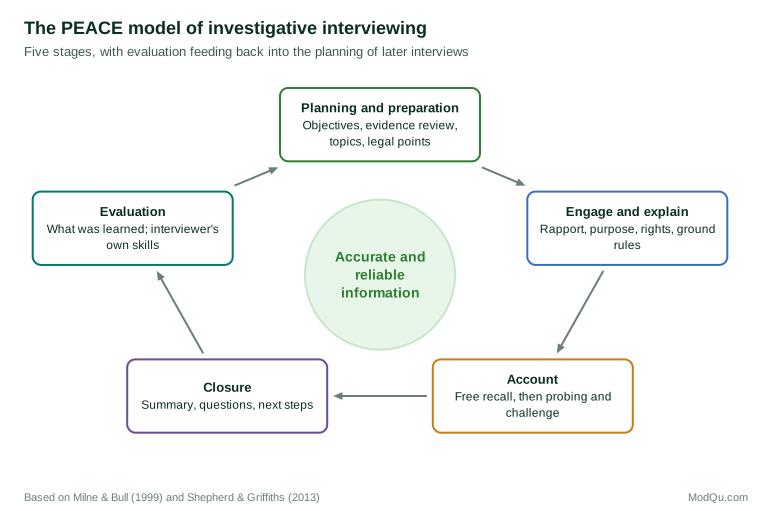
Planning and preparation. The interviewer sets objectives, reviews the evidence, identifies the topics to cover and the points to prove, considers the interviewee's characteristics and needs, and decides how and when evidence will be disclosed. Planning is the stage most often neglected in practice and the one with the greatest effect on what follows.
Engage and explain. The interviewer establishes rapport, explains the purpose of the interview and the routines that will be followed, and makes sure the interviewee understands their rights. Rapport is not friendliness for its own sake; it creates conditions in which the interviewee is willing to talk and is not frightened into saying what they think the interviewer wants to hear.
Account, clarification and challenge. The interviewee is first invited to give their own account in their own words, with minimal interruption. The interviewer then probes the account by topic, using open questions before closed ones. Finally, the interviewer challenges inconsistencies, either within the account or between the account and the evidence. Challenge is part of PEACE, but it is done by presenting evidence and asking for explanations, not by accusing, threatening or lying about the evidence.
Closure. The interviewer summarises the account so the interviewee can correct misunderstandings, answers questions and explains what happens next. A respectful closure makes future cooperation more likely, which matters because investigators often need to speak to the same person again as new evidence emerges.
Evaluation. The interviewer considers what the interview has added to the investigation and what further inquiries are needed, and reflects on their own performance. Supervisors use recorded interviews to assess skills and plan training, and evaluation of the information obtained often leads to new lines of inquiry or to a further, better-planned interview.
PEACE is designed for both suspects and witnesses. For cooperative witnesses, the account stage often uses techniques from the cognitive interview, which helps witnesses recall more detail (Fisher & Geiselman, 1992). For resistant suspects, a variant known as conversation management gives interviewers structured ways to handle reluctance and to probe accounts systematically (Shepherd & Griffiths, 2013).
What the evidence shows
The first national evaluation of PEACE training found that interviews with suspects improved in several respects, especially in the quality of explanation and the absence of oppressive tactics, but that skills declined over time without supervision, and that challenge and the probing of accounts often remained weak (Clarke & Milne, 2001). Later field research found that interviews rated as more skilled according to PEACE criteria were associated with better outcomes, including fuller accounts and more admissions (Walsh & Bull, 2010).
The strongest evidence comes from comparisons between approaches. Meissner et al. (2014) conducted a meta-analysis of field and laboratory studies comparing accusatorial methods, which rely on control, confrontation and psychological manipulation, with information-gathering methods such as PEACE, which rely on rapport, open questions and the presentation of evidence. In experimental studies, accusatorial methods increased both true and false confessions, while information-gathering methods increased true confessions without a corresponding rise in false ones. In other words, information-gathering interviews improved the diagnostic value of what suspects said.
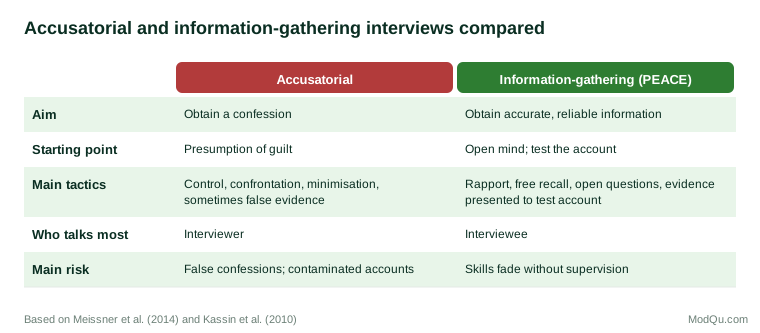
Research on false confessions explains why the distinction matters. Kassin et al. (2010) identify risk factors including lengthy detention, presentation of false evidence, minimisation of the seriousness of the offence, and vulnerable suspects such as young people and those with intellectual disabilities. Gudjonsson (2003) documents how suggestibility and compliance make some people prone to agree with interviewers. Accusatorial techniques such as the widely taught Reid technique (Inbau et al., 2013) use several of these tactics. The presumption of guilt also affects interviewers themselves: Kassin et al. (2003) found that interviewers who expected guilt asked more guilt-presumptive questions and pressed harder, which made innocent suspects appear more defensive.
A short illustration
Consider a hypothetical workplace investigation into an allegation that a warehouse supervisor falsified overtime records. In an accusatorial interview, the investigator might open by stating that the evidence proves the falsification, suggest that "anyone in your position would have done the same", and press for an admission. The supervisor, anxious about their job, might agree simply to end the interview, or might deny everything and say nothing more.
Under PEACE, the investigator would first plan. They would review the overtime records, door-entry logs and rotas, decide which discrepancies matter, list the topics to cover and decide to hold back the door-entry data until the supervisor had given their own account. In the engage and explain stage, they would explain the purpose of the meeting, the supervisor's right to be accompanied and how the meeting would be recorded. In the account stage, they would invite the supervisor to describe how overtime is recorded and approved on their team, and to talk through the specific weeks in question, before asking more focused questions. Only then would they present the door-entry logs, which show the supervisor leaving the site two hours before the overtime they claimed, and ask for an explanation.
Two very different outcomes are possible. The supervisor may have an explanation that the investigator had not considered, such as a shared login used by several staff, which opens a new line of inquiry. Or the supervisor's earlier detailed account, given before the logs were disclosed, may now be clearly contradicted by them, which is far stronger evidence than an admission obtained under pressure. Either way, the investigation has learned something reliable.
Rapport and its limits
Rapport is often misunderstood as being friendly or sympathetic. In investigative interviewing it means establishing a working relationship in which the interviewee is willing to communicate. That requires respect, a clear explanation of what is happening and genuine attention to what the person says. It does not mean agreeing with them, promising favourable treatment or hiding the purpose of the interview. Interviewers who confuse rapport with ingratiation risk both unreliable information and later complaints that the interviewee was misled. The PEACE literature therefore treats rapport as a skill to be trained and assessed, like questioning or the planned disclosure of evidence (Milne & Bull, 1999).
Adoption beyond England and Wales
PEACE or similar models have been adopted in Norway, New Zealand, Australia and other countries, and some Canadian police services have moved towards it, although Snook et al. (2010) found that accusatorial practices remained common in Canada and called for reform. In 2021 an international group of experts published the Méndez Principles, which set out standards for effective, non-coercive interviewing for all investigators and draw directly on the information-gathering approach (Méndez Principles, 2021).
The model also applies outside policing. Workplace investigators, regulators, auditors and safety investigators conduct interviews in which the same risks arise: a confident investigator, an anxious interviewee and a temptation to seek confirmation of a theory. Vrij et al. (2014) summarise research showing that information-gathering approaches also make lies easier to detect, because truthful interviewees provide more verifiable detail when allowed to talk.
Lessons for any interviewer
The PEACE model distils into a few practical rules. Prepare thoroughly, because an unplanned interview cannot test an account. Let the interviewee talk first and talk most. Ask open questions before closed ones. Challenge with evidence rather than accusation. Record everything. And evaluate each interview, both for what it revealed and for how it was conducted. These principles serve any organisation that needs to find out what happened from the people who were there.
References
Baldwin, J. (1993). Police interview techniques: Establishing truth or proof? British Journal of Criminology, 33(3), 325–352. https://doi.org/10.1093/oxfordjournals.bjc.a048329
Clarke, C., & Milne, R. (2001). National evaluation of the PEACE investigative interviewing course (Police Research Award Scheme Report No. PRAS/149). Home Office.
Fisher, R. P., & Geiselman, R. E. (1992). Memory-enhancing techniques for investigative interviewing: The cognitive interview. Charles C Thomas.
Gudjonsson, G. H. (2003). The psychology of interrogations and confessions: A handbook. Wiley.
Inbau, F. E., Reid, J. E., Buckley, J. P., & Jayne, B. C. (2013). Criminal interrogation and confessions (5th ed.). Jones & Bartlett Learning.
Kassin, S. M., Drizin, S. A., Grisso, T., Gudjonsson, G. H., Leo, R. A., & Redlich, A. D. (2010). Police-induced confessions: Risk factors and recommendations. Law and Human Behavior, 34(1), 3–38. https://doi.org/10.1007/s10979-009-9188-6
Kassin, S. M., Goldstein, C. C., & Savitsky, K. (2003). Behavioral confirmation in the interrogation room: On the dangers of presuming guilt. Law and Human Behavior, 27(2), 187–203. https://doi.org/10.1023/A:1022599230598
Meissner, C. A., Redlich, A. D., Michael, S. W., Evans, J. R., Camilletti, C. R., Bhatt, S., & Brandon, S. (2014). Accusatorial and information-gathering interrogation methods and their effects on true and false confessions: A meta-analytic review. Journal of Experimental Criminology, 10(4), 459–486. https://doi.org/10.1007/s11292-014-9207-6
Milne, R., & Bull, R. (1999). Investigative interviewing: Psychology and practice. Wiley.
Méndez Principles. (2021). Principles on effective interviewing for investigations and information gathering. Association for the Prevention of Torture, Anti-Torture Initiative and Norwegian Centre for Human Rights.
Police and Criminal Evidence Act 1984, c. 60 (UK).
Shepherd, E., & Griffiths, A. (2013). Investigative interviewing: The conversation management approach (2nd ed.). Oxford University Press.
Snook, B., Eastwood, J., Stinson, M., Tedeschini, J., & House, J. C. (2010). Reforming investigative interviewing in Canada. Canadian Journal of Criminology and Criminal Justice, 52(2), 215–229. https://doi.org/10.3138/cjccj.52.2.215
Vrij, A., Hope, L., & Fisher, R. P. (2014). Eliciting reliable information in investigative interviews. Policy Insights from the Behavioral and Brain Sciences, 1(1), 129–136. https://doi.org/10.1177/2372732214548592
Walsh, D., & Bull, R. (2010). What really is effective in interviews with suspects? A study comparing interviewing skills against interviewing outcomes. Legal and Criminological Psychology, 15(2), 305–321. https://doi.org/10.1348/135532509X463356
Williamson, T. (1993). From interrogation to investigative interviewing: Strategic trends in police questioning. Journal of Community & Applied Social Psychology, 3(2), 89–99. https://doi.org/10.1002/casp.2450030203