
Investigation · Foundations
Investigation as a Discipline: Principles Common to All Fields
Detectives, auditors, accident investigators, epidemiologists and journalists work in different settings, but they share a common logic. This article sets out the principles that make investigation a discipline in its own right.
A detective reconstructing a homicide, an auditor tracing a missing payment, an air accident investigator sifting wreckage, an epidemiologist mapping an outbreak and a journalist following a paper trail seem to have little in common. They answer to different institutions, follow different rules and produce different kinds of reports. Yet each is doing the same basic thing: using evidence to establish what happened, how and why, when the answer is not known at the start and someone has a stake in getting it right. This article argues that investigation is a discipline with principles that hold across fields, and sets out what those principles are.
What makes something an investigation
Investigation differs from routine information gathering in three ways. First, it starts from a specific question about a particular event or situation, not a general curiosity. Second, the answer is uncertain and may be actively concealed, disputed or misremembered. Third, the findings will be used to make a consequential decision: to charge or not to charge, to dismiss or retain an employee, to ground an aircraft type, to close a water source, or to publish.
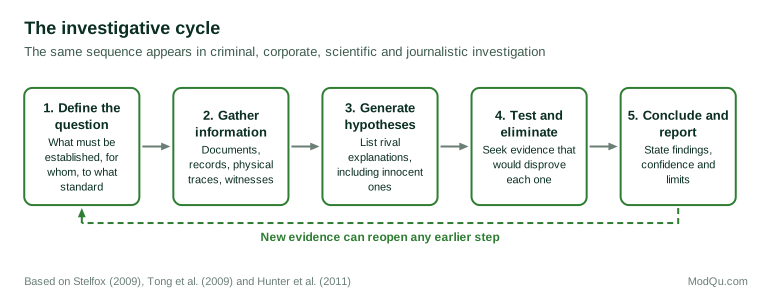
Texts on criminal investigation describe it as a process of gathering, testing and recording information so that a reliable account of past events can be presented to a decision-maker (Stelfox, 2009; Tong et al., 2009). The same description fits a fraud examination, a workplace inquiry or a product failure analysis. What changes from field to field is the standard of proof required and the decision that follows, not the underlying logic.
Principle 1: Start with a defined question
Every sound investigation begins by stating what it is trying to find out. A vague mandate, such as "look into the problems in the finance team", invites drift and wasted effort. A defined question, such as "were payments made to suppliers who did not provide goods, and if so by whom and since when?", tells the investigator what evidence is relevant and when the work is finished. Defining the question also exposes assumptions early. Asking "who stole the money?" assumes a theft occurred; asking "why does the account not reconcile?" leaves room for error, system faults or legitimate explanations.
In practice the question often changes as evidence arrives, and that is legitimate. What matters is that changes are deliberate and recorded, so that the final report answers a question the reader can see.
Principle 2: Reason from evidence to explanation
Investigators rarely observe the event they are investigating. They work backwards from traces: documents, physical evidence, digital records, witness accounts. The form of reasoning involved is often called abduction, or inference to the best explanation: proposing the explanation that would, if true, best account for the evidence at hand (Josephson & Josephson, 1994). A good investigator then tests that explanation, looking for further evidence that it predicts and that rival explanations do not.
Evidence scholars stress that every item of evidence has to be assessed for three things: its relevance to the question, the credibility of its source, and its inferential force, meaning how strongly it bears on one explanation over another (Anderson et al., 2005; Schum, 1994). A clear security camera image and a confident eyewitness may point in the same direction, but they differ greatly in credibility and in the ways they can be wrong.
Principle 3: Keep more than one hypothesis alive
The most consistent finding about investigative failure is that investigators settle on an explanation too early and then interpret everything that follows in its light. Psychologists call the general tendency confirmation bias (Nickerson, 1998). In criminal justice the resulting pattern is known as tunnel vision (Findley & Scott, 2006). Research with police investigators shows that the need for quick closure and the pressure of time make early commitment more likely (Ask & Granhag, 2005), and interview studies with experienced detectives identify specific "tipping points" at which a suspect becomes the focus of a case (Fahsing & Ask, 2013). In forensic science, Kassin et al. (2013) and Dror (2020) document how context and expectations can shape the interpretation of physical evidence itself.
The remedy is procedural rather than a matter of willpower. Investigators can list rival explanations at the outset, record what evidence would distinguish them, and actively look for evidence that would disprove the leading theory. This reflects Popper's (1959) argument that explanations earn credibility by surviving serious attempts to refute them, not by accumulating confirmations.
Principle 4: Protect the integrity of the evidence
An investigation is only as good as the evidence it rests on, and evidence can be lost, contaminated or altered. Physical items need a documented chain of custody. Digital evidence needs to be copied in a way that can be shown not to have changed it. Witness memory is especially fragile: the way a witness is questioned can add details that were never observed. These concerns look different in each field, but the principle is the same: collect evidence in a way that preserves it and that another person could later check.
The United States National Research Council (2009) report on forensic science made this point forcefully. It found that many forensic methods had never been properly validated and that laboratories were often not independent of the police agencies that relied on their findings. The lesson applies well beyond forensic laboratories: the methods used to collect and interpret evidence must be reliable, and the people interpreting it should be shielded from information that could bias them.
Principle 5: Record everything
Investigators keep records for three reasons. They allow the investigator to retrace their own reasoning when memory fades. They allow supervisors, courts, regulators or editors to check the work. And they protect the people involved, including subjects who are eventually cleared. A record that shows which leads were followed, which were dropped and why, is often as important as the final conclusion. Investigative journalism manuals make the same point, recommending that every factual claim in a story be traceable to a documented source (Hunter et al., 2011).
Principle 6: Match the conclusion to the standard of proof
Different settings require different degrees of certainty. A criminal court needs proof beyond reasonable doubt. A civil claim or an employment decision usually rests on the balance of probabilities. A public health team may act on a credible suspicion, because waiting for certainty could cost lives. A newspaper needs enough evidence to defend the story in court and to its readers. Kovach and Rosenstiel (2014) describe verification as the essence of journalism, the thing that separates it from entertainment or propaganda.
Good investigators state clearly what standard their conclusions meet. They distinguish what is established, what is probable and what remains unknown. Overstating certainty is one of the commonest ways investigations cause harm.
Principle 7: Look for causes, not only culprits
Many investigations end by identifying a responsible person. But in complex systems, individual errors usually occur within conditions that made them likely: poor design, unclear procedures, production pressure or weak oversight. Reason (2000) contrasted a "person approach", which blames individuals, with a "system approach", which asks why the defences failed. Accident investigation has built this principle into its rules. The international standard for aircraft accident investigation states that the sole objective of an investigation is the prevention of future accidents and that it is not its purpose to apportion blame or liability (International Civil Aviation Organization [ICAO], 2020).
Criminal and disciplinary investigations must still establish individual responsibility. Even there, asking how the event became possible produces recommendations that reduce the chance of it happening again.
Common principles across fields
The table below summarises how the same principles appear in different settings.
| Principle | Criminal | Corporate | Accident | Public health | Journalism |
|---|---|---|---|---|---|
| Defined question | Was an offence committed, and by whom? | Did misconduct or loss occur? | What caused the event? | What is the source of the outbreak? | What happened, and who is accountable? |
| Standard of proof | Beyond reasonable doubt | Balance of probabilities | Probable cause | Sufficient to act | Defensible and verified |
| Main output | Case file for prosecution | Report to management or board | Safety recommendations | Control measures | Published story |
The epidemiologist's version of the cycle is visible in John Snow's investigation of the 1854 cholera outbreak in London, which combined mapping, interviews and a natural comparison between water companies to identify contaminated water as the cause (Snow, 1855). Snow had a hypothesis before the outbreak, but he tested it against cases that did not fit, including people who lived near the pump but did not fall ill, and found explanations for them. That willingness to examine the exceptions is a mark of good investigation in any field.
Differences that matter
Recognising common principles does not mean that investigators in one field can simply work in another. Each field has its own legal powers, rules of evidence and ethical constraints. Police can obtain warrants; private investigators cannot. Accident investigators often have privileged access to evidence on condition that it is not used to punish. Journalists must weigh public interest against privacy. Innes (2003), in a study of homicide investigations, showed that much detective work is shaped by organisational routines and by the type of case, from those that are effectively solved at the scene to those that require long inquiry. Knowing the setting is part of the discipline.
Why the shared principles matter
Treating investigation as a discipline has practical benefits. It allows lessons learned in one field, such as the use of structured interviewing in policing or blame-free reporting in aviation, to be transferred to others. It gives organisations a basis for training and for judging the quality of investigations. And it provides a common language for people who must rely on investigative findings without having done the work themselves.
For organisations that commission or use research, the same principles offer a useful checklist. Was the question defined before the data were collected? Were alternative explanations considered? Can the evidence be traced and checked? Does the conclusion claim more certainty than the evidence supports? An investigation, a survey and a research study all generate knowledge from evidence, and all are judged by how carefully that link between evidence and conclusion has been made.
References
Anderson, T., Schum, D., & Twining, W. (2005). Analysis of evidence (2nd ed.). Cambridge University Press. https://doi.org/10.1017/CBO9780511610585
Ask, K., & Granhag, P. A. (2005). Motivational sources of confirmation bias in criminal investigations: The need for cognitive closure. Journal of Investigative Psychology and Offender Profiling, 2(1), 43–63. https://doi.org/10.1002/jip.19
Dror, I. E. (2020). Cognitive and human factors in expert decision making: Six fallacies and the eight sources of bias. Analytical Chemistry, 92(12), 7998–8004. https://doi.org/10.1021/acs.analchem.0c00704
Fahsing, I., & Ask, K. (2013). Decision making and decisional tipping points in homicide investigations: An interview study of British and Norwegian detectives. Journal of Investigative Psychology and Offender Profiling, 10(2), 155–165. https://doi.org/10.1002/jip.1384
Findley, K. A., & Scott, M. S. (2006). The multiple dimensions of tunnel vision in criminal cases. Wisconsin Law Review, 2006(2), 291–397.
Hunter, M. L., Hanson, N., Sabbagh, R., Sengers, L., Sullivan, D., & Svith, F. T. (2011). Story-based inquiry: A manual for investigative journalists. UNESCO.
Innes, M. (2003). Investigating murder: Detective work and the police response to criminal homicide. Oxford University Press.
International Civil Aviation Organization. (2020). Annex 13 to the Convention on International Civil Aviation: Aircraft accident and incident investigation (12th ed.). ICAO.
Josephson, J. R., & Josephson, S. G. (Eds.). (1994). Abductive inference: Computation, philosophy, technology. Cambridge University Press. https://doi.org/10.1017/CBO9780511530128
Kassin, S. M., Dror, I. E., & Kukucka, J. (2013). The forensic confirmation bias: Problems, perspectives, and proposed solutions. Journal of Applied Research in Memory and Cognition, 2(1), 42–52. https://doi.org/10.1016/j.jarmac.2013.01.001
Kovach, B., & Rosenstiel, T. (2014). The elements of journalism: What newspeople should know and the public should expect (3rd ed.). Three Rivers Press.
National Research Council. (2009). Strengthening forensic science in the United States: A path forward. National Academies Press. https://doi.org/10.17226/12589
Nickerson, R. S. (1998). Confirmation bias: A ubiquitous phenomenon in many guises. Review of General Psychology, 2(2), 175–220. https://doi.org/10.1037/1089-2680.2.2.175
Popper, K. R. (1959). The logic of scientific discovery. Hutchinson.
Reason, J. (2000). Human error: Models and management. BMJ, 320(7237), 768–770. https://doi.org/10.1136/bmj.320.7237.768
Schum, D. A. (1994). The evidential foundations of probabilistic reasoning. Wiley.
Snow, J. (1855). On the mode of communication of cholera (2nd ed.). John Churchill.
Stelfox, P. (2009). Criminal investigation: An introduction to principles and practice. Willan.
Tong, S., Bryant, R. P., & Horvath, M. A. H. (2009). Understanding criminal investigation. Wiley-Blackwell. https://doi.org/10.1002/9780470749616