
Investigation · Journalism and public investigation
Freedom of Information Requests as an Investigative Tool
Freedom of information laws give anyone the right to request records held by public bodies. This article explains how these laws work, how journalists, researchers and citizens use them to investigate, the obstacles they meet, and how to write requests that succeed.
Public bodies hold vast amounts of information: contracts, inspection reports, emails, meeting minutes, spending records, complaints and internal reviews. Much of it is never published. Freedom of information (FOI) laws, also called access to information or right to information laws, give members of the public a legal right to request such records and require public bodies to release them unless a specific exemption applies. For investigators, these laws are among the most important tools available, because they provide documentary evidence produced by the institutions themselves.
This article explains the origins and principles of FOI laws, how they are used in investigations, what research says about how well they work, and practical techniques for making effective requests.
Origins and principles
Sweden's Freedom of the Press Act of 1766 is usually cited as the first law to give citizens a right of access to government documents. The modern spread of such laws began with the United States Freedom of Information Act of 1966 (5 U.S.C. § 552), and accelerated after the end of the Cold War. Banisar (2006) counted nearly 70 countries with comprehensive FOI laws by 2006, and the number has since grown to well over 100. In the United Kingdom, the Freedom of Information Act 2000 came fully into force in 2005. India's Right to Information Act 2005 has been used by millions of citizens to obtain information about public services, welfare programmes and local government.
International bodies increasingly treat access to information as a human right. The United Nations Human Rights Committee has stated that the right to freedom of expression in the International Covenant on Civil and Political Rights includes a right of access to information held by public bodies (UN Human Rights Committee, 2011). The Council of Europe adopted the first binding international treaty on access to official documents in 2009 (Council of Europe, 2009), and the institutions of the European Union are subject to their own access rules (Regulation (EC) No 1049/2001, 2001).
The free expression organisation ARTICLE 19 (1999) set out principles that good FOI laws should follow. They include maximum disclosure, meaning that all information held by public bodies should be subject to disclosure; narrow and clearly defined exemptions, applied only where disclosure would cause substantial harm that outweighs the public interest; fast and low-cost processes; and independent review of refusals. Most modern laws reflect these principles to some degree, though their strength varies greatly.
How FOI laws work
Although the details differ, most FOI laws share a common structure.
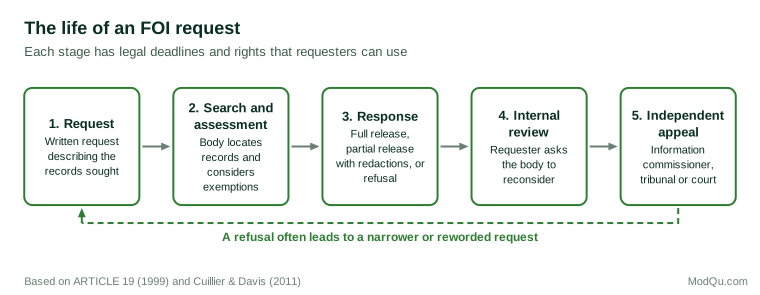
A requester submits a written request describing the information sought. In many countries, anyone can make a request, regardless of nationality or purpose, and the requester does not have to explain why they want the information. The public body must search for the records, decide whether any exemptions apply, and respond within a set period, often 20 working days. It may release the information in full, release it with parts removed (redacted), or refuse. If the requester is dissatisfied, they can usually ask for an internal review and then appeal to an independent body, such as an information commissioner, a tribunal or a court.
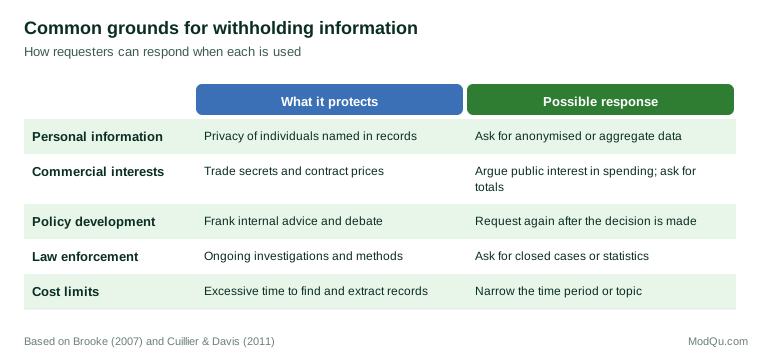
Exemptions typically protect national security, law enforcement investigations, personal privacy, commercial confidentiality, legal advice and the internal deliberations of government. Some exemptions are absolute; others apply only if the harm of disclosure outweighs the public interest in release. Much of the contest over FOI takes place over how broadly these exemptions are interpreted.
FOI in investigations
FOI requests serve several purposes in investigations. They can obtain documents that confirm or refute a tip, such as an inspection report on a care home or the emails between officials about a contract. They can obtain data, such as records of every complaint about a service or every payment to a contractor, which can then be analysed. And they can test official statements by comparing what officials said in public with what their own records show.
The best-known British example is the scandal over parliamentary expenses. Journalists and campaigners, including Heather Brooke, made FOI requests for details of the expenses claimed by Members of Parliament. The House of Commons resisted, but in 2008 the High Court upheld decisions requiring disclosure of details of claims (Corporate Officer of the House of Commons v Information Commissioner, 2008). Before the official release, a full set of records was leaked to The Daily Telegraph in 2009, whose reporting led to resignations, prosecutions and reform of the expenses system. Brooke (2007) had earlier published a practical guide to using the Act, arguing that ordinary citizens could use it to hold government to account.
Michener and Worthy (2018) describe how requesters use FOI in different ways, from targeted requests for specific documents to broad "fishing" requests that seek to discover what exists, and from one-off requests to systematic requests sent to many bodies at once. Systematic requests, for example asking every police force or local council the same question, are particularly useful for investigations because they produce comparable data that reveal national patterns no single body would publish.
How well does FOI work?
Research has examined whether FOI laws achieve their aims. Hazell et al. (2010) studied the first years of the United Kingdom's Act in central government and found that it had increased transparency and accountability, though not as much as advocates had hoped, and had not achieved goals such as increasing public trust in government. Journalists were among the most frequent and effective users. Worthy and Hazell (2017), looking back on ten years of the Act, found that it had become embedded in British government and had produced a steady stream of disclosures, while also generating resistance and periodic attempts to restrict it.
Roberts (2006) describes how governments in many countries have responded to FOI laws with strategies that reduce their effect: delays, high fees, broad interpretations of exemptions, and changes in record-keeping so that sensitive matters are discussed orally or in informal channels rather than in written records. Worthy (2017) examines why governments pass FOI laws that constrain their own power, and finds that the laws often emerge from a combination of political commitments and pressure, and are then contested and reshaped in practice.
In the United States, Kwoka (2016) found that commercial requesters, such as companies seeking information about competitors or regulators, made a large share of FOIA requests to many federal agencies, while journalists made a relatively small share. Kreimer (2008) argued that FOIA works not in isolation but as part of an "ecology of transparency" that includes the press, whistleblowers, congressional oversight and the courts, each of which makes the others more effective. Fenster (2006) cautions that transparency laws cannot by themselves make government fully visible, because what is recorded, how it is described and what is released remain shaped by the institutions involved.
Making effective requests
Practical guides offer consistent advice for requesters (Brooke, 2007; Cuillier & Davis, 2011; Hunter et al., 2011).
Do the research first. Find out what records the body is likely to hold, what they are called and who holds them. Published reports, records schedules, previous FOI responses and conversations with current or former staff can all help. A request for "the monthly performance report on contract X" is more likely to succeed than a request for "all information about contract X".
Be specific and reasonable. Name the records, the time period and the subject. Overly broad requests are likely to be refused on cost grounds or to produce unmanageable amounts of material.
Ask for data in useful formats. Request spreadsheets or databases in their original electronic format rather than printouts, so that the information can be analysed.
Know the law. Cite the relevant statute, note the deadline, and be ready to challenge exemptions that do not apply or a public interest test that has not been properly applied.
Be persistent and polite. Cuillier (2010) tested different styles of request letter in an experiment with public agencies and found that friendly letters did not produce better results than neutral ones, and that letters mentioning the law and the possibility of legal action produced faster responses in some cases. The findings suggest that requesters should be courteous but firm and clear about their rights.
Keep records. Log every request, response, deadline and appeal. Records of delays and refusals can themselves become part of the story.
Uses beyond journalism
Journalists are the most visible users of FOI, but they are far from the only ones. Academic researchers use requests to obtain data on public services, policing, health and education that are not published, and to study how decisions were made. Campaign groups and charities use them to monitor how laws are enforced and how public money is spent. Lawyers use them to gather evidence before litigation. Businesses use them to understand regulators' thinking, to learn about public contracts they might bid for, and sometimes to obtain information about competitors (Kwoka, 2016).
For researchers, FOI raises some particular methodological issues. Responses from different bodies to the same request may not be comparable, because organisations record information in different ways or interpret the request differently. Some bodies will answer quickly and fully, others slowly or not at all, so the resulting dataset may have gaps that are not random. Researchers who use FOI as a data collection method should therefore record the response from each body, report response rates, and check whether bodies that did not respond differ from those that did. They should also consider the burden their requests place on public bodies, especially small ones, and keep requests focused on what the research genuinely needs.
Limits and complements
FOI is not a complete investigative method. Requests take time, sometimes months or years when appeals are involved, which makes them better suited to long investigations than to breaking news. Records may be incomplete or heavily redacted, and they show what officials wrote down, not necessarily what happened. Private companies, including contractors performing public services, are often outside the scope of FOI laws, although some laws cover them where they hold information on behalf of public bodies.
For these reasons, investigators use FOI alongside other methods: published records, court files, company filings, interviews and sources inside organisations. A document obtained through FOI is often most useful as a starting point that shows what questions to ask, or as confirmation of what a source has said.
A short example
The following hypothetical case illustrates the process. A local journalist hears from residents that a council's housing repairs are slow and that complaints are ignored. The journalist sends the council a request for its repairs database for the past three years, including the date each repair was reported, its category and the date it was completed, in spreadsheet format, with tenants' names and addresses removed.
The council refuses, saying that extracting the data would exceed the cost limit. The journalist narrows the request to the past 12 months and to emergency and urgent repairs only, and the council releases the data. Analysis shows that the council met its target time for urgent repairs in only 41 per cent of cases, while its published annual report claimed 85 per cent. A second request, for the method used to calculate the published figure, reveals that repairs were counted as "completed" when an appointment was booked rather than when the work was done.
The journalist interviews tenants whose repairs took months, puts the findings to the council, and publishes the story with the data and the council's response. The council commissions an independent review of its performance reporting.
Conclusion
Freedom of information laws give investigators a legal right to the records of public institutions, and they have helped expose misconduct, waste and failure in many countries. They work best when requesters understand the law, research what records exist, ask for specific information in useful formats and persist through refusals and appeals. Their limits, including delays, exemptions, incomplete records and resistance from public bodies, mean that FOI is most powerful when combined with other investigative methods. As a source of documentary evidence created by institutions themselves, it remains one of the most valuable tools for generating public knowledge.
References
ARTICLE 19. (1999). The public's right to know: Principles on freedom of information legislation. ARTICLE 19.
Banisar, D. (2006). Freedom of information around the world 2006: A global survey of access to government information laws. Privacy International.
Brooke, H. (2007). Your right to know: A citizen's guide to the Freedom of Information Act (2nd ed.). Pluto Press.
Corporate Officer of the House of Commons v Information Commissioner [2008] EWHC 1084 (Admin).
Council of Europe. (2009). Council of Europe Convention on Access to Official Documents (CETS No. 205).
Cuillier, D., & Davis, C. N. (2011). The art of access: Strategies for acquiring public records. CQ Press.
Cuillier, D. (2010). Honey v. vinegar: Testing compliance-gaining theories in the context of freedom of information laws. Communication Law and Policy, 15(3), 203–229. https://doi.org/10.1080/10811680.2010.489842
Fenster, M. (2006). The opacity of transparency. Iowa Law Review, 91(3), 885–949.
Freedom of Information Act 2000, c. 36 (UK).
Freedom of Information Act, 5 U.S.C. § 552 (1966).
Hazell, R., Worthy, B., & Glover, M. (2010). The impact of the Freedom of Information Act on central government in the UK: Does FOI work? Palgrave Macmillan.
Hunter, M. L., Hanson, N., Sabbagh, R., Sengers, L., Sullivan, D., & Svith, F. T. (2011). Story-based inquiry: A manual for investigative journalists. UNESCO.
Kreimer, S. F. (2008). The Freedom of Information Act and the ecology of transparency. University of Pennsylvania Journal of Constitutional Law, 10(5), 1011–1080.
Kwoka, M. B. (2016). FOIA, Inc. Duke Law Journal, 65(7), 1361–1437.
Michener, G., & Worthy, B. (2018). The information-gathering matrix: A framework for conceptualizing the use of freedom of information laws. Administration & Society, 50(4), 476–500. https://doi.org/10.1177/0095399715590825
Regulation (EC) No 1049/2001 of the European Parliament and of the Council of 30 May 2001 regarding public access to European Parliament, Council and Commission documents. (2001). Official Journal of the European Communities, L 145, 43–48.
Right to Information Act, 2005, No. 22 of 2005 (India).
Roberts, A. (2006). Blacked out: Government secrecy in the information age. Cambridge University Press.
UN Human Rights Committee. (2011). General comment No. 34: Article 19: Freedoms of opinion and expression (CCPR/C/GC/34). United Nations.
Worthy, B., & Hazell, R. (2017). Disruptive, dynamic and democratic? Ten years of FOI in the UK. Parliamentary Affairs, 70(1), 22–42. https://doi.org/10.1093/pa/gsv069
Worthy, B. (2017). The politics of freedom of information: How and why governments pass laws that threaten their power. Manchester University Press.