
Investigation · Foundations
Eyewitness Testimony and the Fallibility of Memory
Eyewitness evidence is persuasive but often wrong. This article explains how memory can fail at each stage from perception to testimony, what research has found about identification procedures, and how investigators can collect witness evidence that is more reliable.
Few kinds of evidence persuade like a confident eyewitness. A person who says "I saw him do it, I will never forget that face" seems to settle the matter. Yet decades of research, and hundreds of wrongful convictions later overturned by DNA evidence, show that eyewitnesses are frequently mistaken, and that confidence is not always a reliable sign of accuracy. Garrett (2011), analysing the first 250 people in the United States exonerated by DNA testing, found that 190 of them, about three-quarters, had been convicted in part on the evidence of eyewitnesses who identified the wrong person. Most of those witnesses were honest. Their memories had failed in ways that they could not detect.
This article explains why eyewitness memory is fallible, describes the factors that affect its accuracy, and summarises what research recommends for collecting and evaluating eyewitness evidence.
Memory is reconstructive
The common view of memory treats it as a recording that can be replayed. Psychologists have long known this is wrong. Bartlett (1932) showed that when people retold a story from an unfamiliar culture, they altered it to fit their own expectations, dropping details that did not make sense to them and adding others that did. Memory, in his account, is an act of reconstruction guided by existing knowledge, not the retrieval of a fixed trace.
Schacter (1999) catalogued the ways memory goes wrong, which he called the "seven sins": transience (fading over time), absent-mindedness (failing to encode information in the first place), blocking (being temporarily unable to retrieve), misattribution (assigning a memory to the wrong source), suggestibility (incorporating information from others), bias (distorting memories to fit current beliefs) and persistence (being unable to forget unwanted memories). Several of these are directly relevant to eyewitnesses. Misattribution can lead a witness to identify someone they saw elsewhere, such as an innocent bystander, as the offender. Suggestibility means that what a witness hears after an event can become part of what they remember.
Even vivid, detailed memories can be wrong. Neisser (1981) compared the testimony of John Dean, a senior aide to President Nixon whose memory was praised as exceptional during the Watergate hearings, with recordings of the conversations he described. Dean captured the gist of events accurately, but many specific details, including who said what and when, were wrong. He was not lying; he had reconstructed the meetings in ways that fitted his understanding of them.
Three stages where memory can fail
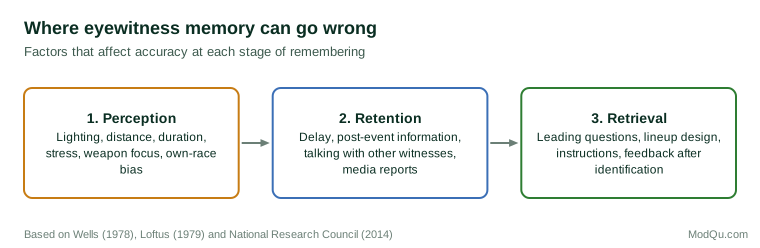
Eyewitness memory can be distorted at three stages: when the event is perceived, while the memory is retained, and when it is retrieved.
Perception
Witnesses often see events briefly, at a distance, in poor light and under stress. A meta-analysis by Deffenbacher et al. (2004) found that high stress impairs both the accuracy of face identification and the recall of event details. When a weapon is present, witnesses tend to focus on it at the expense of the offender's face, a phenomenon known as weapon focus (Loftus et al., 1987). Steblay (1992) confirmed the effect in a meta-analysis, although it is stronger in laboratory studies than in some field settings.
People are also better at recognising faces of their own ethnic group than faces of other groups. Meissner and Brigham (2001), combining results from three decades of research, found that this own-race bias both reduces correct identifications and increases false identifications of people from other groups. The effect has obvious implications for cross-group identifications in criminal cases.
Retention
Memory fades with time, and faster in the early period after an event. Shapiro and Penrod (1986) found in a meta-analysis that longer delays between seeing a face and attempting to identify it reduced accuracy. During the delay, memory is also exposed to new information. Loftus's research programme showed that misleading information provided after an event, through questions, conversations or media reports, can be incorporated into the witness's memory and later reported as something they saw (Loftus, 1979, 2005). In the best-known demonstration, people who were asked how fast cars were going when they "smashed into" each other later estimated higher speeds and were more likely to report seeing broken glass that was not there (Loftus & Palmer, 1974).
Witnesses who discuss an event with each other can also influence one another. Gabbert et al. (2003) showed pairs of participants slightly different versions of the same event and then let them discuss it. Many participants later reported details that only their partner had seen. In real cases, witnesses often talk before they are interviewed, and their accounts can converge in ways that look like independent corroboration but are not.
Retrieval
The way memory is tested affects what is reported. Leading questions, repeated questioning and pressure to provide answers can all introduce errors. Identification procedures are especially sensitive. A lineup in which the suspect stands out from the fillers, instructions that imply the offender is present, or an administrator who knows which person is the suspect and unconsciously signals it, can all increase the risk of a mistaken identification (National Research Council, 2014; Wells et al., 2020).
What happens after an identification also matters. Wells and Bradfield (1998) found that witnesses who were told "Good, you identified the suspect" after choosing someone from a lineup later reported being more confident, having had a better view and having paid more attention, even though their original identifications had been wrong. Confirming feedback inflates confidence without improving accuracy, and that inflated confidence is what a jury later sees.
A worked illustration
Consider a hypothetical robbery at a petrol station at night. The cashier sees the robber for about twenty seconds, under bright forecourt lights, while a knife is pointed at them. Afterwards, the cashier and a customer who saw the robber leave wait together for the police and talk about what happened. The next day, a local news site publishes a photograph of a man arrested nearby for an unrelated offence. A week later, the police show the cashier a lineup that includes that man.
Each stage carries risk. At perception, the duration was short and the stress and weapon were likely to draw attention away from the face. During retention, the conversation with the customer may have blended two partial memories into one, and the news photograph may have created a sense of familiarity unrelated to the robbery. At retrieval, if the lineup includes the man from the news photograph and he is the only one who matches some feature the cashier mentioned, his selection may reflect the photograph rather than the robbery. If the officer running the lineup knows he is the suspect and responds warmly when he is chosen, the cashier's confidence will grow and later testimony will sound certain.
An investigator applying the research would act differently at every point under their control. They would separate the witnesses at the scene, record each description in full before any discussion, ask whether the witness has seen any images of possible suspects, build a lineup in which several people fit the description, have it run by an officer who does not know the suspect, warn the witness that the offender may not be present, and record the witness's confidence in their own words immediately. None of these steps can repair the conditions of the original sighting, but together they prevent the investigation itself from adding error.
System and estimator variables
Wells (1978) proposed a distinction that has shaped research and policy ever since. Estimator variables are factors that affect accuracy but cannot be controlled by the justice system, such as lighting, stress, distance and own-race bias. They can only be used to estimate how reliable an identification is likely to be. System variables are factors that the justice system controls, such as how witnesses are interviewed, how lineups are constructed and conducted, and what witnesses are told. Because system variables can be changed, they are where reform can make the most difference.
Confidence and accuracy
For many years, researchers emphasised that confidence was a poor predictor of accuracy. Wixted and Wells (2017) reviewed the evidence and reached a more nuanced conclusion. When an identification is made under good conditions, with a fair lineup, neutral instructions and a blind administrator, and confidence is recorded immediately, high confidence is a strong indicator of accuracy and low confidence a strong indicator of error. The problem is that confidence is malleable. By the time a witness testifies in court, often months later and after feedback, repeated interviews and preparation, their confidence may have grown substantially. The initial confidence statement is informative; confidence expressed at trial often is not.
How courts assess eyewitness evidence
Courts have developed their own safeguards. In the United States, Manson v. Brathwaite (1977) held that identifications obtained through suggestive procedures may still be admitted if they are otherwise reliable, considering factors such as the witness's opportunity to view the offender, degree of attention, accuracy of prior description, level of certainty and the time between the crime and the identification. Critics note that some of these factors, especially certainty, are themselves affected by suggestive procedures (National Research Council, 2014). In England and Wales, R v Turnbull (1977) requires judges to warn juries about the special need for caution before convicting on identification evidence, and to direct them to examine the circumstances in which the identification was made.
Recommendations for investigators
Research has produced a consistent set of recommendations for collecting eyewitness evidence (National Research Council, 2014; Wells et al., 2020):
- Record the witness's account and description promptly, before memory fades or is contaminated, using open questions and techniques such as the cognitive interview (Fisher & Geiselman, 1992).
- Separate witnesses and ask them not to discuss the event with each other.
- Avoid leading questions and avoid giving witnesses information about the case or the suspect.
- Use double-blind identification procedures, in which the person running the lineup does not know which member is the suspect.
- Construct fair lineups, in which the suspect does not stand out, with fillers who match the witness's description.
- Warn witnesses that the offender may not be present and that the investigation will continue whether or not they identify someone.
- Record confidence immediately, in the witness's own words, before any feedback is given.
- Give no feedback about whether the witness chose the suspect.
- Video-record the procedure, so that its fairness can be assessed later.
There has been debate about whether lineup members should be shown one at a time (sequentially) or all together (simultaneously). An early meta-analysis found that sequential lineups reduced mistaken identifications but also reduced correct ones (Steblay et al., 2011). Later analyses using different methods have suggested that simultaneous lineups may be at least as good at distinguishing guilty from innocent suspects, and the most recent recommendations treat the format as less important than blind administration, fair composition and prompt recording of confidence (Wells et al., 2020).
Beyond criminal cases
The same lessons apply wherever investigators rely on people's recollections. In workplace investigations, witnesses to a disputed meeting may have discussed it among themselves before being interviewed. In safety investigations, staff may have heard theories about the cause of an accident before giving their account. In customer research, respondents' memories of past purchases or experiences are shaped by what has happened since and by the way questions are asked. In every setting, accounts collected early, separately and with open questions are more reliable than those collected late, together and with prompts.
Conclusion
Eyewitnesses are not unreliable because they are careless or dishonest. They are unreliable because human memory reconstructs events rather than recording them, and because the reconstruction is shaped by stress, time, expectations and what others say. The research does not suggest that eyewitness evidence should be ignored; often it is essential. It suggests that it should be collected with care, preserved before it is contaminated, and weighed with a clear understanding of how it can fail. Investigators control many of the conditions that make eyewitness evidence better or worse, and that is where the greatest gains in accuracy lie.
References
Bartlett, F. C. (1932). Remembering: A study in experimental and social psychology. Cambridge University Press.
Deffenbacher, K. A., Bornstein, B. H., Penrod, S. D., & McGorty, E. K. (2004). A meta-analytic review of the effects of high stress on eyewitness memory. Law and Human Behavior, 28(6), 687–706. https://doi.org/10.1007/s10979-004-0565-x
Fisher, R. P., & Geiselman, R. E. (1992). Memory-enhancing techniques for investigative interviewing: The cognitive interview. Charles C Thomas.
Gabbert, F., Memon, A., & Allan, K. (2003). Memory conformity: Can eyewitnesses influence each other's memories for an event? Applied Cognitive Psychology, 17(5), 533–543. https://doi.org/10.1002/acp.885
Garrett, B. L. (2011). Convicting the innocent: Where criminal prosecutions go wrong. Harvard University Press.
Loftus, E. F. (1979). Eyewitness testimony. Harvard University Press.
Loftus, E. F., Loftus, G. R., & Messo, J. (1987). Some facts about "weapon focus." Law and Human Behavior, 11(1), 55–62. https://doi.org/10.1007/BF01044839
Loftus, E. F., & Palmer, J. C. (1974). Reconstruction of automobile destruction: An example of the interaction between language and memory. Journal of Verbal Learning and Verbal Behavior, 13(5), 585–589. https://doi.org/10.1016/S0022-5371(74)80011-3
Loftus, E. F. (2005). Planting misinformation in the human mind: A 30-year investigation of the malleability of memory. Learning & Memory, 12(4), 361–366. https://doi.org/10.1101/lm.94705
Manson v. Brathwaite, 432 U.S. 98 (1977).
Meissner, C. A., & Brigham, J. C. (2001). Thirty years of investigating the own-race bias in memory for faces: A meta-analytic review. Psychology, Public Policy, and Law, 7(1), 3–35. https://doi.org/10.1037/1076-8971.7.1.3
National Research Council. (2014). Identifying the culprit: Assessing eyewitness identification. National Academies Press. https://doi.org/10.17226/18891
Neisser, U. (1981). John Dean's memory: A case study. Cognition, 9(1), 1–22. https://doi.org/10.1016/0010-0277(81)90011-1
R v Turnbull [1977] QB 224 (Court of Appeal of England and Wales).
Schacter, D. L. (1999). The seven sins of memory: Insights from psychology and cognitive neuroscience. American Psychologist, 54(3), 182–203. https://doi.org/10.1037/0003-066X.54.3.182
Shapiro, P. N., & Penrod, S. (1986). Meta-analysis of facial identification studies. Psychological Bulletin, 100(2), 139–156. https://doi.org/10.1037/0033-2909.100.2.139
Steblay, N. K., Dysart, J. E., & Wells, G. L. (2011). Seventy-two tests of the sequential lineup superiority effect: A meta-analysis and policy discussion. Psychology, Public Policy, and Law, 17(1), 99–139. https://doi.org/10.1037/a0021650
Steblay, N. M. (1992). A meta-analytic review of the weapon focus effect. Law and Human Behavior, 16(4), 413–424. https://doi.org/10.1007/BF02352267
Wells, G. L. (1978). Applied eyewitness-testimony research: System variables and estimator variables. Journal of Personality and Social Psychology, 36(12), 1546–1557. https://doi.org/10.1037/0022-3514.36.12.1546
Wells, G. L., & Bradfield, A. L. (1998). "Good, you identified the suspect": Feedback to eyewitnesses distorts their reports of the witnessing experience. Journal of Applied Psychology, 83(3), 360–376. https://doi.org/10.1037/0021-9010.83.3.360
Wells, G. L., Kovera, M. B., Douglass, A. B., Brewer, N., Meissner, C. A., & Wixted, J. T. (2020). Policy and procedure recommendations for the collection and preservation of eyewitness identification evidence. Law and Human Behavior, 44(1), 3–36. https://doi.org/10.1037/lhb0000359
Wixted, J. T., & Wells, G. L. (2017). The relationship between eyewitness confidence and identification accuracy: A new synthesis. Psychological Science in the Public Interest, 18(1), 10–65. https://doi.org/10.1177/1529100616686966