
Investigation · Foundations
Cognitive Interviewing versus Traditional Interrogation: Knowledge Yield Comparisons
How an interview is conducted determines how much accurate information it produces. This article compares the cognitive interview and information-gathering approaches with traditional accusatory interrogation, summarising what research shows about the amount and reliability of the knowledge each yields.
Interviews are the main way investigators learn what people know. The quality of that knowledge depends heavily on how the interview is conducted. Two broad traditions exist. Traditional interrogation, used mainly with suspects, aims to obtain a confession through control, confrontation and persuasion. Information-gathering approaches, including the cognitive interview for witnesses and the PEACE model for suspects, aim to obtain as much accurate information as possible through rapport and open questions. Research allows their "knowledge yield", meaning the amount and accuracy of information produced, to be compared.
The cognitive interview
The cognitive interview was developed by Fisher and Geiselman (1992) from research on memory. The interviewer builds rapport, hands control of the conversation to the witness, and uses techniques that help retrieval: mentally reinstating the context of the event, reporting everything however trivial, and recalling events in different orders or from different perspectives. Open questions come first; specific questions come later and are based on what the witness has already said.
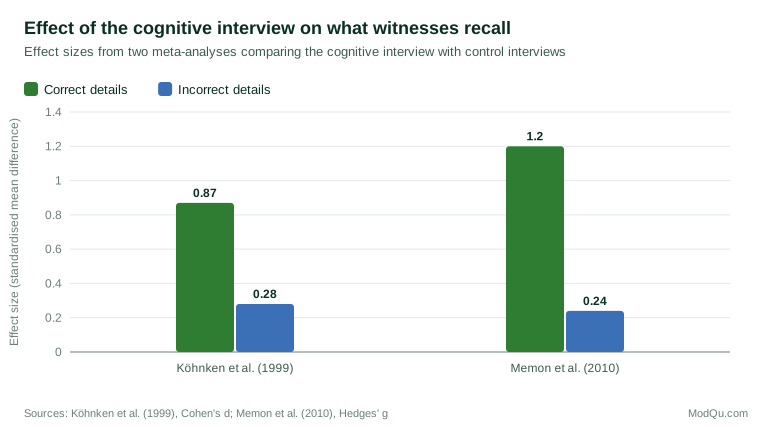
Two meta-analyses show the yield. Köhnken et al. (1999), combining more than 50 studies, found a large increase in correct details compared with standard interviews and a smaller increase in incorrect details, leaving overall accuracy similar. Memon et al. (2010), reviewing 25 years of research, found an even larger effect on correct details. In practice, the cognitive interview produces substantially more usable information without making witnesses less accurate.
Traditional interrogation
Accusatory interrogation, such as the widely taught Reid technique, begins from a belief that the suspect is guilty. The interviewer confronts the suspect, discourages denials, and offers themes that minimise the offence or provide face-saving explanations (Inbau et al., 2013). The aim is a confession rather than a full account.
Research shows that this approach yields less diagnostic information. Meissner et al. (2014), in a meta-analysis of field and experimental studies, found that accusatorial methods increased both true and false confessions, while information-gathering methods increased true confessions without increasing false ones. Kassin et al. (2010) describe the risk factors for false confessions, including lengthy detention, presentation of false evidence and minimisation, and the particular vulnerability of young people and people with intellectual disabilities. A confession obtained this way may say little about what actually happened.
Comparing the yield
The difference lies in what each approach treats as the product. Interrogation treats the confession as the product and other information as secondary. Information-gathering treats the full account as the product. A detailed account can be checked against other evidence, so it yields knowledge that can be tested; a bare admission cannot. Even when a suspect lies, a full account gives investigators specific claims to verify, and inconsistencies with the evidence become informative.
Limits of the evidence
The research has limits. Most cognitive interview studies are laboratory experiments with student volunteers recalling filmed events, which lack the stress and stakes of real cases. Field studies are fewer, and interviewers trained in the method do not always use all its components in practice. The comparison with interrogation also rests partly on experimental paradigms in which participants are accused of minor rule-breaking. Even so, the direction of the findings is consistent across settings, and no body of research shows accusatory methods producing more accurate information.
Practical implications
Investigators who want reliable knowledge should establish rapport, ask open questions first, let the interviewee speak without interruption, introduce evidence later and strategically, and record the interview in full. Many jurisdictions, including England and Wales, have moved to information-gathering models for both witnesses and suspects. These methods take training and time, but the evidence indicates they yield more accurate knowledge and fewer wrongful convictions.
Conclusion
Compared with traditional interrogation, the cognitive interview and other information-gathering methods produce more information, maintain accuracy and reduce the risk of false confessions. For any investigation whose aim is to establish what happened, they offer the higher knowledge yield.
References
Fisher, R. P., & Geiselman, R. E. (1992). Memory-enhancing techniques for investigative interviewing: The cognitive interview. Charles C Thomas.
Inbau, F. E., Reid, J. E., Buckley, J. P., & Jayne, B. C. (2013). Criminal interrogation and confessions (5th ed.). Jones & Bartlett Learning.
Kassin, S. M., Drizin, S. A., Grisso, T., Gudjonsson, G. H., Leo, R. A., & Redlich, A. D. (2010). Police-induced confessions: Risk factors and recommendations. Law and Human Behavior, 34(1), 3–38. https://doi.org/10.1007/s10979-009-9188-6
Köhnken, G., Milne, R., Memon, A., & Bull, R. (1999). The cognitive interview: A meta-analysis. Psychology, Crime & Law, 5(1–2), 3–27. https://doi.org/10.1080/10683169908414991
Meissner, C. A., Redlich, A. D., Michael, S. W., Evans, J. R., Camilletti, C. R., Bhatt, S., & Brandon, S. (2014). Accusatorial and information-gathering interrogation methods and their effects on true and false confessions: A meta-analytic review. Journal of Experimental Criminology, 10(4), 459–486. https://doi.org/10.1007/s11292-014-9207-6
Memon, A., Meissner, C. A., & Fraser, J. (2010). The cognitive interview: A meta-analytic review and study space analysis of the past 25 years. Psychology, Public Policy, and Law, 16(4), 340–372. https://doi.org/10.1037/a0020518