
Intelligence · Market and competitive intelligence
Sales Intelligence and Account Research
Sales intelligence helps salespeople decide which accounts to pursue and arrive at each conversation already understanding the customer's business. This article explains how to prioritise accounts, what to research and how to learn from every sale won or lost.
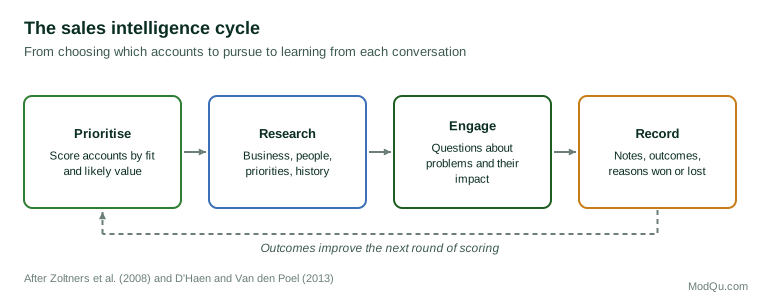
Salespeople have limited time. Every hour spent on an account that will never buy is an hour not spent on one that would. And a first meeting in which the salesperson knows nothing about the customer's business is usually a wasted opportunity. Sales intelligence addresses both problems: it helps decide which accounts deserve attention and prepares salespeople to understand each customer's situation before they speak. This article explains the main elements and how to put them into practice.
Why knowledge drives sales performance
Verbeke et al. (2011), in a meta-analysis of studies on the drivers of sales performance, found that knowledge-related factors, such as the salesperson's understanding of selling situations and ability to adapt, had become among the strongest predictors of results. They described modern salespeople as knowledge brokers, who connect what they know about the customer's problems with what their own company can offer. Zoltners et al. (2008) place customer and market knowledge among the core drivers of sales force effectiveness, alongside people, processes and incentives.
This is the sales-level counterpart of what Kohli and Jaworski (1990) called market orientation: generating intelligence about customers, sharing it across the organisation and acting on it.
Prioritising accounts
The first task is choosing where to spend effort. Many firms rank accounts by past revenue, but past revenue does not always indicate future value. Kumar et al. (2008) showed in a field study that a sales campaign directed at customers with high predicted future value produced better results than one based on past revenue.
For prospects that have not yet bought, the challenge is harder because there is no purchase history. D'Haen and Van den Poel (2013) proposed a model that learns from the characteristics of past customers to estimate which prospects are most likely to convert, updating its predictions as new results come in. For existing customers, recency, frequency and monetary value give a simple basis for ranking, which Fader et al. (2005) linked to lifetime value.
A practical scoring approach combines fit, meaning how closely the account resembles the firm's best customers in size, industry and needs, with signals of current interest, such as recent enquiries, leadership changes, expansion or new regulation affecting the account.
Researching an account
Before a meeting, the salesperson should be able to answer a short set of questions:
- The business. What does the account sell, to whom, and how is it performing? Annual reports, press releases and industry news answer most of this.
- Priorities and pressures. What has the leadership said about its goals? Is the sector facing new regulation, cost pressure or technological change?
- The people. Who makes, influences and approves the decision? What are their roles and concerns?
- The history. Has the account bought from the firm before? What did previous contacts, service calls and proposals reveal?
Payne and Frow (2005) emphasise that customer information is most valuable when it is integrated across all points of contact, so that the salesperson can see what marketing, service and finance already know.
Using intelligence in the conversation
Research is a starting point, not a script. Rackham (1988), drawing on a large study of sales calls, found that in larger sales the most successful salespeople asked more questions about the customer's problems and their consequences, and spent less time presenting product features. Good preparation lets the salesperson ask sharper questions, such as how a new regulation is affecting the customer's costs, rather than spending the meeting on basic facts.
Learning from outcomes
Each sale won or lost contains information. Recording why it was won or lost, which competitors were involved and what the customer valued improves the next round of prioritisation and research. Without this record, the same mistakes are repeated across the sales team.
An illustration
A company that sells workplace safety software has 400 prospects in its territory and three salespeople. Instead of working through the list alphabetically, it scores each prospect on fit, using industry, number of sites and workforce size compared with its best existing customers, and on signals, such as recent safety incidents reported in the news, new provincial regulations and job postings for health and safety managers. The top 60 accounts receive full research before any contact.
One of these is a food processing firm that has just opened a second plant. The salesperson reads the firm's announcements, notes that the new plant must meet stricter inspection requirements and learns from the firm's website who runs operations. The first conversation opens with questions about how the firm is managing inspections across two sites, not with a product demonstration. After each meeting, the salesperson records what the customer said mattered most. Within a quarter, the team finds that recent expansion is the strongest signal of interest and gives it more weight in the next round of scoring.
Ethics and privacy
Sales intelligence should rely on information that is public or that customers have chosen to share. Martin et al. (2017) found that perceived misuse of customer data damages trust and performance. Salespeople who arrive with an uncomfortable amount of personal detail about a buyer can harm the relationship they are trying to build. Professional information about the organisation and its public priorities is the right focus.
Conclusion
Sales intelligence directs effort to the accounts most likely to buy and prepares salespeople to understand each customer's business. Its value comes from scoring accounts on predicted value rather than past revenue, researching the business and the people involved, asking better questions and recording what each outcome teaches.
References
D'Haen, J., & Van den Poel, D. (2013). Model-supported business-to-business prospect prediction based on an iterative customer acquisition framework. Industrial Marketing Management, 42(4), 544–551. https://doi.org/10.1016/j.indmarman.2013.03.006
Fader, P. S., Hardie, B. G. S., & Lee, K. L. (2005). RFM and CLV: Using iso-value curves for customer base analysis. Journal of Marketing Research, 42(4), 415–430. https://doi.org/10.1509/jmkr.2005.42.4.415
Kohli, A. K., & Jaworski, B. J. (1990). Market orientation: The construct, research propositions, and managerial implications. Journal of Marketing, 54(2), 1–18. https://doi.org/10.1177/002224299005400201
Kumar, V., Venkatesan, R., & Reinartz, W. (2008). Performance implications of adopting a customer-focused sales campaign. Journal of Marketing, 72(5), 50–68. https://doi.org/10.1509/jmkg.72.5.050
Martin, K. D., Borah, A., & Palmatier, R. W. (2017). Data privacy: Effects on customer and firm performance. Journal of Marketing, 81(1), 36–58. https://doi.org/10.1509/jm.15.0497
Payne, A., & Frow, P. (2005). A strategic framework for customer relationship management. Journal of Marketing, 69(4), 167–176. https://doi.org/10.1509/jmkg.2005.69.4.167
Rackham, N. (1988). SPIN selling. McGraw-Hill.
Verbeke, W., Dietz, B., & Verwaal, E. (2011). Drivers of sales performance: A contemporary meta-analysis. Have salespeople become knowledge brokers? Journal of the Academy of Marketing Science, 39(3), 407–428. https://doi.org/10.1007/s11747-010-0211-8
Zoltners, A. A., Sinha, P., & Lorimer, S. E. (2008). Sales force effectiveness: A framework for researchers and practitioners. Journal of Personal Selling & Sales Management, 28(2), 115–131. https://doi.org/10.2753/PSS0885-3134280201