
Intelligence · Analysis and tradecraft
Prediction Markets as Intelligence Tools
Prediction markets let people trade contracts whose value depends on future events, so that prices act as probability forecasts. This article explains how they work, what research says about their accuracy and where they fit as an intelligence tool.
Knowledge about the future is usually scattered. A sales representative hears that a customer is delaying orders; an engineer knows that a component is behind schedule; an analyst reads a regulatory notice. No single person sees the whole picture. Prediction markets offer one way to combine these fragments. Participants buy and sell contracts whose payout depends on whether an event happens, and the resulting price serves as a collective estimate of its probability.
The idea behind them
Hayek (1945) argued that the knowledge needed to run an economy is never held by any single mind but is dispersed among many individuals, and that market prices are a mechanism for bringing it together. Prediction markets apply this idea to forecasting. If a contract pays one dollar when an event occurs and nothing otherwise, a trader who believes the probability is higher than the current price has an incentive to buy, and one who believes it is lower has an incentive to sell. The price therefore moves towards the traders' combined estimate of the probability (Wolfers & Zitzewitz, 2004).
How accurate are they?
The longest-running evidence comes from the Iowa Electronic Markets, run by a university since 1988, where traders buy contracts tied to election results. Berg et al. (2008) compared market prices with nearly a thousand opinion polls and found that the markets were closer to the final result most of the time, particularly in the months before an election.
In business, Spann and Skiera (2003) tested internet-based markets for forecasting cinema attendance and mobile phone sales and found them at least as accurate as established methods. Cowgill and Zitzewitz (2015) studied internal markets at Google, Ford and a third company. The markets were generally accurate and outperformed the companies' own expert forecasts in several cases, but they also showed biases, notably optimism about the company's own projects, which declined as markets matured.
Prediction markets in intelligence
In 2003, the American Defense Advanced Research Projects Agency proposed a Policy Analysis Market in which participants would trade contracts on political and economic events in the Middle East. Critics described it as a market in terrorism and it was cancelled within days. Looney (2004) reviewed the episode and argued that the concept had merit for intelligence but that its design and presentation had ignored ethical and political concerns.
Markets compared with other methods
A prediction market differs from a survey in two ways. Participants have an incentive to be right rather than to give a socially acceptable answer, and the price updates continuously as new information arrives, without anyone having to call a meeting or commission a new poll. Compared with an expert panel, a market can draw on people who are not recognised as experts but who hold relevant facts, such as front-line staff. Its weakness is that it gives a number without an explanation. Analysts still need to find out why a price has moved before they can advise decision-makers what to do about it.
Limits
Markets work best when many informed participants trade, when events are clearly defined and when outcomes are known within a reasonable time. Thin trading produces unreliable prices. Participants may manipulate prices, or be reluctant to trade against their managers' projects. Questions about rare or distant events are hard to run as markets. Wolfers and Zitzewitz (2004) also note that prices reflect the beliefs of those who choose to trade, which may not be representative.
Using them well
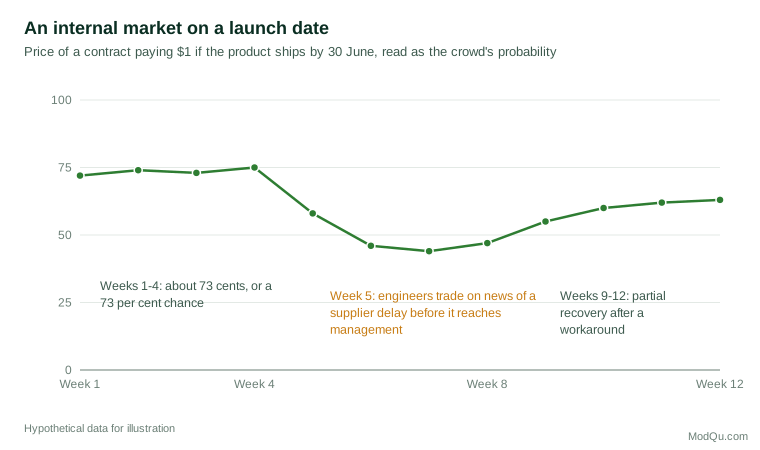
For organisations, an internal prediction market is most useful as a supplement to normal forecasting. Good questions are specific and verifiable, such as whether a project will ship on time or whether quarterly sales will exceed a target. Wide participation, small rewards rather than real money where law requires, and anonymity help people trade on what they know. The price can then be watched like any other indicator: a sudden fall is a prompt to ask what traders know that management does not.
Conclusion
Prediction markets turn dispersed knowledge into a single, continuously updated probability. Research shows they can match or beat polls and expert forecasts when they are well designed and well used. They are not a replacement for analysis, but they are a useful source of intelligence about what people across an organisation really expect.
References
Berg, J. E., Forsythe, R., Nelson, F., & Rietz, T. (2008). Results from a dozen years of election futures markets research. In C. R. Plott & V. L. Smith (Eds.), Handbook of experimental economics results (Vol. 1, pp. 742–751). North-Holland.
Cowgill, B., & Zitzewitz, E. (2015). Corporate prediction markets: Evidence from Google, Ford, and Firm X. Review of Economic Studies, 82(4), 1309–1341. https://doi.org/10.1093/restud/rdv014
Hayek, F. A. (1945). The use of knowledge in society. American Economic Review, 35(4), 519–530.
Looney, R. (2004). DARPA's Policy Analysis Market for intelligence: Outside the box or off the wall? International Journal of Intelligence and CounterIntelligence, 17(3), 405–419. https://doi.org/10.1080/08850600490446718
Spann, M., & Skiera, B. (2003). Internet-based virtual stock markets for business forecasting. Management Science, 49(10), 1310–1326. https://doi.org/10.1287/mnsc.49.10.1310.17314
Wolfers, J., & Zitzewitz, E. (2004). Prediction markets. Journal of Economic Perspectives, 18(2), 107–126. https://doi.org/10.1257/0895330041371321