
Intelligence · Organisational intelligence
Information Overload and the Filtering Problem
More information does not always lead to better decisions. This article explains information overload, the research showing how it harms judgement, and the filtering practices that help intelligence teams and decision-makers focus on what matters.
In 1971, the economist and psychologist Herbert Simon made an observation that has become more relevant every year since. Simon wrote that, in an information-rich world, the wealth of information means a dearth of something else: the attention of its recipients. Information consumes attention, and so a wealth of information creates a poverty of attention (Simon, 1971). For intelligence work, this reverses a long-standing assumption. The main problem is no longer finding information but deciding what to ignore.
What information overload is
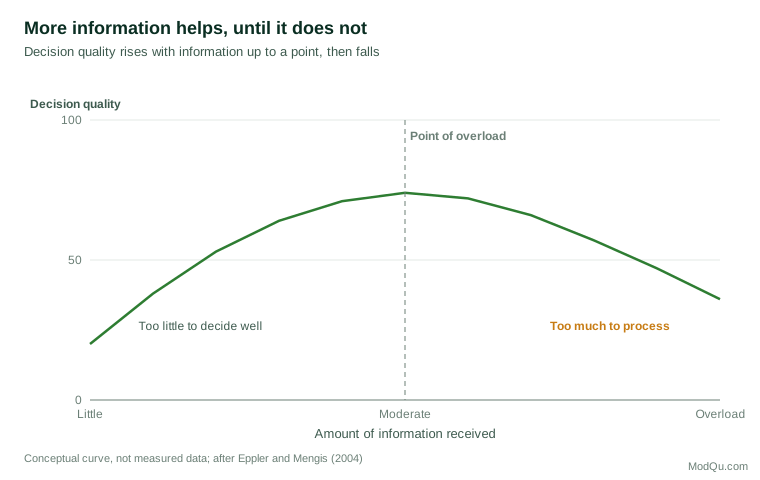
Information overload occurs when the amount of information a person must process exceeds their capacity to process it. Eppler and Mengis (2004), reviewing research across organisation science, accounting, marketing and information systems, found broad agreement that decision quality rises with the amount of information up to a point, then declines as further information overwhelms the decision-maker. Figure 1 illustrates this pattern.
The limit comes from human cognition. Miller (1956) showed that people can hold only a small number of items in working memory at once. Beyond that, information must be grouped, summarised or ignored.
The evidence
Jacoby, Speller and Kohn (1974) gave consumers information about different brands and varied how much they received. Beyond a certain amount, more information led consumers to make poorer choices, while they felt more satisfied and confident. Overload did not feel like overload; it felt like being well informed.
Speier, Valacich and Vessey (1999) studied interruptions at work. For complex tasks, interruptions reduced decision quality and increased the time needed, as people struggled to switch between demands. Iyengar and Lepper (2000) found that shoppers offered a large range of jams were more likely to stop and look but much less likely to buy than those offered a small range. Too many options can prevent a choice altogether.
Edmunds and Morris (2000), reviewing the problem in business organisations, found that managers widely reported feeling overloaded, that the problem was made worse by easy electronic communication, and that the causes lay as much in poor filtering and organisation of information as in its volume.
Why overload is an intelligence problem
Intelligence functions can make overload worse. Teams that measure their success by the number of reports, alerts or sources monitored push more information to decision-makers than they can use. Important warnings are then lost among routine material. The value of an intelligence function lies less in what it collects than in what it filters out.
Filtering practices
Several practices help:
- Filter by requirement. Send decision-makers only what relates to their agreed key questions.
- Lead with the conclusion. Put the main point first, so readers can stop early.
- Summarise and group. Combine related items into a single assessment rather than forwarding each one.
- Set alert thresholds. Decide in advance what level of change justifies an immediate alert, and send everything else in a scheduled summary.
- Reduce interruptions. Batch routine updates at regular times rather than sending them as they arrive.
- Offer fewer options. Present two or three well-defined choices rather than many.
- Review what is read. Stop producing material that no one uses.
Overload inside the intelligence team
Analysts face overload too. A team that monitors hundreds of sources can spend most of its time reading and too little thinking. Signs include analysts who can summarise every recent development but cannot say what it means, and products that grow longer without growing more useful. Remedies mirror those for decision-makers: prune sources that rarely contribute, assign clear responsibility for each key topic, and set aside protected time for analysis rather than monitoring. Automated tools can help with sorting and summarising, but their output also needs filtering, or they simply add another stream to read.
An illustration
The marketing director of a consumer goods company receives forty news alerts and six reports from the intelligence team each week, and reads almost none of them. The team replaces them with a single weekly page covering the three questions the director has said matter most, plus an immediate alert only when a competitor launches a product in the company's core categories. The director now reads every summary and, for the first time, responds with follow-up questions.
Conclusion
Information overload is not solved by collecting less but by filtering better. Intelligence teams that understand the limits of attention send fewer, clearer, better-targeted products, and in doing so make it more likely that what matters is noticed and acted on.
References
Edmunds, A., & Morris, A. (2000). The problem of information overload in business organisations: A review of the literature. International Journal of Information Management, 20(1), 17–28. https://doi.org/10.1016/S0268-4012(99)00051-1
Eppler, M. J., & Mengis, J. (2004). The concept of information overload: A review of literature from organization science, accounting, marketing, MIS, and related disciplines. The Information Society, 20(5), 325–344. https://doi.org/10.1080/01972240490507974
Iyengar, S. S., & Lepper, M. R. (2000). When choice is demotivating: Can one desire too much of a good thing? Journal of Personality and Social Psychology, 79(6), 995–1006. https://doi.org/10.1037/0022-3514.79.6.995
Jacoby, J., Speller, D. E., & Kohn, C. A. (1974). Brand choice behavior as a function of information load. Journal of Marketing Research, 11(1), 63–69. https://doi.org/10.1177/002224377401100106
Miller, G. A. (1956). The magical number seven, plus or minus two: Some limits on our capacity for processing information. Psychological Review, 63(2), 81–97. https://doi.org/10.1037/h0043158
Simon, H. A. (1971). Designing organizations for an information-rich world. In M. Greenberger (Ed.), Computers, communications, and the public interest (pp. 37–72). Johns Hopkins Press.
Speier, C., Valacich, J. S., & Vessey, I. (1999). The influence of task interruption on individual decision making: An information overload perspective. Decision Sciences, 30(2), 337–360. https://doi.org/10.1111/j.1540-5915.1999.tb01613.x