
Intelligence · Organisational intelligence
"Decision Intelligence: Linking Data to Decisions"
Organisations collect more data than ever, yet many still struggle to turn it into better decisions. Decision intelligence is an approach that starts from the decision rather than the data, mapping how actions lead to outcomes and where evidence fits. This article explains its roots in decision analysis, its methods, and how to apply it.
Many organisations have invested heavily in data and analytics, only to find that decisions have not improved as much as hoped. Dashboards multiply, reports are produced and models are built, but the link between all this information and the choices managers actually make remains weak. Analysts deliver insights that no one acts on; decision-makers ask questions that the available data cannot answer.
Decision intelligence is a response to this gap. Rather than starting with data and asking what it shows, it starts with a decision and asks what would make it better. Pratt (2019) describes decision intelligence as an engineering discipline that connects data, actions and outcomes, making explicit how a choice is expected to lead to results and where evidence, models and judgement fit into that chain. The term is relatively new, but the ideas behind it draw on decades of work in decision analysis, decision support systems and management science.
Roots in decision analysis
Decision analysis emerged in the 1960s as a systematic way to make choices under uncertainty. Raiffa (1968) set out its core methods: describe the alternatives available, the uncertain events that affect their outcomes, the probabilities of those events and the value of each outcome, then choose the alternative with the best expected result. Howard (1966) added information value theory, a way to calculate how much it would be worth to reduce uncertainty before deciding. This was, in effect, the first rigorous account of the value of intelligence.
Keeney (1992) argued that decision-making too often starts with the alternatives on the table and asks which is best. Keeney proposed value-focused thinking: start by clarifying what you are trying to achieve, then search for alternatives that serve those objectives better. Hammond et al. (1999) translated these ideas into a practical guide for managers, summarised in a sequence: define the problem, specify objectives, create alternatives, understand consequences, consider trade-offs, clarify uncertainties, assess risk tolerance and consider linked decisions.
Decision intelligence inherits this discipline. It insists that data and analysis serve a decision, defined by objectives and alternatives, rather than existing for their own sake.
Roots in decision support
A second root lies in decision support systems. Gorry and Scott Morton (1971) proposed a framework that classified management decisions by how structured they are, from routine, programmable decisions to unique, unstructured ones. Simon (1973) had analysed the nature of ill-structured problems, in which goals, alternatives and consequences are unclear. Computer systems, Gorry and Scott Morton argued, could automate structured decisions and support semi-structured ones, but unstructured decisions would always require human judgement.
Power (2008) traces the history of decision support systems from these early frameworks through spreadsheets, data warehouses and executive dashboards. A recurring finding is that systems succeed when they are designed around specific decisions and fail when they are designed around available data.
From analytics to decision intelligence
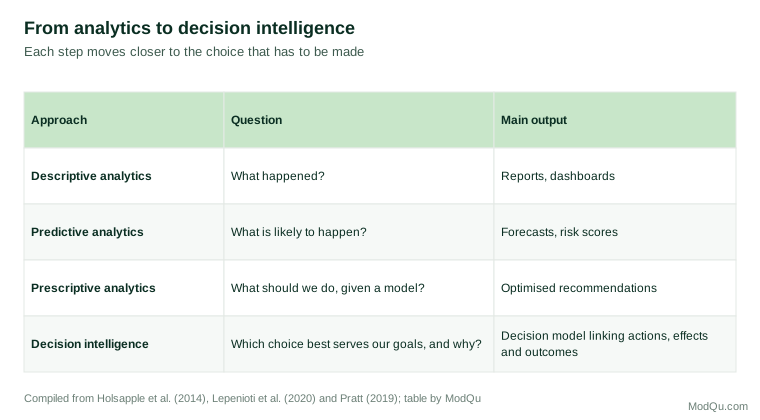
Business analytics is often described in stages. Holsapple, Lee-Post and Pakath (2014) review definitions and propose a unified view in which analytics is evidence-based problem recognition and solving. Descriptive analytics reports what has happened. Predictive analytics forecasts what is likely to happen. Prescriptive analytics recommends what to do. Lepenioti et al. (2020) review prescriptive analytics methods, which use optimisation, simulation and decision rules to recommend actions. Bertsimas and Kallus (2020) show how predictive models can be combined with optimisation so that recommendations account for uncertainty directly.
Decision intelligence extends this sequence. Figure 1 compares the approaches.
The difference is not merely technical. Provost and Fawcett (2013) emphasise that data science creates value only when it is framed around business problems and decisions. Davenport and Harris (2007) found that organisations that compete on analytics embed it in their decision processes rather than treating it as a separate function.
Mapping the decision
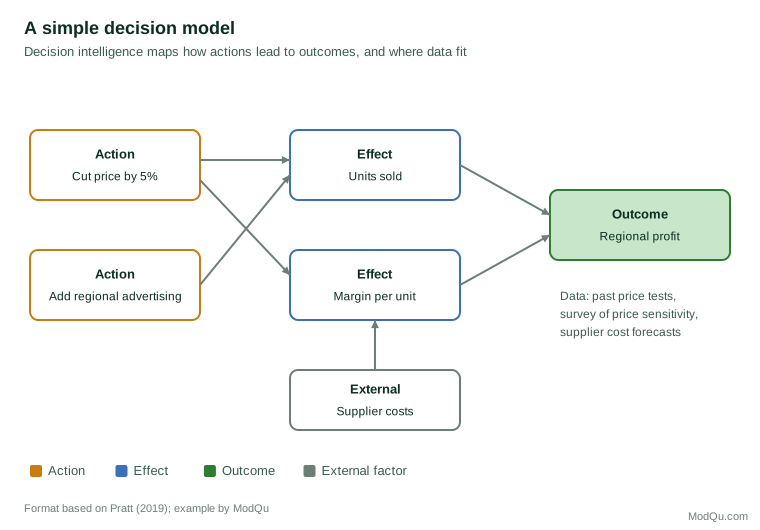
The central tool of decision intelligence is a decision model: a diagram showing the actions available, the intermediate effects they produce, the outcomes that matter and the external factors that affect them. Pratt (2019) calls such diagrams causal decision diagrams. Figure 2 shows a simple example.
Building such a model has several benefits:
- It makes assumptions visible. Each arrow represents a belief about cause and effect that can be questioned and tested.
- It shows where data fit. Data are useful only where they inform an uncertain link. A model reveals which links matter most and which data would help.
- It connects specialists. Marketing, finance and operations staff can each contribute knowledge about different links.
- It supports explanation. Decision-makers can see why a recommendation follows, not just what it is.
Pearl and Mackenzie (2018) explain why causal models are needed. Data alone show associations; decisions require understanding of what will happen if we intervene. A causal diagram states the assumptions under which data can answer questions about interventions.
Feedback and dynamics
Many decisions play out over time, with effects that feed back on their causes. Forrester (1961) developed system dynamics to model such feedback in industrial organisations, showing how delays and feedback loops produce oscillations and unintended consequences. Sterman (1989) found in experiments that managers systematically misperceive feedback, ignoring delays and reacting too strongly to recent changes. Decision models that include feedback, such as a price cut prompting a competitor's response that reduces the expected gain, help avoid such errors.
Judgement in decision intelligence
Decision intelligence does not remove human judgement. Klein (1998) showed that experienced decision-makers often recognise situations and act on the first workable option, without comparing alternatives formally. This recognition-primed decision-making is effective in familiar, fast-moving situations. Decision intelligence is most useful for decisions that are important, not urgent, and not routine: where there is time to think and the cost of error is high.
Even then, judgement is needed to define objectives, propose alternatives, estimate uncertain relationships and decide how much risk to accept. Kahneman (2011) and Kahneman, Sibony and Sunstein (2021) describe the biases and noise that affect such judgements, and recommend structured methods to reduce them: breaking judgements into components, assessing each independently, and combining them by a consistent rule. Larrick (2004) reviews debiasing techniques, such as considering the opposite and using decision aids, that can be built into the decision process.
Klein (2007) proposed the pre-mortem: before committing to a decision, imagine that it has failed and ask why. This simple technique surfaces risks that optimism hides. Dewar (2002) developed assumption-based planning, which identifies the assumptions on which a plan depends, the signs that they are failing, and actions to take if they do. Both fit naturally into a decision model.
Good decisions and good outcomes
Decision analysis draws a careful distinction between the quality of a decision and the quality of its outcome. A good decision is one that was well reasoned given what was known and could reasonably have been learned at the time. A good outcome is one that turned out well. Under uncertainty, good decisions sometimes produce bad outcomes, and poor decisions sometimes get lucky. Raiffa (1968) and later writers in the field stressed that judging decisions only by their results encourages people to learn the wrong lessons, rewarding luck and punishing sound reasoning that met bad fortune.
Decision intelligence takes this distinction seriously. By recording the decision model, the alternatives considered, the evidence used and the expected results at the time of the decision, it allows a later review to ask the right questions. Was the model reasonable? Were the probabilities sensible? Was important information available but ignored? Did something happen that no one could have foreseen? Over many decisions, such reviews show whether an organisation's decision process is improving, which outcome figures alone cannot reveal.
Uncertainty and scenarios
A decision model must reflect uncertainty honestly. Some uncertainties can be quantified with probabilities; others cannot. Schoemaker (1995) describes scenario planning as a way to explore several plausible futures when probabilities are hard to estimate. A decision that performs acceptably across several scenarios may be preferable to one that is optimal in the most likely scenario but disastrous in others.
The intelligence function's role
For intelligence and research teams, decision intelligence offers a clearer role. Instead of producing general reports in the hope that someone finds them useful, the team works with decision-makers to build the decision model, identifies the uncertain links that matter most, and directs collection and analysis to reduce those uncertainties. Howard's (1966) value-of-information reasoning tells the team which questions are worth answering: those whose answers could change the decision.
This approach also helps intelligence teams decline work. A request for information that would not affect any decision, however interesting, can be deprioritised.
Applying decision intelligence
A practical sequence for applying decision intelligence to an important decision:
- Frame the decision. State the choice to be made, by whom and by when.
- Clarify objectives. List what the decision is meant to achieve, including trade-offs between objectives.
- Generate alternatives. Look beyond the obvious options, guided by the objectives.
- Map the model. Draw the chain from actions through effects to outcomes, including external factors and feedback.
- Identify key uncertainties. Mark the links where uncertainty is greatest and matters most.
- Gather evidence. Direct data collection, research and analysis to those links.
- Evaluate alternatives. Estimate outcomes for each alternative, with uncertainty, using the model.
- Stress-test. Run a pre-mortem, check assumptions and consider scenarios.
- Decide and record. Make the choice and record the model, assumptions and expected results.
- Review. Compare actual results with expectations and update the model.
Roles in a decision intelligence team
Decision intelligence works best as a collaboration between people with different skills:
- The decision owner defines the decision, sets objectives and makes the final choice. Without an engaged owner, the work becomes an academic exercise.
- Subject experts from different functions supply knowledge about the causal links in the model: how customers respond to prices, how long supply changes take, how competitors behave.
- Analysts gather and analyse data, build quantitative estimates for key links and test the model against past results.
- The intelligence function monitors external factors, such as competitors, regulation and markets, and provides early warning when assumptions in the model start to fail.
- A facilitator, often from the intelligence or strategy team, runs the process, keeps the model simple and ensures that disagreements are resolved by evidence.
In a small organisation, one or two people may fill several of these roles. What matters is that each perspective is represented.
Simple tools
Decision intelligence does not require specialised software. Most of its value comes from the discipline of thinking through the decision. Useful tools include a whiteboard or diagramming program for the decision model, a spreadsheet for estimating outcomes under different assumptions, a decision record template capturing objectives, alternatives, assumptions and expected results, and a calendar reminder to review the decision after a set period. More sophisticated simulation and optimisation tools can be added for decisions that are frequent or very large.
Which decisions deserve this effort?
Not every decision needs a decision model. The approach takes time, and many choices are too small, too urgent or too routine to justify it. A useful test considers four questions. Is the decision costly to get wrong? Is it hard or impossible to reverse? Is there real uncertainty about how the alternatives will play out? And is there time to gather evidence before deciding? Decisions that score highly on all four, such as entering a market, making an acquisition, changing a pricing strategy or redesigning a supply chain, are strong candidates. Routine decisions that recur often, such as setting stock levels, may justify building a model once and then automating it. Small, reversible decisions are usually better made quickly and adjusted in light of results.
Common mistakes
- Starting with the data. Building models from available data without a clear decision produces analysis that answers no one's question.
- Treating the model as reality. A decision model is a simplification; it must be checked against experience and revised.
- Overcomplicating. A model with a few key links is often more useful than an elaborate one that no one understands.
- Ignoring objectives. Optimising a single measure, such as revenue, can damage other goals, such as customer trust.
- Skipping the review. Without comparing results to expectations, the organisation cannot learn whether its models were right.
A business illustration
A regional grocery chain is considering whether to cut prices on fresh produce to win customers from a discount rival. In the past, the decision would have been made in a meeting, based on the commercial director's experience and a sales report. This time, the intelligence team convenes a short workshop with commercial, finance and store operations staff to build a decision model.
The model links the price cut to the number of shoppers, the amount they spend, the margin on produce and on other items in their baskets, and the rival's likely response. The team identifies two key uncertainties: how many shoppers would switch, and whether the rival would match the cut. It runs a price test in a sample of stores, reviews survey data on shoppers' sensitivity to produce prices, and analyses the rival's past responses to price moves. The evidence suggests that shoppers would respond, but that the rival had matched previous cuts within weeks. Under that scenario, the price cut would reduce profit.
The model points to an alternative: improving produce quality and freshness, which the survey showed shoppers valued highly and which the rival would find harder to copy quickly. The chain invests in supplier changes and shorter delivery times instead. A year later, its share of produce sales has grown, with margins intact. The team compares the outcome with the model's expectations and updates it for the next decision.
Conclusion
Decision intelligence reverses the usual relationship between data and decisions. It starts with the choice to be made, clarifies objectives, maps how actions lead to outcomes, and directs evidence to the uncertainties that matter most. Drawing on decision analysis, decision support and causal reasoning, it gives intelligence and analytics teams a clear role: not to produce information for its own sake, but to make specific decisions better.
References
Bertsimas, D., & Kallus, N. (2020). From predictive to prescriptive analytics. Management Science, 66(3), 1025–1044. https://doi.org/10.1287/mnsc.2018.3253
Davenport, T. H., & Harris, J. G. (2007). Competing on analytics: The new science of winning. Harvard Business School Press.
Dewar, J. A. (2002). Assumption-based planning: A tool for reducing avoidable surprises. Cambridge University Press.
Forrester, J. W. (1961). Industrial dynamics. MIT Press.
Gorry, G. A., & Scott Morton, M. S. (1971). A framework for management information systems. Sloan Management Review, 13(1), 55–70.
Hammond, J. S., Keeney, R. L., & Raiffa, H. (1999). Smart choices: A practical guide to making better decisions. Harvard Business School Press.
Holsapple, C., Lee-Post, A., & Pakath, R. (2014). A unified foundation for business analytics. Decision Support Systems, 64, 130–141. https://doi.org/10.1016/j.dss.2014.05.013
Howard, R. A. (1966). Information value theory. IEEE Transactions on Systems Science and Cybernetics, 2(1), 22–26. https://doi.org/10.1109/TSSC.1966.300074
Kahneman, D. (2011). Thinking, fast and slow. Farrar, Straus and Giroux.
Kahneman, D., Sibony, O., & Sunstein, C. R. (2021). Noise: A flaw in human judgment. Little, Brown Spark.
Keeney, R. L. (1992). Value-focused thinking: A path to creative decisionmaking. Harvard University Press.
Klein, G. (1998). Sources of power: How people make decisions. MIT Press.
Klein, G. (2007). Performing a project premortem. Harvard Business Review, 85(9), 18–19.
Larrick, R. P. (2004). Debiasing. In D. J. Koehler & N. Harvey (Eds.), Blackwell handbook of judgment and decision making (pp. 316–337). Blackwell.
Lepenioti, K., Bousdekis, A., Apostolou, D., & Mentzas, G. (2020). Prescriptive analytics: Literature review and research challenges. International Journal of Information Management, 50, 57–70. https://doi.org/10.1016/j.ijinfomgt.2019.04.003
Pearl, J., & Mackenzie, D. (2018). The book of why: The new science of cause and effect. Basic Books.
Power, D. J. (2008). Decision support systems: A historical overview. In F. Burstein & C. W. Holsapple (Eds.), Handbook on decision support systems 1 (pp. 121–140). Springer. https://doi.org/10.1007/978-3-540-48713-5_7
Pratt, L. (2019). Link: How decision intelligence connects data, actions, and outcomes for a better world. Emerald Publishing.
Provost, F., & Fawcett, T. (2013). Data science and its relationship to big data and data-driven decision making. Big Data, 1(1), 51–59. https://doi.org/10.1089/big.2013.1508
Raiffa, H. (1968). Decision analysis: Introductory lectures on choices under uncertainty. Addison-Wesley.
Schoemaker, P. J. H. (1995). Scenario planning: A tool for strategic thinking. Sloan Management Review, 36(2), 25–40.
Simon, H. A. (1973). The structure of ill structured problems. Artificial Intelligence, 4(3–4), 181–201. https://doi.org/10.1016/0004-3702(73)90011-8
Sterman, J. D. (1989). Modeling managerial behavior: Misperceptions of feedback in a dynamic decision making experiment. Management Science, 35(3), 321–339. https://doi.org/10.1287/mnsc.35.3.321