
Intelligence · Market and competitive intelligence
Industry Analysis and Sector Reports
Industry analysis explains why some sectors are more profitable than others and how their structure is changing. This article sets out the main frameworks, what a good sector report contains and the mistakes to avoid.
Before a company decides where to compete, it needs to understand the arena. Some industries earn high returns year after year; others struggle to cover their cost of capital even in good times. Industry analysis explains these differences by examining the structure of a sector: who the competitors are, how much power customers and suppliers hold, how easily new firms can enter and what alternatives buyers have. A sector report packages this analysis for decision-makers, usually with data on size, growth and trends. This article explains the main frameworks, what a useful sector report contains and the most common mistakes.
Why industry structure matters
The idea that structure shapes performance has deep roots in economics. Bain (1956) studied how barriers to entry, such as economies of scale, product differentiation and capital requirements, allowed established firms in some manufacturing industries to earn persistently higher profits. Porter (1985) translated this tradition into a practical tool for managers, arguing that the attractiveness of an industry is one of the two basic determinants of a firm's profitability, the other being its position within that industry.
How much does industry matter compared with the firm itself? Researchers have studied the question by decomposing differences in profitability. Rumelt (1991) found that business-unit effects explained far more of the variation than industry effects. McGahan and Porter (1997), using a larger data set, found that industry still accounted for a substantial share, around a fifth, and that its importance differed across sectors. Hawawini et al. (2003) showed that industry matters most for ordinary firms; the very best and very worst performers are distinguished mainly by firm-specific factors. The practical conclusion is that industry analysis is necessary but not sufficient: it sets the conditions within which strategy works.
The five forces
The best-known framework for industry analysis is Porter's five forces (Porter, 2008). It holds that the profitability of an industry depends on five forces:
- Rivalry among existing competitors. Intense rivalry, driven by many similar competitors, slow growth, high fixed costs or high exit barriers, transfers value to customers through lower prices and higher costs.
- Threat of new entrants. Where entry is easy, new firms compete away profits. Barriers include scale, capital requirements, access to distribution, brand loyalty and regulation.
- Bargaining power of buyers. Concentrated, well-informed or price-sensitive buyers can force prices down.
- Bargaining power of suppliers. Concentrated suppliers, or those providing critical inputs, can capture value through higher prices.
- Threat of substitutes. Products from other industries that meet the same need cap the price an industry can charge.
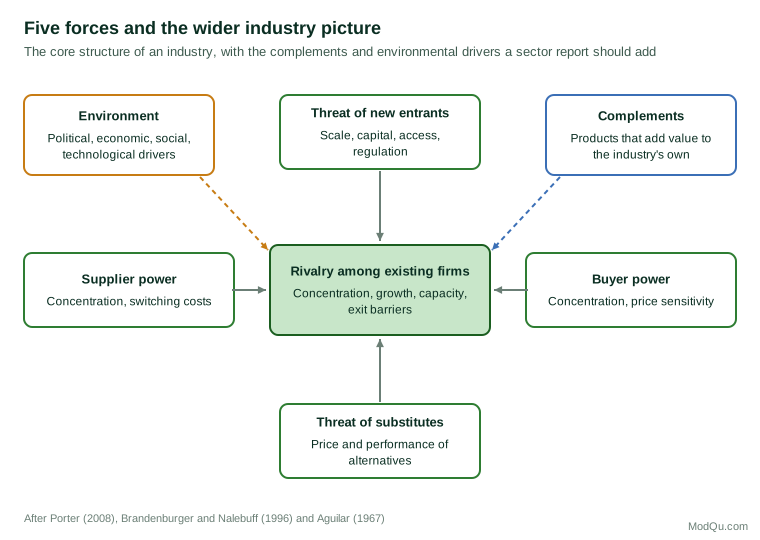
Porter (2008) stresses that the strongest force determines profitability, and that the analysis should explain why the industry earns what it does, not merely list factors. Porter also warns against common errors, such as confusing a fast-growing industry with an attractive one, or treating government as a sixth force rather than considering how regulation affects each of the five.
Extensions and criticisms
The framework has been extended in several ways. Brandenburger and Nalebuff (1996) added complementors: firms whose products make an industry's own products more valuable, such as software for computers or charging networks for electric vehicles. Complements can increase demand and profitability, and competition is not only about dividing value but about creating it.
Grundy (2006) argued that the five forces are often applied as a static checklist, and proposed linking them to the drivers of change in the wider environment, to growth and to the dynamics of competitive behaviour. Christensen (1997) showed how disruptive technologies can transform industry structure from below, as new entrants serving neglected customers improve until they challenge the incumbents. An analysis that captures only today's structure can miss these shifts.
Grant (2016) adds that industry boundaries are often unclear. Is a streaming service in the television industry, the film industry or the wider entertainment industry? The answer depends on the question being asked, and defining the industry too narrowly or too broadly can lead to misleading conclusions.
The wider environment
Industry structure does not change on its own. Aguilar (1967), in an early study of how managers scanned their business environment, identified economic, technical, political and social sectors as sources of information. This grouping is the basis of the PEST framework now widely used to examine the forces outside an industry: regulation, economic cycles, demographic change and technology. A good sector report connects these external drivers to the five forces. A new regulation may raise entry barriers; a demographic shift may change buyer power; a new technology may create a substitute.
What a good sector report contains
Sector reports, whether produced by consultancies, banks, industry associations or in-house teams, vary widely in quality. A useful one typically contains:
- A clear definition of the industry, its segments and its boundaries.
- Size and growth, with sources, definitions and a range of forecasts rather than a single figure.
- Structure: concentration, the main competitors and their shares, and the strength of each of the five forces.
- Economics: typical margins, cost structures and how value is divided along the value chain.
- Drivers of change: technology, regulation, customer needs and new entrants.
- Implications: what the analysis means for the reader's decisions.
The last element is the one most often missing. Gilad (2004) argues that the purpose of intelligence about markets is to anticipate change and support decisions, and a report that describes the industry without drawing conclusions leaves the hardest work to the reader.
Common mistakes
Several mistakes recur in industry analysis. The first is treating it as a one-off exercise. Mintzberg (1994) criticised planning processes that produced elaborate analyses which were filed and forgotten; industry structure changes, and the analysis needs to be revisited. The second is relying on a single market-size figure from a commercial report without checking how it was derived. Different sources define markets differently and can differ by large factors. The third is analysing the industry as it is, without asking how it could change. The fourth is ignoring complements and substitutes from outside the conventional boundaries. The fifth is averaging across segments: an industry may contain a profitable premium segment and an unprofitable mass segment, and a single average describes neither. Checking each figure against at least two independent sources, and asking how each force differs by segment, guards against most of these errors.
An illustration
A food manufacturer considers entering the market for plant-based dairy alternatives. A five forces analysis shows that rivalry is intense, with many brands and heavy promotion; buyer power is high because a few supermarket chains control access to shoppers; supplier power is moderate; entry barriers are low for small brands but high for national distribution; and the main substitute, conventional dairy, is cheaper. Environmental scanning adds that consumer interest has levelled off after rapid growth. The conclusion is not that the market is unattractive in general, but that profits will go to firms with distribution strength and cost advantages. The manufacturer, which has both, decides to enter through its existing retail relationships rather than by building a new brand from scratch.
Conclusion
Industry analysis explains why sectors differ in profitability and how their structure is likely to change. The five forces remain the central framework, best used with attention to complements, the wider environment and the dynamics of change. A good sector report goes beyond description to state what the analysis means for the reader's choices, and it is revisited as conditions change.
References
Aguilar, F. J. (1967). Scanning the business environment. Macmillan.
Bain, J. S. (1956). Barriers to new competition: Their character and consequences in manufacturing industries. Harvard University Press.
Brandenburger, A. M., & Nalebuff, B. J. (1996). Co-opetition. Currency Doubleday.
Christensen, C. M. (1997). The innovator's dilemma: When new technologies cause great firms to fail. Harvard Business School Press.
Gilad, B. (2004). Early warning: Using competitive intelligence to anticipate market shifts, control risk, and create powerful strategies. AMACOM.
Grant, R. M. (2016). Contemporary strategy analysis: Text and cases (9th ed.). Wiley.
Grundy, T. (2006). Rethinking and reinventing Michael Porter's five forces model. Strategic Change, 15(5), 213–229. https://doi.org/10.1002/jsc.764
Hawawini, G., Subramanian, V., & Verdin, P. (2003). Is performance driven by industry- or firm-specific factors? A new look at the evidence. Strategic Management Journal, 24(1), 1–16. https://doi.org/10.1002/smj.278
McGahan, A. M., & Porter, M. E. (1997). How much does industry matter, really? Strategic Management Journal, 18(S1), 15–30.
Mintzberg, H. (1994). The rise and fall of strategic planning. Free Press.
Porter, M. E. (1985). Competitive advantage: Creating and sustaining superior performance. Free Press.
Porter, M. E. (2008). The five competitive forces that shape strategy. Harvard Business Review, 86(1), 78–93.
Rumelt, R. P. (1991). How much does industry matter? Strategic Management Journal, 12(3), 167–185. https://doi.org/10.1002/smj.4250120302