
Intelligence · Organisational intelligence
"Bottom Line Up Front: Writing for Busy Decision-Makers"
Busy decision-makers often read only the first lines of a document. Bottom line up front, or BLUF, is a writing discipline that puts the conclusion and its implications at the very start. This article explains where BLUF comes from, why it works, and how to apply it to emails, briefs and intelligence estimates.
A senior manager opens a three-page report between meetings. The first paragraph describes how the project began. The second explains the method. By the third, the manager is called away, and the report's conclusion, on page three, goes unread. This happens every day in organisations of all kinds. Bottom line up front, usually shortened to BLUF, is the simplest remedy: state the conclusion, and what the reader should do about it, at the very beginning.
Where BLUF comes from
BLUF is most closely associated with military writing. The United States Army's regulation on correspondence instructs writers to put the bottom line up front, stating the purpose, conclusion or recommendation at the start of a document rather than building up to it (Department of the Army, 2020). The aim is speed: commanders and staff must be able to grasp the essential point of a message at once.
The principle is much older than the acronym. Journalists have long used the inverted pyramid, in which the most important facts come in the first paragraph and less important details follow. Pöttker (2003) traced the spread of the inverted pyramid in American newspapers in the late nineteenth century and argued that it was adopted because it made news easier for readers to understand. Kovach and Rosenstiel (2014) describe how journalists still organise stories so that readers who stop early get the essentials.
In business, Minto (2009) developed the pyramid principle for management consultants. Every document, Minto argued, should start with a single governing idea at the top, supported by a small number of key arguments, each supported in turn by detail. Readers should be able to stop at any level and still have a coherent message.
Why it works
Readers skim
Most readers do not read documents from beginning to end. Nielsen (1997), studying how people read on the web, found that most users scanned pages rather than reading word by word, picking out headings, highlighted words and first sentences. Office documents and emails are read in much the same way, especially on phones. A conclusion in the first sentence will be seen; a conclusion in the last paragraph often will not.
Working memory is limited
Miller (1956) showed that people can hold only a small number of items in working memory at once. Sweller (1988) developed cognitive load theory, showing that learning and understanding suffer when people must hold many pieces of information in mind before they can see how they fit together. A document that presents background and evidence before its conclusion asks readers to remember everything without knowing what it is for. Stating the conclusion first gives them a frame into which each later point fits.
First impressions anchor
Kahneman (2011) describes how first impressions shape later judgement. Readers who meet a clear conclusion first evaluate the evidence that follows in relation to it, and can see quickly whether the evidence supports it. Readers who meet evidence first may form their own conclusion, perhaps a different one, before reaching the writer's.
The structure of a BLUF document
Figure 1 compares the familiar order of discovery with the BLUF order.
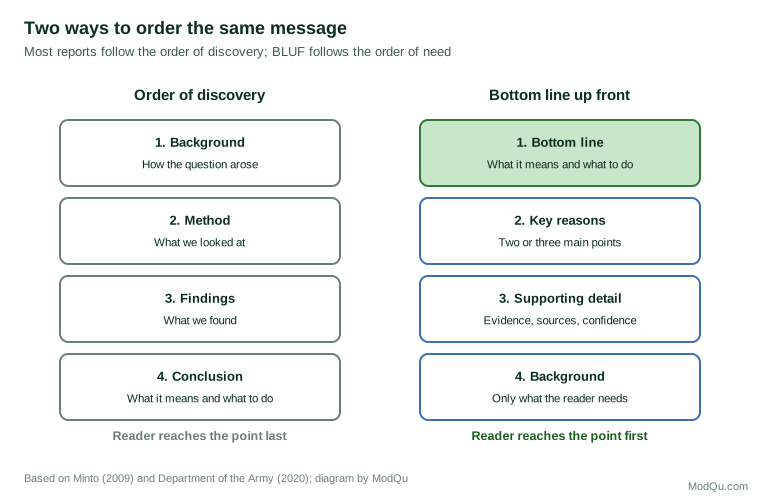
A BLUF document has four layers:
- The bottom line. One or two sentences stating the conclusion, recommendation or request, and why it matters to the reader.
- Key reasons. Two to four main points that support the bottom line.
- Supporting detail. Evidence, sources, methods and an indication of confidence.
- Background. Only as much context as the reader needs, placed last or in an annex.
The first layer must stand on its own. A reader who reads nothing else should still know what the writer concluded and what action, if any, is needed.
Writing a good bottom line
A good bottom line is specific, actionable and honest about uncertainty. Compare:
- Weak: "This report examines recent developments in the regional market."
- Better: "Competition in the regional market is increasing."
- Strong: "Our main rival is likely to open a store within two miles of our flagship by next spring; we recommend starting lease talks for a second site now."
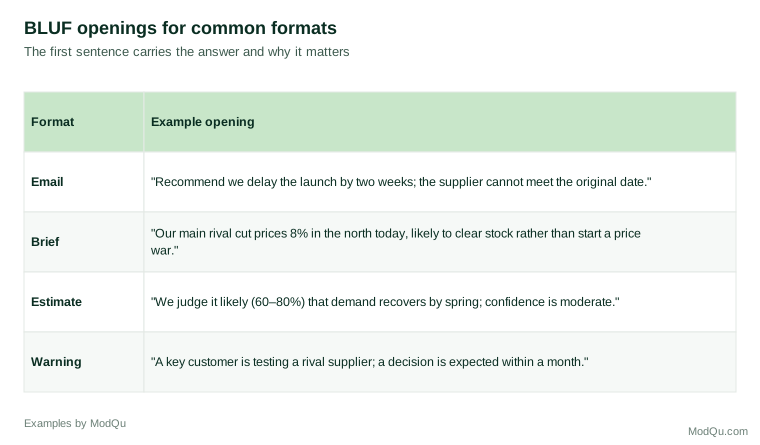
The weak version describes the document rather than its content. The better version states a finding but gives no sense of its importance. The strong version states the finding, its likelihood and the recommended action. Figure 2 gives examples for several formats.
BLUF in intelligence products
Intelligence analytic standards require products to be relevant to users and to present clear and logical argument (Office of the Director of National Intelligence, 2015). In practice, this means opening estimates with key judgements and briefs with the development and its significance. Pherson and Heuer (2021) recommend that analysts write their key judgements first, before drafting the body, as a test of whether they know what they think.
BLUF does not mean dropping uncertainty. An intelligence bottom line should state how likely the judgement is and how confident the analyst is. Kent (1964) showed that vague probability words mean different things to different readers. Friedman and Zeckhauser (2012) and Dhami and Mandel (2021) argue for explicit, consistent expressions of likelihood. A bottom line such as "We judge it likely (60–80%) that…" combines clarity with honesty.
Davis (2006) notes that analysts sometimes resist stating conclusions plainly, fearing that they will be blamed if they are wrong. Burying the conclusion does not reduce that risk; it only makes the product less useful. The remedy is to state the conclusion clearly and to state the confidence just as clearly.
Plain language
BLUF works best with plain language. The American Plain Writing Act of 2010 requires federal agencies to use clear communication that the public can understand and use. Flesch (1948) developed one of the first readability formulas, showing that shorter sentences and shorter words make text easier to read. Orwell (1946) urged writers to cut unnecessary words, prefer the active voice and avoid jargon. Williams and Bizup (2017) show that clear sentences put the main actor in the subject and the main action in the verb.
A bottom line written in bureaucratic language loses much of its value. "It is recommended that consideration be given to the potential reallocation of resources" should become "We recommend moving two staff to the northern team."
BLUF in spoken briefings
The same principle applies when speaking. An oral briefing that opens with background risks losing the listener's attention before the main point arrives, and meetings often run short of time. A spoken BLUF opens with one sentence stating the conclusion and one stating what is needed from the listener: "The supplier will miss the deadline; I need your approval to use our backup supplier at higher cost." The rest of the briefing then supports that point and answers questions. Briefers who state the bottom line first also find that the discussion focuses more quickly on the decision rather than on the background.
A BLUF checklist
Before sending any document, check:
- Could a reader who stops after two sentences say what I concluded?
- Does the opening say why this matters to this reader?
- Is any action or decision needed stated clearly, with a deadline?
- Is uncertainty expressed in consistent, defined terms?
- Do the key reasons follow immediately, in order of importance?
- Has background been reduced to what the reader actually needs?
- Does the subject line or title carry the main message?
Common objections
"Readers need the background first." Some do, but most can understand a conclusion without it, and those who need context can read on. Putting the conclusion first does not remove the background; it moves it.
"It seems abrupt." In some cultures and organisations, starting with the conclusion can feel impolite. A short framing phrase can help: "In short, we recommend…" The substance should still come first.
"The conclusion is complicated." If the bottom line cannot be stated in two sentences, the writer may not yet have a clear view. Working out the bottom line is part of the analysis.
"What if the reader disagrees?" Then it is better for them to know the conclusion at once, and read the evidence critically, than to reach it late and feel led.
Applying BLUF in practice
- Write the bottom line first. Before drafting anything else, write the one or two sentences a reader must take away.
- Use the subject line. In emails, put the bottom line or the action needed in the subject: "Decision needed by Friday: supplier change".
- Test it. Ask a colleague to read only the first two sentences and say what the document concludes.
- Cut background. Move anything the reader does not need to an annex or delete it.
- Match length to need. Many documents can be a single page if the bottom line is clear.
An illustration
A procurement manager sends a weekly update to the finance director. Past updates began with a list of meetings held and suppliers contacted. The finance director rarely replied, and several decisions were delayed because the key information sat in the last paragraph of a long message. The manager rewrites the next update to begin: "Steel prices are likely to rise 10–15% next quarter; I recommend we fix prices with our main supplier this month. Decision needed by Friday." The supporting detail and meeting notes follow. The finance director replies within an hour, approves the contract and asks for future updates in the same format. Within a month, other managers in the department have adopted the same structure, and the finance director reports spending less time on email and making decisions sooner.
Conclusion
Bottom line up front is a simple discipline with a strong rationale. Readers skim, their working memory is limited and first impressions shape their judgement. Putting the conclusion, its significance and any required action at the start respects those limits and makes documents more useful. In intelligence work, a BLUF opening that states key judgements with clear expressions of likelihood and confidence gives decision-makers what they need in the time they have.
References
Davis, J. (2006). Intelligence analysts and policymakers: Benefits and dangers of tensions in the relationship. Intelligence and National Security, 21(6), 999–1021. https://doi.org/10.1080/02684520601046325
Department of the Army. (2020). Preparing and managing correspondence (Army Regulation 25-50).
Dhami, M. K., & Mandel, D. R. (2021). Words or numbers? Communicating probability in intelligence analysis. American Psychologist, 76(3), 549–560. https://doi.org/10.1037/amp0000637
Flesch, R. (1948). A new readability yardstick. Journal of Applied Psychology, 32(3), 221–233. https://doi.org/10.1037/h0057532
Friedman, J. A., & Zeckhauser, R. (2012). Assessing uncertainty in intelligence. Intelligence and National Security, 27(6), 824–847. https://doi.org/10.1080/02684527.2012.708275
Kahneman, D. (2011). Thinking, fast and slow. Farrar, Straus and Giroux.
Kent, S. (1964). Words of estimative probability. Studies in Intelligence, 8(4), 49–65.
Kovach, B., & Rosenstiel, T. (2014). The elements of journalism: What newspeople should know and the public should expect (3rd ed.). Three Rivers Press.
Miller, G. A. (1956). The magical number seven, plus or minus two: Some limits on our capacity for processing information. Psychological Review, 63(2), 81–97. https://doi.org/10.1037/h0043158
Minto, B. (2009). The pyramid principle: Logic in writing and thinking (3rd ed.). Pearson Education.
Nielsen, J. (1997, September 30). How users read on the web. Nielsen Norman Group.
Office of the Director of National Intelligence. (2015). Intelligence Community Directive 203: Analytic standards.
Orwell, G. (1946). Politics and the English language. Horizon, 13(76), 252–265.
Pherson, R. H., & Heuer, R. J., Jr. (2021). Structured analytic techniques for intelligence analysis (3rd ed.). CQ Press.
Plain Writing Act of 2010, Pub. L. No. 111-274, 124 Stat. 2861 (2010).
Pöttker, H. (2003). News and its communicative quality: The inverted pyramid—when and why did it appear? Journalism Studies, 4(4), 501–511. https://doi.org/10.1080/1461670032000136596
Sweller, J. (1988). Cognitive load during problem solving: Effects on learning. Cognitive Science, 12(2), 257–285. https://doi.org/10.1207/s15516709cog1202_4
Williams, J. M., & Bizup, J. (2017). Style: Lessons in clarity and grace (12th ed.). Pearson.