
Intelligence · Organisational intelligence
"Intelligence Requirements: Asking Decision-Makers What They Need to Know"
Intelligence is only useful if it answers the questions decision-makers actually face. This article explains what intelligence requirements are, why they are hard to get right, and how to identify, break down and maintain them through structured conversations with the people intelligence serves.
Every intelligence function faces the same basic problem. There is far more that could be known than can be collected, analysed and reported. Something has to decide where effort goes. That something is the set of intelligence requirements: statements of what decision-makers need to know, in what detail and by when. Requirements are the first step of the intelligence cycle, and they determine the value of everything that follows. An organisation that collects brilliantly against the wrong questions produces nothing of use.
What a requirement is
In government, an intelligence requirement is a stated need for information about a subject, issued by or on behalf of a decision-maker. Military doctrine distinguishes priority intelligence requirements, the questions a commander considers most important to a decision, from lesser requirements, and links each to the decisions it supports (Joint Chiefs of Staff, 2013). Lowenthal (2022) describes how national intelligence agencies set requirements through formal processes that translate the priorities of policymakers into tasks for collectors and analysts.
In business, the same idea appears under other names. Herring (1999) introduced key intelligence topics, a short list of the subjects on which senior managers most need intelligence. Rockart (1979) asked executives to identify the critical success factors of their business, the few areas in which good performance is essential, and the information needed to track them. Both approaches start from the decision-maker's needs rather than from the information available.
Kent (1949) saw this relationship as central to strategic intelligence. Kent wrote that intelligence must be close enough to policy to know what is needed, but far enough to keep its independence of judgement. Requirements are the point at which that closeness is achieved.
Why requirements are hard to get right
Requirements look simple but are notoriously difficult to establish.
Decision-makers often do not know what they need. They may not have thought about future decisions in detail, or may not know what intelligence could provide. Asked "What information do you need?", many will reply "Everything" or "Anything important", which gives no guidance.
Stated needs differ from real needs. A manager may ask for a list of competitors' prices when the real question is whether to cut prices. Answering the stated request precisely while missing the underlying decision is a common failure.
Requirements go stale. Priorities change with events, leadership and strategy. Requirements set once a year are out of date within months.
Intelligence can drive its own agenda. Without clear requirements, analysts tend to work on what interests them or what they already know, and collectors gather what is easy to obtain. Wilensky (1967) observed that intelligence specialists can drift away from the questions leaders face.
The relationship is uneven. Davis (2006) describes the tensions between analysts and policymakers: analysts want to be relevant without being captured, policymakers want support without being told what they would rather not hear. Kerbel and Olcott (2010) argue that the traditional model, in which policymakers send requirements and analysts send back finished products, underestimates how much good intelligence depends on continuing conversation.
Hulnick (2006) goes further, arguing that the intelligence cycle's depiction of requirements flowing neatly from policymakers to intelligence rarely matches reality. In practice, intelligence officers often have to infer what decision-makers need from what they are doing. Phythian (2013) and contributors examine these debates about how well the cycle describes real intelligence work.
Identifying requirements through interviews
The most effective way to establish requirements is to talk to decision-makers about their decisions, not about information. Herring (1999) recommended structured interviews with senior managers, using questions designed to draw out the decisions they face, the surprises they fear and the assumptions they hold. Figure 1 lists questions that work well.
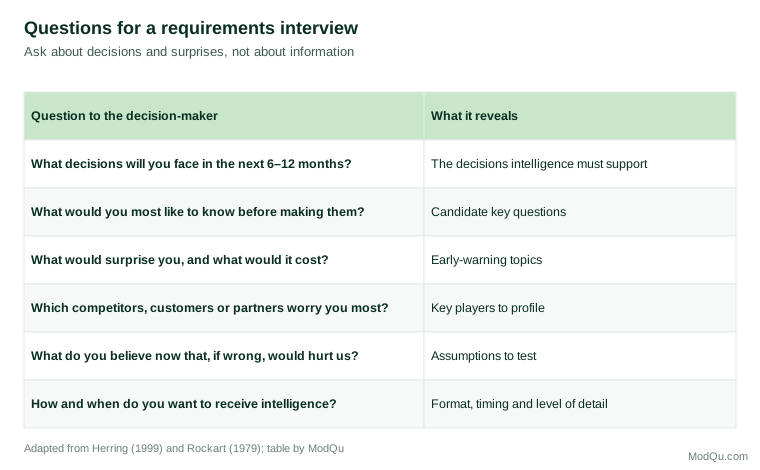
Several practices make these interviews more productive:
- Prepare. Learn about the decision-maker's area and current issues beforehand, so the conversation can be specific.
- Listen for decisions. Every requirement should be traceable to a decision or a risk.
- Probe assumptions. Ask what the decision-maker currently believes and what evidence would change their mind. Heuer (1999) showed how unexamined assumptions underlie many analytic failures; requirements are a chance to surface them.
- Agree priorities. Not every question can be answered. Ask which three matter most.
- Write it down and check it. Send a short summary of the agreed requirements back to the decision-maker for confirmation.
Breaking requirements down
A requirement such as "How will competitors respond to our entry into the northern market?" is too broad to guide collection. It must be broken down into more specific questions and then into indicators, observable signs that would answer them. Clark (2020) describes this process of decomposition as building a model of the target and identifying the information gaps within it. Figure 2 shows an example.
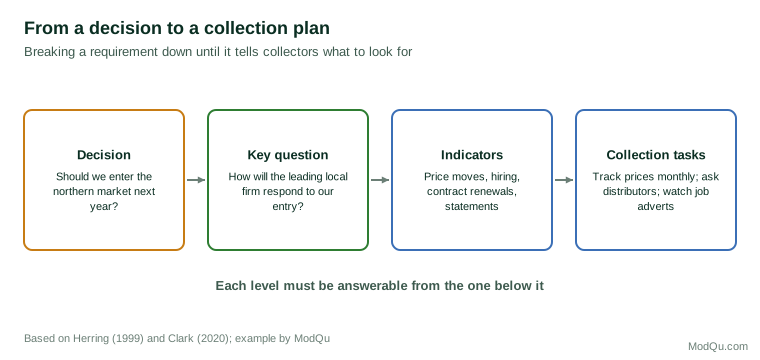
Pherson and Heuer (2021) describe structured techniques that help with this step, such as listing key assumptions, generating alternative hypotheses and identifying the indicators that would distinguish between them. Kahaner (1996) and Fleisher and Bensoussan (2015) show how business intelligence teams translate topics into collection plans drawing on public sources, field contacts and research.
Types of requirement
Requirements come in different forms, each calling for different treatment:
- Standing requirements cover continuing needs, such as monitoring key competitors or tracking market indicators. They support regular products.
- Ad hoc requirements arise from specific decisions or events, such as an acquisition or a crisis. They need fast, focused support.
- Early-warning requirements identify developments that would pose a major threat or opportunity. Gilad (2004) argues that early warning is among the most valuable services intelligence provides.
- Estimative requirements concern future developments that cannot be known for certain. Treverton (2003) distinguishes puzzles, which more information could solve, from mysteries, which depend on future choices. Requirements about mysteries call for judgement and scenarios, not just collection.
Keeping requirements current
Requirements must be revisited regularly. A practical approach is to review standing requirements quarterly with each main decision-maker, asking which are still relevant, which have been answered and what new questions have arisen. Ad hoc requirements should be closed formally when the decision is made, with a brief note of whether the intelligence was useful.
Omand (2010) emphasises that intelligence exists to improve decision-making by reducing ignorance, and that its priorities must reflect the risks decision-makers actually face. Betts (2007) cautions that even well-set requirements cannot remove uncertainty; they can only focus effort where it matters most.
Writing a good requirement
A well-written requirement has several features. It is phrased as a question, not a topic: "Will our main competitor open a plant in the region within two years?" rather than "Competitor X". It is tied to a named decision or risk, so that its purpose is clear. It has a time frame, both for the period it concerns and for when an answer is needed. It states the level of detail required, which prevents both superficial answers and wasted effort. And it has an owner, the decision-maker who will use the answer and can say whether it helped.
A simple template captures these elements: the question; the decision it supports; who needs the answer and by when; the indicators that would answer it; and the priority relative to other requirements. Kept to a single page for each key topic, such templates form a requirements register that the whole intelligence team can work from.
Checking that requirements are working
An intelligence function can check the health of its requirements with a few measures:
- Coverage. What share of products can be linked to an agreed requirement? Products without a requirement may indicate drift.
- Use. How often do decision-makers cite intelligence when making the decisions linked to requirements?
- Timeliness. Were answers delivered before the decisions they were meant to support?
- Turnover. How many requirements were added, closed or changed in the last quarter? A register that never changes is probably out of date.
- Feedback. Do decision-makers say the products answered their questions?
These measures need not be elaborate. Even a simple quarterly review against them reveals whether the intelligence effort is still pointed at the right questions.
Common mistakes
- Asking "What information do you need?" The answer is rarely useful. Ask about decisions instead.
- Accepting the first answer. Probe for the underlying decision behind a request.
- Setting too many priorities. If everything is a priority, nothing is.
- Never revisiting. Requirements set at the start of the year are often obsolete by the middle.
- Collecting before deciding what to look for. Without indicators, collection drifts towards what is easy.
- Losing the link. Every product should state which requirement it answers.
A business illustration
The intelligence team at a building materials company has been producing a long monthly report on industry news. Readership is low. The new head of intelligence interviews the six members of the executive team, asking each about decisions they expect to make in the coming year. Three themes emerge: whether to build a new plant, how to respond to a competitor's aggressive pricing in one region, and whether new building regulations will change demand for a key product. For each, the team agrees with the relevant executive a key question, a set of indicators and a timetable.
The monthly report is replaced by a short brief organised under the three themes, each section stating what has changed in the indicators and what it implies for the decision. Readership rises immediately. Six months later, the team reports that the competitor's price cuts appear to be a temporary clearance of excess stock rather than a lasting strategy, based on its hiring, inventory and public statements. The executive responsible decides not to match the cuts, saving the company a significant amount of margin.
Conclusion
Intelligence requirements connect intelligence to the decisions it serves. Getting them right means talking to decision-makers about their decisions, probing for the real questions behind stated requests, agreeing a short list of priorities, breaking each down into indicators and collection tasks, and reviewing them regularly. When requirements are clear, everything downstream becomes more focused and more useful. When they are vague or stale, even excellent collection and analysis is wasted.
References
Betts, R. K. (2007). Enemies of intelligence: Knowledge and power in American national security. Columbia University Press.
Clark, R. M. (2020). Intelligence analysis: A target-centric approach (6th ed.). CQ Press.
Davis, J. (2006). Intelligence analysts and policymakers: Benefits and dangers of tensions in the relationship. Intelligence and National Security, 21(6), 999–1021. https://doi.org/10.1080/02684520601046325
Fleisher, C. S., & Bensoussan, B. E. (2015). Business and competitive analysis: Effective application of new and classic methods (2nd ed.). Pearson Education.
Gilad, B. (2004). Early warning: Using competitive intelligence to anticipate market shifts, control risk, and create powerful strategies. AMACOM.
Herring, J. P. (1999). Key intelligence topics: A process to identify and define intelligence needs. Competitive Intelligence Review, 10(2), 4–14.
Heuer, R. J., Jr. (1999). Psychology of intelligence analysis. Center for the Study of Intelligence, Central Intelligence Agency.
Hulnick, A. S. (2006). What's wrong with the intelligence cycle. Intelligence and National Security, 21(6), 959–979. https://doi.org/10.1080/02684520601046291
Joint Chiefs of Staff. (2013). Joint intelligence (Joint Publication 2-0). U.S. Department of Defense.
Kahaner, L. (1996). Competitive intelligence: How to gather, analyze, and use information to move your business to the top. Simon & Schuster.
Kent, S. (1949). Strategic intelligence for American world policy. Princeton University Press.
Kerbel, J., & Olcott, A. (2010). Synthesizing with clients, not analyzing for customers. Studies in Intelligence, 54(4), 11–27.
Lowenthal, M. M. (2022). Intelligence: From secrets to policy (9th ed.). CQ Press.
Omand, D. (2010). Securing the state. Hurst.
Pherson, R. H., & Heuer, R. J., Jr. (2021). Structured analytic techniques for intelligence analysis (3rd ed.). CQ Press.
Phythian, M. (Ed.). (2013). Understanding the intelligence cycle. Routledge. https://doi.org/10.4324/9780203558478
Rockart, J. F. (1979). Chief executives define their own data needs. Harvard Business Review, 57(2), 81–93.
Treverton, G. F. (2003). Reshaping national intelligence for an age of information. Cambridge University Press.
Wilensky, H. L. (1967). Organizational intelligence: Knowledge and policy in government and industry. Basic Books.