
Insights · Customer and market insight
Voice of the Customer Programmes
What a voice of the customer programme is, where its ideas come from, how to design one that listens across channels, turns feedback into action and closes the loop with customers, and the mistakes that make many programmes ineffective.
Most organisations say they listen to their customers. Fewer do so systematically. A voice of the customer programme is an organised, continuing effort to capture what customers say about their needs and experiences, analyse it, and use it to improve products, services and decisions. Done well, it gives an organisation a reliable and current understanding of its customers. Done badly, it produces dashboards of scores that nobody acts on and surveys that irritate the customers they are meant to serve.
This article describes the origins of the idea, the components of an effective programme, the evidence on why listening to customers matters, and the common mistakes to avoid.
Origins of the idea
The phrase "voice of the customer" became widely used in product development. Hauser and Clausing (1988) described the "house of quality", a planning method in which customers' needs, expressed in their own words, are systematically linked to the engineering characteristics of a product, so that design decisions are driven by what customers want. Griffin and Hauser (1993) studied methods for identifying customer needs and showed that a moderate number of interviews could uncover most of the needs customers have in a product category, and that needs should be organised into a hierarchy and prioritised.
The idea has broader roots. Hirschman (1970) distinguished two ways in which dissatisfied customers can respond: exit, by taking their business elsewhere, and voice, by complaining or expressing their views. Hirschman argued that voice is valuable to organisations because it tells them what is wrong while there is still time to fix it, whereas exit gives only a signal that something is wrong. A voice of the customer programme can be seen as an effort to encourage and use voice before customers exit.
Research on market orientation provides further support. Kohli and Jaworski (1990) described market orientation as the generation of intelligence about customers' current and future needs, its dissemination across departments, and the organisation's responsiveness to it. Narver and Slater (1990) found that market orientation was positively related to profitability in a sample of business units. Kirca et al. (2005) conducted a meta-analysis and found a positive relationship between market orientation and organisational performance across many studies.
Components of a programme
An effective voice of the customer programme has four connected components.
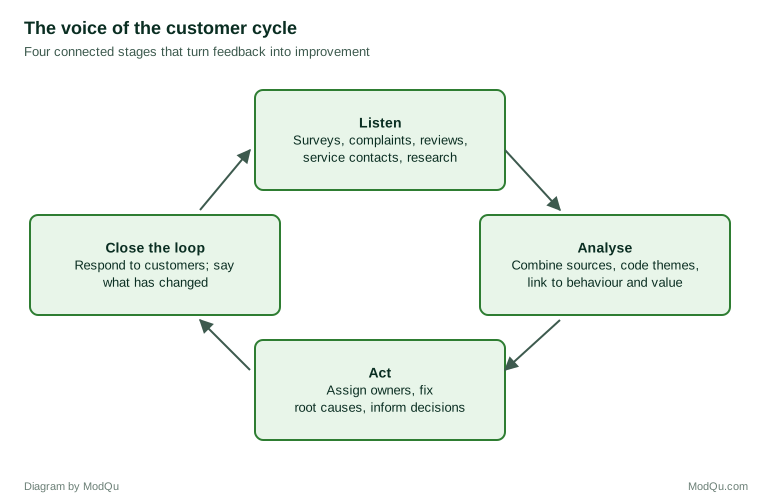
Listen. Capture feedback from many sources: relationship and transactional surveys, complaints, online reviews, social media, service contacts, sales conversations and qualitative research. Each source has different strengths and biases, and combining them gives a more complete picture.
Analyse. Combine sources, code open-ended feedback into themes, and link feedback to customer records and behaviour. Timoshenko and Hauser (2019) showed that machine learning can help identify customer needs from large volumes of online reviews. Berger et al. (2020) reviewed how text from customers can be analysed to provide marketing insight.
Act. Assign each important issue an owner, investigate root causes, make changes and track whether they work. Morgan et al. (2005) studied how firms use customer satisfaction information and found that the value of such information depends on how it is disseminated and used in decisions, not only on how it is collected.
Close the loop. Respond to individual customers who raise problems, and tell customers more generally what has changed as a result of their feedback.
Relationship and transactional feedback
Most programmes combine two kinds of survey. Relationship surveys are sent periodically, for example once or twice a year, and ask customers about their overall view of the organisation. Transactional surveys are sent after specific interactions, such as a purchase, a delivery or a service call, and ask about that interaction. The two answer different questions. Relationship surveys show how customers feel overall and how this changes over time; transactional surveys show how well particular processes work and where they fail.
Each has weaknesses. Relationship surveys are too infrequent to detect problems quickly and too general to show what to fix. Transactional surveys can show that every individual interaction scores well while the overall relationship deteriorates, because they miss problems that span several interactions or that build up over time. Using both, and comparing them, helps avoid either blind spot.
Sharing what customers say
Feedback has value only if it reaches the people who can act on it. Kohli and Jaworski (1990) treated the dissemination of market intelligence across departments as a core part of market orientation, not an optional extra. In practice, this means making customer feedback easy to find and understand for product teams, operations, finance and senior leaders, not only for the insight or customer service team.
Several practices help. Regular summaries that pair the main themes with representative quotations bring customers' words to people who never meet them. Giving teams direct access to coded feedback about their own area, with the ability to read individual comments, builds familiarity and trust in the data. Inviting leaders to listen to service calls or read a sample of complaints each month keeps the customer's perspective concrete. And reporting progress on the actions taken, alongside the feedback itself, shows that the programme leads somewhere.
Governance matters too. A small group that meets regularly, with representatives from the main functions, can review the most important themes, agree owners and priorities, and resolve issues that cross departmental boundaries. Without such a forum, problems that belong to no single department, such as a confusing handover between sales and support, tend to remain unresolved however often customers mention them.
Why complaints matter
Complaints are one of the most valuable sources of customer voice, and one of the most neglected. Fornell and Wernerfelt (1987) argued that encouraging and handling complaints well can be a cost-effective defensive strategy, because retaining dissatisfied customers who complain is often cheaper than winning new ones. Many dissatisfied customers never complain; they simply leave. Each complaint received may therefore represent many unvoiced ones.
How complaints are handled also matters. Tax et al. (1998) found that customers judged complaint handling by the fairness of the outcome, the process and the way they were treated, and that these judgements affected their trust and commitment. Homburg and Fürst (2005) found that complaint satisfaction and loyalty were influenced both by formal guidelines and processes for handling complaints and by an organisational culture that valued complaints, and that the two approaches were complementary.
Measuring and interpreting
Many programmes are built around a single headline measure, such as satisfaction or the net promoter score proposed by Reichheld (2003). A headline measure is useful for tracking, but research cautions against treating any single number as sufficient. Keiningham et al. (2007) found that the net promoter score was not a better predictor of revenue growth than other satisfaction measures. Peterson and Wilson (1992) found that satisfaction ratings are typically skewed toward positive responses, so that averages hide important variation. The most useful insight usually comes from the reasons customers give for their scores and from linking scores to behaviour.
The limits of listening
Listening to customers has limits. Christensen (1997) argued that established firms can fail precisely because they listen closely to their existing customers, who want improvements to current products, and so miss disruptive technologies that initially serve different customers. Customers are good at describing their problems and experiences, but less good at imagining radically new solutions. Von Hippel (1986) proposed that "lead users", customers whose needs are ahead of the market and who often develop their own solutions, can be a source of novel product concepts that ordinary customers would not suggest. A voice of the customer programme should therefore include deliberate efforts to hear from unusual customers, non-customers and lead users, not only from the average current customer.
Common mistakes
Several mistakes recur in voice of the customer programmes. Measuring too much, with long surveys after every interaction, burdens customers and lowers response rates. Focusing on scores rather than reasons leaves organisations knowing that something is wrong but not what. Separating feedback from customer data prevents analysis of how experience affects behaviour. Reporting without ownership means that issues are noted but not fixed. And failing to close the loop teaches customers that giving feedback is pointless.
An example
Consider a hypothetical software company that runs a quarterly satisfaction survey and reports the average score to its leadership team. Scores are stable, and little changes. A new insight lead redesigns the programme. Survey comments, support tickets, sales notes and cancellation reasons are brought together and coded into a common set of themes. Each theme is linked to customer value and renewal rates, and each major theme is assigned an owner who reports progress monthly. Customers who report problems receive a personal response, and a quarterly update tells all customers what has changed.
Within a year, the company has fixed several long-standing issues that support tickets had recorded for years but nobody had connected to renewals. Response rates to its surveys have risen, because customers can see that their feedback leads to action.
Key takeaways
A voice of the customer programme systematically captures, analyses and acts on what customers say. Its roots lie in product development, in the economics of voice and exit, and in research showing that market-oriented organisations perform better. Effective programmes listen across many sources, link feedback to behaviour, assign owners and close the loop with customers. Complaints are especially valuable. Single headline scores are useful for tracking but insufficient for understanding. And because current customers cannot always see what they will need next, programmes should also listen to lead users and non-customers.
References
Berger, J., Humphreys, A., Ludwig, S., Moe, W. W., Netzer, O., & Schweidel, D. A. (2020). Uniting the tribes: Using text for marketing insight. Journal of Marketing, 84(1), 1–25. https://doi.org/10.1177/0022242919873106
Christensen, C. M. (1997). The innovator's dilemma: When new technologies cause great firms to fail. Harvard Business School Press.
Fornell, C., & Wernerfelt, B. (1987). Defensive marketing strategy by customer complaint management: A theoretical analysis. Journal of Marketing Research, 24(4), 337–346. https://doi.org/10.1177/002224378702400401
Griffin, A., & Hauser, J. R. (1993). The voice of the customer. Marketing Science, 12(1), 1–27. https://doi.org/10.1287/mksc.12.1.1
Hauser, J. R., & Clausing, D. (1988). The house of quality. Harvard Business Review, 66(3), 63–73.
Hirschman, A. O. (1970). Exit, voice, and loyalty: Responses to decline in firms, organizations, and states. Harvard University Press.
Homburg, C., & Fürst, A. (2005). How organizational complaint handling drives customer loyalty: An analysis of the mechanistic and the organic approach. Journal of Marketing, 69(3), 95–114. https://doi.org/10.1509/jmkg.69.3.95.66367
Keiningham, T. L., Cooil, B., Andreassen, T. W., & Aksoy, L. (2007). A longitudinal examination of net promoter and firm revenue growth. Journal of Marketing, 71(3), 39–51. https://doi.org/10.1509/jmkg.71.3.039
Kirca, A. H., Jayachandran, S., & Bearden, W. O. (2005). Market orientation: A meta-analytic review and assessment of its antecedents and impact on performance. Journal of Marketing, 69(2), 24–41. https://doi.org/10.1509/jmkg.69.2.24.60761
Kohli, A. K., & Jaworski, B. J. (1990). Market orientation: The construct, research propositions, and managerial implications. Journal of Marketing, 54(2), 1–18. https://doi.org/10.1177/002224299005400201
Morgan, N. A., Anderson, E. W., & Mittal, V. (2005). Understanding firms' customer satisfaction information usage. Journal of Marketing, 69(3), 131–151. https://doi.org/10.1509/jmkg.69.3.131.66359
Narver, J. C., & Slater, S. F. (1990). The effect of a market orientation on business profitability. Journal of Marketing, 54(4), 20–35. https://doi.org/10.1177/002224299005400403
Peterson, R. A., & Wilson, W. R. (1992). Measuring customer satisfaction: Fact and artifact. Journal of the Academy of Marketing Science, 20(1), 61–71. https://doi.org/10.1007/BF02723476
Reichheld, F. F. (2003). The one number you need to grow. Harvard Business Review, 81(12), 46–54.
Tax, S. S., Brown, S. W., & Chandrashekaran, M. (1998). Customer evaluations of service complaint experiences: Implications for relationship marketing. Journal of Marketing, 62(2), 60–76. https://doi.org/10.1177/002224299806200205
Timoshenko, A., & Hauser, J. R. (2019). Identifying customer needs from user-generated content. Marketing Science, 38(1), 1–20. https://doi.org/10.1287/mksc.2018.1123
von Hippel, E. (1986). Lead users: A source of novel product concepts. Management Science, 32(7), 791–805. https://doi.org/10.1287/mnsc.32.7.791