
Insights · Generating insight
Unmet Needs Analysis
How to identify customer needs that current products fail to meet, using interviews, observation, lead users and importance-satisfaction scoring, and how to turn the results into priorities for innovation.
An unmet need is something customers want to achieve that current products and services do not help them achieve well. Unmet needs are among the most valuable sources of insight, because they point directly to opportunities for new or improved offers. They are also hard to find. Customers rarely state them clearly, and many have adapted to their problems so completely that they no longer notice them.
Responsive and latent needs
Narver et al. (2004) distinguished between a responsive market orientation, which addresses the needs customers can express, and a proactive orientation, which addresses latent needs customers are not yet aware of. They found that proactive market orientation was positively related to new product success. Unmet needs analysis aims at both: needs customers can describe but that no one serves well, and needs that become visible only through observation or careful questioning.
Finding needs
Interviews. In-depth interviews remain the main method for identifying needs. Griffin and Hauser (1993) studied how many interviews are needed to capture customer needs for a product category and found that 20 to 30 interviews typically identified about 90% or more of the needs, and that several analysts reading the same transcripts found more needs than one analyst alone. Questions should focus on what customers are trying to accomplish, the difficulties they encounter and how they work around them, rather than on product features.
Observation. Leonard and Rayport (1997) argued that watching customers in their own environment, an approach they called empathic design, reveals needs that interviews miss: the improvised workarounds, the steps customers skip, and the frustrations they take for granted.
Lead users. von Hippel (1986) proposed studying lead users, customers who face needs months or years before the bulk of the market and who benefit greatly from solving them. Because lead users often build their own solutions, their adaptations are a direct view of needs that will later become widespread.
Jobs and outcomes. Christensen et al. (2005) argued that customers "hire" products to get jobs done, and that needs are best understood in terms of those jobs rather than product categories. Ulwick (2002) proposed expressing needs as desired outcomes, measurable statements of what customers want to achieve, such as "minimise the time it takes to find a past order".
Measuring which needs are unmet
Once needs are identified, a survey can measure how important each outcome is and how satisfied customers are with their current ability to achieve it. Ulwick (2002) proposed an opportunity score that combines the two: importance plus the amount by which importance exceeds satisfaction, with the second term set to zero when satisfaction is higher than importance. Outcomes that are important and poorly served score highest.
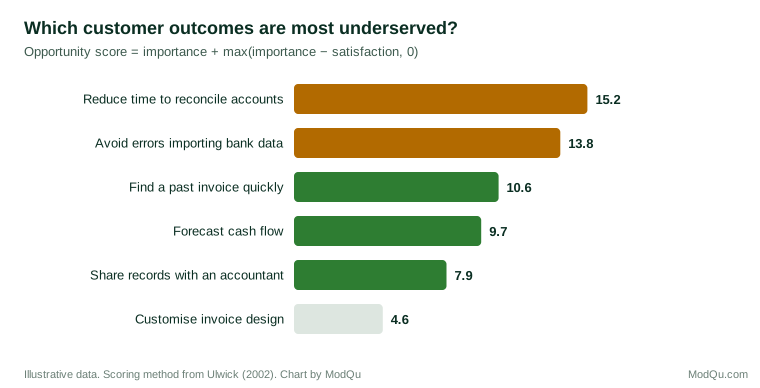
The scores turn a long list of needs into priorities. In the example, reconciling accounts quickly and avoiding import errors are both highly important and poorly served, so they are the strongest candidates for innovation. Customising invoice design is moderately important and already well served, so further investment there is unlikely to matter much to customers.
The scores also suggest where to look next. Finding past invoices and forecasting cash flow sit in the middle of the range: worth further qualitative research to understand what makes them difficult, but not yet clear priorities. Repeating the measurement after a product change shows whether the targeted outcomes have moved.
Cautions
Several cautions apply. Importance ratings tend to cluster near the top of the scale, so differences between them should not be over-interpreted. Satisfaction depends on what customers currently use, so a need may appear well served simply because customers have low expectations. Latent needs, by definition, may not appear in a survey at all, which is why observation and lead user research remain essential. And an unmet need is an opportunity only if the organisation can meet it profitably.
Key takeaways
Unmet needs analysis looks for outcomes customers want but cannot achieve well with current offers. Interviews, observation and lead user research find needs; surveys of importance and satisfaction show which are most underserved. Expressing needs as jobs or desired outcomes, rather than product features, keeps the analysis focused on what customers are trying to achieve.
References
Christensen, C. M., Cook, S., & Hall, T. (2005). Marketing malpractice: The cause and the cure. Harvard Business Review, 83(12), 74–83.
Griffin, A., & Hauser, J. R. (1993). The voice of the customer. Marketing Science, 12(1), 1–27. https://doi.org/10.1287/mksc.12.1.1
Leonard, D., & Rayport, J. F. (1997). Spark innovation through empathic design. Harvard Business Review, 75(6), 102–113.
Narver, J. C., Slater, S. F., & MacLachlan, D. L. (2004). Responsive and proactive market orientation and new-product success. Journal of Product Innovation Management, 21(5), 334–347. https://doi.org/10.1111/j.0737-6782.2004.00086.x
Ulwick, A. W. (2002). Turn customer input into innovation. Harvard Business Review, 80(1), 91–97.
von Hippel, E. (1986). Lead users: A source of novel product concepts. Management Science, 32(7), 791–805. https://doi.org/10.1287/mnsc.32.7.791